Triplet BPM Calculator
Convert straight tempo into triplet note timing, equivalent BPM, swing pulse length, MIDI ticks, and phrase duration.
🎵 Triplet Feel Presets
⏱ Triplet BPM Inputs
Core formula: quarter note milliseconds equals 60000 divided by BPM. A triplet note is the selected straight note multiplied by 2/3, then converted into an equivalent straight-note BPM.
📊 Triplet Formula Grid
📝 Triplet Note Reference
| Triplet Value | Quarter-Note Factor | 120 BPM Time | 960 PPQ Ticks |
|---|---|---|---|
| Half Note Triplet | 1.3333 quarters | 666.67 ms | 1280 ticks |
| Quarter Note Triplet | 0.6667 quarters | 333.33 ms | 640 ticks |
| Eighth Note Triplet | 0.3333 quarters | 166.67 ms | 320 ticks |
| Sixteenth Note Triplet | 0.1667 quarters | 83.33 ms | 160 ticks |
| Thirty-Second Triplet | 0.0833 quarters | 41.67 ms | 80 ticks |
🔀 Equivalent BPM Table
| Source Tempo | Triplet Grid | Straight Equivalent | Formula |
|---|---|---|---|
| 80 BPM | 1/8 triplet | 120 BPM 1/8 | 80 x 1.5 |
| 90 BPM | 1/16 triplet | 135 BPM 1/16 | 90 x 1.5 |
| 100 BPM | 1/4 triplet | 150 BPM 1/4 | 100 x 1.5 |
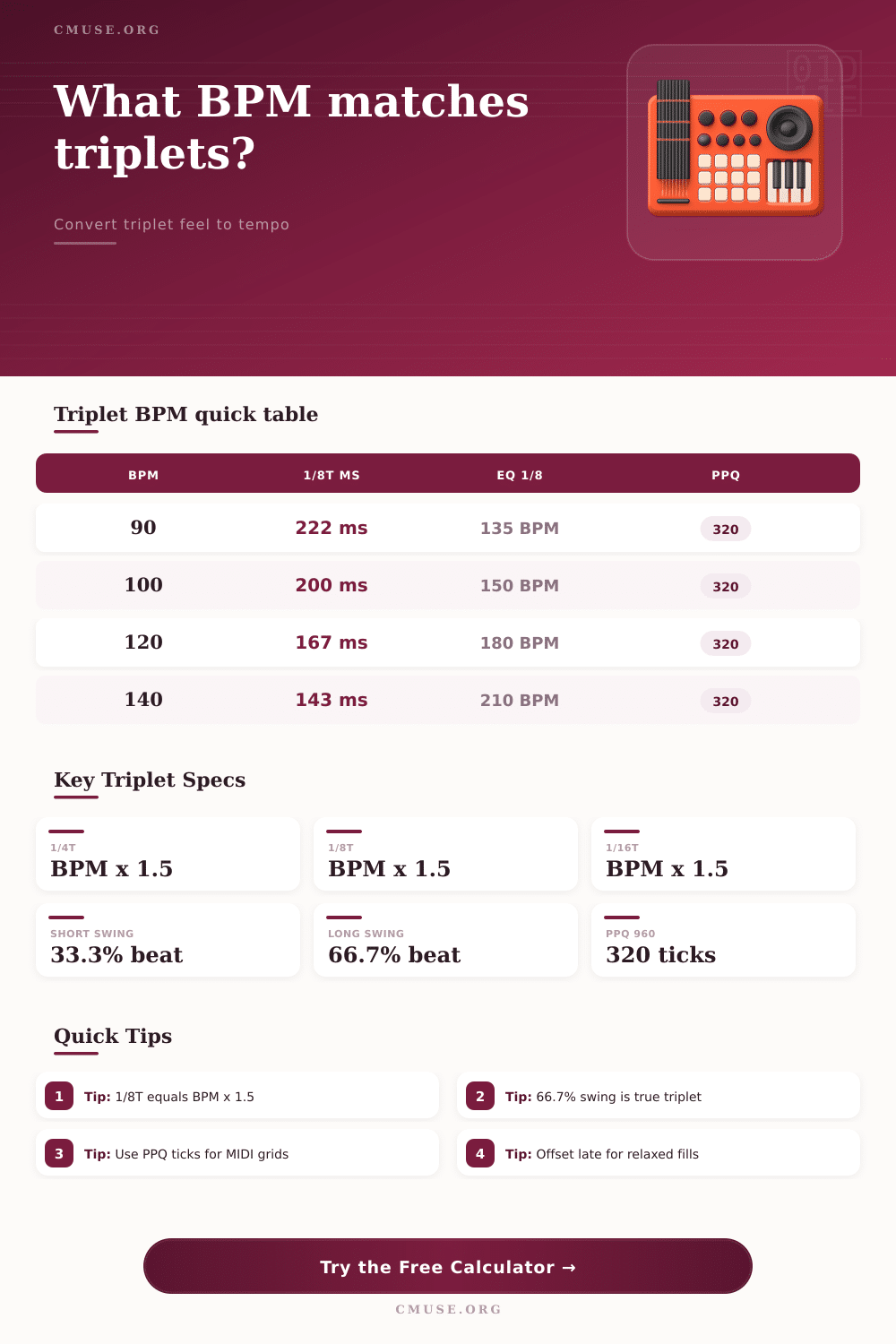
| 120 BPM | 1/8 triplet | 180 BPM 1/8 | 120 x 1.5 |
| 140 BPM | 1/16 triplet | 210 BPM 1/16 | 140 x 1.5 |
| 160 BPM | 1/8 triplet | 240 BPM 1/8 | 160 x 1.5 |
🎼 Common Triplet Use Cases
| Use Case | Typical BPM | Triplet Choice | Secondary Check |
|---|---|---|---|
| Shuffle hi-hats | 90 to 115 | Long and short swing | 66.7% beat share |
| Guitar delay fills | 90 to 140 | 1/8 note triplet | Echoes per bar |
| Trap rolls | 60 to 80 | 1/16 triplet double-time | MIDI tick spacing |
| Rock tom fills | 120 to 160 | 1/8 or 1/16 triplet | Phrase landing point |
| Metric modulation | 80 to 130 | Quarter triplet | Equivalent quarter BPM |
| Film pulse writing | 70 to 110 | Half or quarter triplet | Bar duration |
🎹 DAW Grid and Swing Table
| Grid Setting | 960 PPQ | 480 PPQ | Musical Meaning |
|---|---|---|---|
| 1/4 Triplet | 640 ticks | 320 ticks | Three notes across two beats |
| 1/8 Triplet | 320 ticks | 160 ticks | Three notes inside one beat |
| 1/16 Triplet | 160 ticks | 80 ticks | Six notes inside one beat |
| Swing Long | 640 ticks | 320 ticks | Two tied triplet slots |
| Swing Short | 320 ticks | 160 ticks | Final triplet slot |
| Double-Time 1/16T | 80 ticks | 40 ticks | Fast roll subdivision |
Beyond the use of triplet rhythms in groove decisions, the use of triplet rhythms also affects the way in which producers and musicians approaches the music session. For example, a drummer may use triplet rhythms to create a tom fill that lands on a downbeat, while an electronic producer may use triplet rhythms to create a hi-hat pattern that lies somewhere in between a straight and swung feel. These decision are made based off mathematical principles that affect the way that a listener perceives the pulse of the music.
Beyond the basic use of triplet rhythms, additional calculations can be made within a triplet pattern. For example, a producer can determine the length of an eighth-note triplet at a specific tempo in milliseconds (ms), the number of triplet pulse that will occur within a bar, and the length of the bar in ms. These three value are connected to one another such that changing one will necessarily impact the other two. Therefore, a tool that allow for each of these calculations to occur in one step helps to remove friction in the creative process of the producer.
How Triplet Calculators Help Musicians
Beyond the above calculations, there are additional calculations related to the triplet time signature. For instance, the standard triplet time signature divides a beat into three even parts, but a swing time signature may stretch the first beat by a percentage of the second beat. For example, many producers use a ratio of 66.7% for the second beat to achieve a classic triplet sound.
However, a calculator allow for adjustments of this percentage to achieve a swing feel that lies somewhere in between a strict triplet pattern and a loose shuffle pattern. Additionally, some triplet time signature calculators also include an offset field that allows the producer to shift the entire grid of the song by a certain number of ms. Shifting the song grid by ms allow a producer to adjust the feel of a musical fill to either be relaxed or to land on a beat that makes it seem as if the musical fill is ahead of the beat. Another use of the calculations of the triplet time signature is to allow the producer to calculate to which straight note value a triplet value will be equivalent.
For example, an eighth-note triplet at 120 BPM will have the same duration as a straight eighth note at 180 BPM. This information can be useful to producers who wish to move musical material from one section of a song to another section. Additionally, this information is helpful to those who wish to ensure that the delay effect on a guitar track match the tempo of another track in the song.
Without a tool that can calculate this information, a guitarist must either guess at the timing of the notes or count them on there fingers, processes that may waste time during the musical session. Another use of the same mathematical principles is to calculate the length of a phrase in a song. For instance, a producer can calculate the length of one triplet pulse in a particular time signature.
The producer can then multiply the length of that pulse by the number of triplet pulses in a bar to calculate the length of a bar in ms. Finally, that value can be multiplied by the number of bars in a musical phrase to calculate the length of that musical phrase. The length of that phrase in ms is useful for those who wish to place a vocalist or for those who wish to determine how many time a musical phrase will occur before the next transition in the song. Time signature fields in a triplet time signature calculator allow the producer to ensure that the calculations are performed correctly for 4/4 time signatures, 6/8 time signatures, or any other time signature.
Electronic producers may also use the calculations of ms values for each beat within a project in the Digital Audio workstation (DAW) software in which the song is produced. Each DAW software have a different number of pulses per quarter note (PPQ). Therefore, calculating the ms value for a triplet note allows the electronic producer to accurately place a musical note within a piano roll in the song.
For example, a common number of PPQ for DAW software is 960 PPQ or 480 PPQ. Reference tables for ms values for each beat at these PPQ values can allow the producer to ensure that the DAW software match the intentions of the electronic producer. These calculations each have their use, but the use of these separate calculations together has even more value.
For instance, changing one calculation will impact the other. Therefore, if a producer changes a musical fill to use sixteenth triplets instead of eighth triplets, the tool can calculate the number of ms that each fill will take to play, the BPM that it will need to be played at, the length of the bar in which it can be played, and the tick value for that musical fill. All of these calculations can be performed at once.
Thus, the producer can test if a musical idea will work within a song. For example, the tool can help to determine if a tom fill will still land on the downbeat after eight bar if the fill is changed from eighth to sixteenth triplets. Another example would be determining if a swing percentage that works for a musical phrase at 105 BPM will work at 128 BPM.
Additionally, since these calculations are automated, the arithmetic does not interrupt the flow of the song. A triplet time signature calculation tool cannot assist with musical taste. For example, a mathematically-perfect triplet time signature may still not sound good with a particular sound choice for the musical elements.
Additionally, a musical fill that is placed in a manner that is slightly imperfect may sound better with a performance of the song than one that is mathematically-perfect. However, the calculation tool remove a barrier to the expression of a musical idea. The tool allows producers to determine a series of timing values for their musical idea, thus allowing them to make decisions regarding the musical elements of the song.