ILD Calculator
Estimate interaural level difference from source angle, listener distance, frequency, head spacing, level, and room directness.
🎧Descriptive ILD Presets
⚙Calculator Inputs
Calculated Interaural Level Difference
📊ILD Spec Grid
📐Formula Reference
| Step | Formula | Meaning | Audio Use |
|---|---|---|---|
| Ear distances | r = sqrt(R² + a² +/- 2Ra sin theta) | R is source distance, a is half ear spacing. | Captures near-field left/right distance change. |
| Distance ILD | 20 log10(r far / r near) | Inverse-distance pressure difference in dB. | Dominates very close sources and whispers. |
| Head shadow | Band max x sin(theta)^1.35 | Frequency-dependent acoustic blocking. | Small in bass, strong above 4 kHz. |
| Room blend | (Distance ILD + shadow) x direct share | Diffuse energy reduces ear contrast. | Useful for rooms, halls, stages, and monitors. |
🎼Frequency And Head Shadow Table
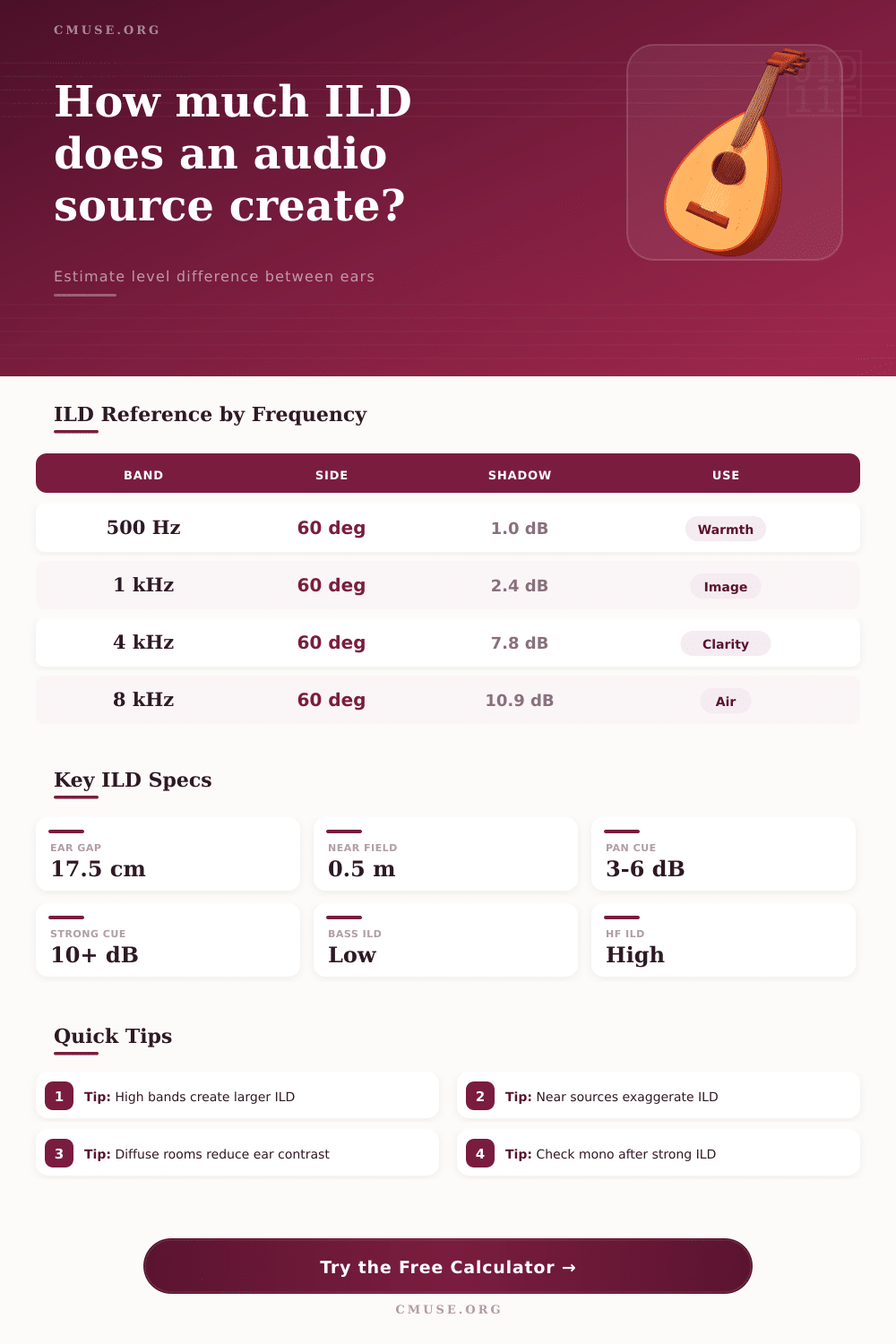
| Band | Max Side Shadow | 60° Approx. | Mix Interpretation |
|---|---|---|---|
| 250 Hz | 0.4 dB | 0.3 dB | Bass localization mostly uses timing, not ILD. |
| 500 Hz | 1.2 dB | 1.0 dB | Low-mid width is gentle and easily masked. |
| 1 kHz | 2.8 dB | 2.3 dB | Vocal presence begins to show side level cues. |
| 2 kHz | 5.8 dB | 4.8 dB | Speech consonants and pick attack localize clearly. |
| 4 kHz | 9.4 dB | 7.7 dB | Bright instruments can feel strongly lateral. |
| 8 kHz | 13.2 dB | 10.8 dB | Air and hiss exaggerate sidedness. |
| 12 kHz | 15.5 dB | 12.7 dB | Very high detail can create sharp edge cues. |
🎙Scenario Reference Table
| Scenario | Typical Distance | Useful Band | Expected ILD Cue |
|---|---|---|---|
| Binaural whisper | 0.20 m / 0.7 ft | 4 to 8 kHz | Very strong, often above 14 dB. |
| Near vocal overdub | 0.45 m / 1.5 ft | 1 to 4 kHz | Moderate to strong if the singer turns aside. |
| Guitar amp side spot | 1.20 m / 3.9 ft | 2 to 4 kHz | Clear lateral cue with cabinet brightness. |
| Speaker toe-in check | 2.00 m / 6.6 ft | 500 Hz to 8 kHz | Small distance ILD, larger high-frequency shadow. |
| Stage monitor | 1.80 m / 5.9 ft | 1 to 4 kHz | Room and spill often reduce the direct cue. |
🔎Reading The Result
| Net ILD | Perceptual Cue | Typical Source | Check |
|---|---|---|---|
| 0 to 1.5 dB | Subtle | Front source, bass band, diffuse room | Use timing and spectral cues too. |
| 1.5 to 4 dB | Light side pull | Small pan, mild off-axis source | Often natural in speakers. |
| 4 to 8 dB | Moderate lateral image | Side instrument, vocal turn, guitar amp | Check balance in headphones. |
| 8 to 14 dB | Strong side image | Close bright source, binaural cue | May narrow mono compatibility. |
| 14+ dB | Extreme edge cue | Whisper, one-sided monitor, very close source | Use deliberately for special effects. |
💡Practical Calculation Notes
Interaural level difference are a concept in audio engineering that describe the difference in volume between the two ear of a listener. The head of a listener will act as a physical barrier to the sound waves that reach the listeners ears. If a sound come from one side of the listener, it will reach one ear at a higher volume than the other ear.
This difference in volume between the sound that reach each ear is referred to as an interaural level difference. The brain use the interaural level difference to understanding the direction from which a sound is coming. The frequency of a sound will affect the interaural level difference between the two ears.
What is interaural level difference?
Low frequencies (such as bass frequencies below 500 Hz) will diffract around the head of the listener. The interaural level difference is, therefore, very small for low frequency. High frequencies (such as frequencies at 4 kHz or 8 kHz) will not diffract around the head.
The high frequencies will hit the head and create a head shadow that reduce the volume of those high frequencies that reach the ear that is further from the sound source. Interaural level difference, therefore, will be larger for high frequencies then for low frequencies. For these reason, high frequencies like cymbals and hi-hats can be more easy positioned in a stereo field through the manipulation of interaural level difference.
The distance between the listener and the sound source will affect the interaural level difference. If the sound is very close to the listener (such as a whisper that is six inches from the listeners ear), the interaural level difference will be very high. The near ear will experience a high sound pressure levels while the ear that is further from the sound source will experience a lower sound pressure level.
As the distance between the listener and the sound source increases, the interaural level difference will decrease. The environment in which a listener hear a sound will also affect the interaural level difference. Direct sound that travels from the sound source to the listeners ear without hitting any other surface will provide the strongest interaural level difference.
Reflections are sound that bounce off of walls or ceilings in the environment before they reach the listeners ear. Reflections will reduce the interaural level difference between the two ears. In environment with many sound reflections (such as a large hall) the interaural level difference will be lower than in environments with no reflections (such as an anechoic chamber).
The physical size of a listeners head will impact the interaural level difference. A larger head will create a larger shadow of the head that impact high frequencies. A larger shadow reduce the volume of high frequencies that reach the ear that is more distant from the sound source.
A smaller head will create a smaller shadow of the head that impact high frequencies. A smaller shadow allow higher frequencies to reach the ear that is further from the sound source. The interaural level difference between each ear will change according to the size of the head.
There are several technical output associated with interaural level difference. Net interaural level difference is a measurement of the total volume difference between the sound that reach each ear. If the interaural level difference is less than 1.5 dB it is considered subtle.
If the interaural level difference is greater than 14 dB it is considered extreme. Near ear levels and far ear levels are measurements of the sound pressure level of the sound that reach each ear. Cue strength labels indicate whether the interaural level difference between the near ear and the far ear is moderate or strong.
If the interaural level difference of a sound is greater than 8 dB, the engineer should of check for mono compatibility. Mono compatibility refers to the process of ensuring that if the engineer sums the mix into a mono signal, the sound will not dissapear or change in volume.