MS Encoder Calculator
Estimate mid-side matrix levels, width ratio, decode coefficients, mono compatibility, and peak headroom before committing an M/S encode.
🎛Preset M/S Scenarios
🎚Encoder Inputs
📊Current Matrix Snapshot
📐Core Mid-Side Formulas
Encode: M = k(L + R) x midTrim and S = k(L - R) x sideTrim. Unity sum uses k = 0.5, constant power uses k = 0.7071, and raw matrix uses k = 1.
RMS estimate with correlation: M = k sqrt(L^2 + R^2 + 2rhoLR) and S = k sqrt(L^2 + R^2 - 2rhoLR). This is why highly correlated stereo creates strong mid and little side.
📋Matrix Normalization Reference
| Mode | Encoder Coefficient | Mono Center Result | Best Use |
|---|---|---|---|
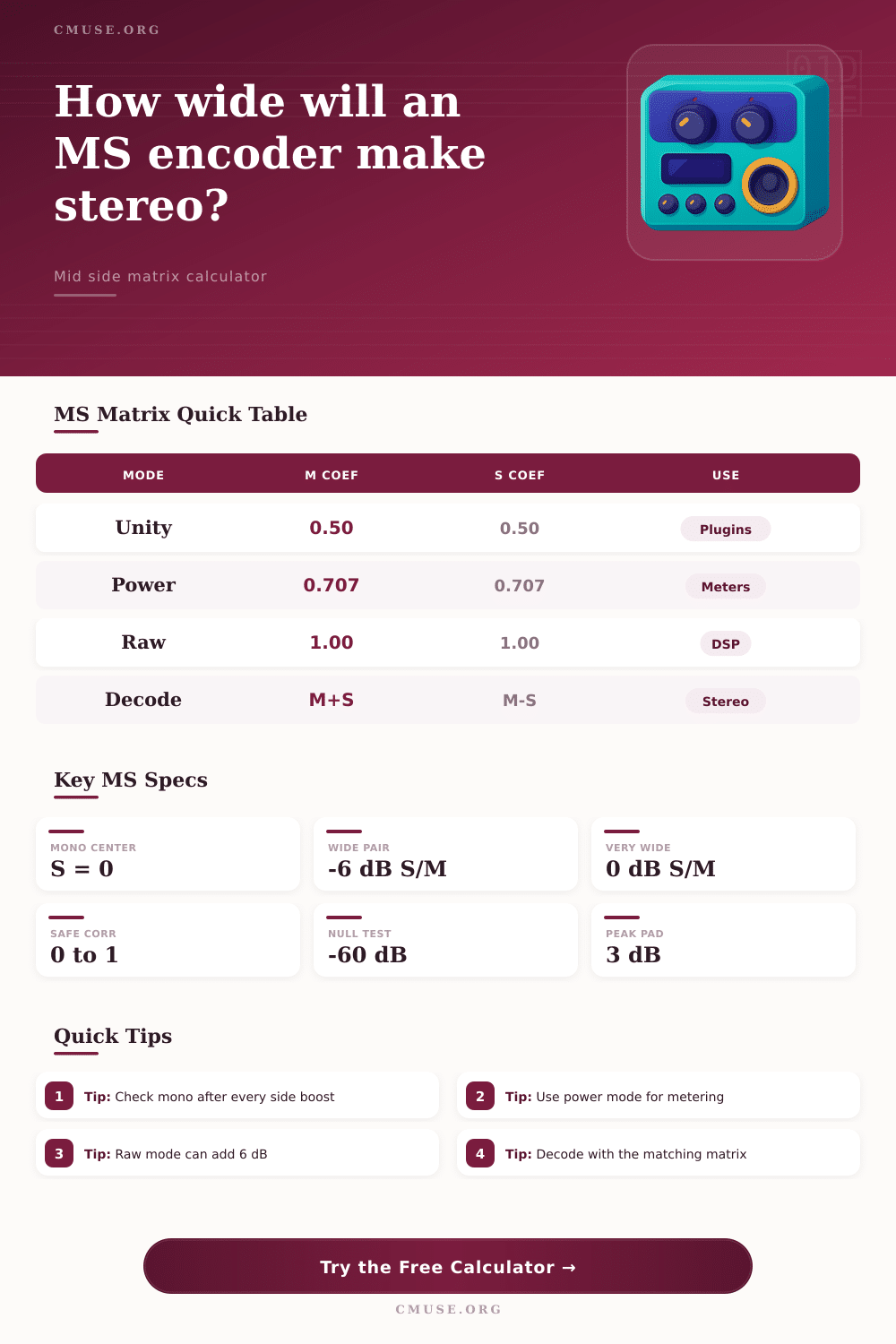
| Unity sum | M=(L+R)/2, S=(L-R)/2 | Center stays near original level | Most DAW M/S utility processors and reversible editing |
| Constant power | M=(L+R)/sqrt(2), S=(L-R)/sqrt(2) | Mono center rises about +3.01 dB | Metering and math where power preservation is preferred |
| Raw matrix | M=L+R, S=L-R | Mono center rises about +6.02 dB | Low-level DSP blocks when gain staging is handled elsewhere |
| Matched decode | Uses the inverse of the chosen encode | Returns the original stereo scale | Null tests, archival work, and technical transfers |
🔎Side-to-Mid Width Guide
| S/M Level | Approx Width | Correlation Clue | Practical Read |
|---|---|---|---|
| -18 dB | Very narrow | Usually above +0.70 | Center-heavy vocal, bass, kick, or dialogue |
| -12 dB | Narrow | Often +0.40 to +0.80 | Stable mix bus with modest ambience |
| -6 dB | Natural wide | Often 0.00 to +0.50 | Stereo mic pairs, piano, drum rooms, pads |
| 0 dB | Very wide | Often near 0 or negative | Special effect width; mono check is essential |
🎞Common M/S Encoding Scenarios
| Source | Typical Correlation | Starting Side Trim | Watch Point |
|---|---|---|---|
| Mono vocal or bass | +0.90 to +1.00 | -6 dB to -18 dB | Side should remain low unless stereo effects are present |
| Stereo acoustic pair | +0.20 to +0.70 | 0 dB to +2 dB | Preserve center image and avoid room exaggeration |
| Drum overheads | 0.00 to +0.50 | -1 dB to +2 dB | Snare and kick should not lean after decoding |
| Synth pad or ambience | -0.20 to +0.30 | 0 dB to +4 dB | Negative correlation can vanish quickly in mono |
🧭Decoder Coefficient Table
| Encode Mode | Matched Decode | Unity Decode Error | Peak Risk |
|---|---|---|---|
| Unity sum | L=M+S, R=M-S | None when trims are flat | Low, unless side is boosted heavily |
| Constant power | L=(M+S)/sqrt(2), R=(M-S)/sqrt(2) | About +3.01 dB if decoded as unity | Moderate on mono-heavy content |
| Raw matrix | L=(M+S)/2, R=(M-S)/2 | About +6.02 dB if decoded as unity | High without input padding |
| Any mode with side trim | Matrix returns adjusted width | Null no longer cancels to silence | Depends on S boost and correlation |
💡Calculation Tips
Mid-side (MS) encoding are used to transform stereo signal into mid and side signal, which allows for the separation of the signals into those that share information with the other channel (the mid signal) or those with different information within each channel (the side signal). The mid signal contain the audio information that is shared between the left and right channels, such as the kick drum, snare drum, and vocals, which are typically locate in the center of the mix. The side signal contains the audio information that is different between each of the left and right channel, such such as panned guitar, cymbals, and other sound that create the width of the stereo image.
In order to utilize MS encoding, you must choose a mathematical method for scaling the signals within the channel. For example, if you utilize the unity sum method to scale the channels, the volume levels of the mid signal will remain the same than that of the original channels. If you choose the constant power method, the volume levels of each of the speakers will remain steady, though the mono channel may experience a slight increase in volume.
Mid-Side Encoding: Simple Guide to Stereo Width and Mono Checks
Finally, if raw matrix is utilized, the matrix will double the signal, which may lead to increases in the audio peaks; a pad should of be utilize prior to the audio plugin to avoid clipping of the audio signal. Another important measurement of MS encoding is the correlation between the left and right channels. If the left and right channels are in perfect phase with one another, the correlation will be at 1.
At this value, all of the energy of the channels will be directed into the mid signal, and the side signal will be quiet. If the correlation reads at a value of 0 or a negative number, the side signal will be louder and the stereo image will be wider. For example, acoustic guitar and piano signals has a correlation between 0.2 and 0.7.
At these settings, the sound is naturaly balance and not too wide. If the side trim knob is increased to a positive number, the stereo image will increase in width. Decreasing the side trim to a negative number will have the same effect; it will tighten the focus of the audio.
This is important for vocals and bass channel. If the side trim is too high, the mono channel may sound muddy due to the noise within the side signal. Headroom for audio signal is the amount of space that the signal has before it begin to clip.
In MS encoding, headroom for audio signals is reduced because matrixing channels with correlated content increases the volume of the mid signal by 3 or 6 dB. In order to ensure that audio does not clip, monitoring stereo RMS and peak estimate will allow the engineer to ensure that headroom is available for the audio signal. A minimum pad of 3 dB should be utilized, though a larger pad should be applied to audio that is to be mastered.
Additionally, another important measurement is the width ratio. For channels such as drum room and synth pads, a side signal 6 dB lower than the mid signal will feel naturaly to listen to. If both the side and mid channel have the same level of audio signal, the stereo image will be very wide.
Thus, mono check should be performed. A mono blend percentage will allow the engineer to adjust the audio to sound as if it is folded down into mono; in mono audio, the side signal will cancel each other out. Various preset can be created for MS encoding to reduce the time that is required for engineers to create their desired settings.
For instance, a drum overhead preset might include settings for a moderate correlation and a slight increase of the side signal to allow for the cymbals in the stereo signal to have more “air.” A synth pad plugin might include a negative correlation and a trim of the side channel to allow for the synth pad to be very wide in its stereo image; however, the mono blend should be reduced to 75% so that the synth pad contains some stereo glue. In mastering scenario, mastering engineers may wish to add 1.5 dB to the side channel; however, they will must pay close attention to the decoding of the audio signals so that the volume of the channels does not change too much. Finally, it is important to note that there are some mistake that may occur during MS encoding.
For example, one common mistake may be to overlook the sound that the signal will make after it is decode from MS to stereo. If the signal was encoded using unity sum but then decoded using constant power, there will be a 3 dB increase in volume to each channel that could lead to clipping of the audio signal. Another common mistake is to boost the side channel too much on audio source with low correlation.
When converted to mono, the side channel will vanish. For vinyl record or radio station, for example, you should remove much of the side signal by decreasing the side signal by 12 dB and more to allow for the mono channel to maintain a high level of correlation. Finally, it is important to always listen to the audio after it is encoded.
The null test will allow engineers to ensure that the stereo and the original audio signal sound the same. Overall, MS encoding can be used for a variety of task to engineers. One of the main task is the control of the width of the stereo channels.
Additionally, it can be used to ensure that the audio signal sounds good when translated into mono channel. The mid channel can be utilized to provide the focus of the audio signal to the center of the stereo image, while the side channel can be utilized to provide the stereo imaging for that sound. Thus, both channel are important to creating a balanced stereo image.