Dynamic Range Audio Calculator
Estimate crest factor, usable range, headroom, ENOB, and analog level from peak, RMS, and noise readings.
Dynamic Range Results
| Material | Typical Crest Factor | Practical Range | Best Use |
|---|---|---|---|
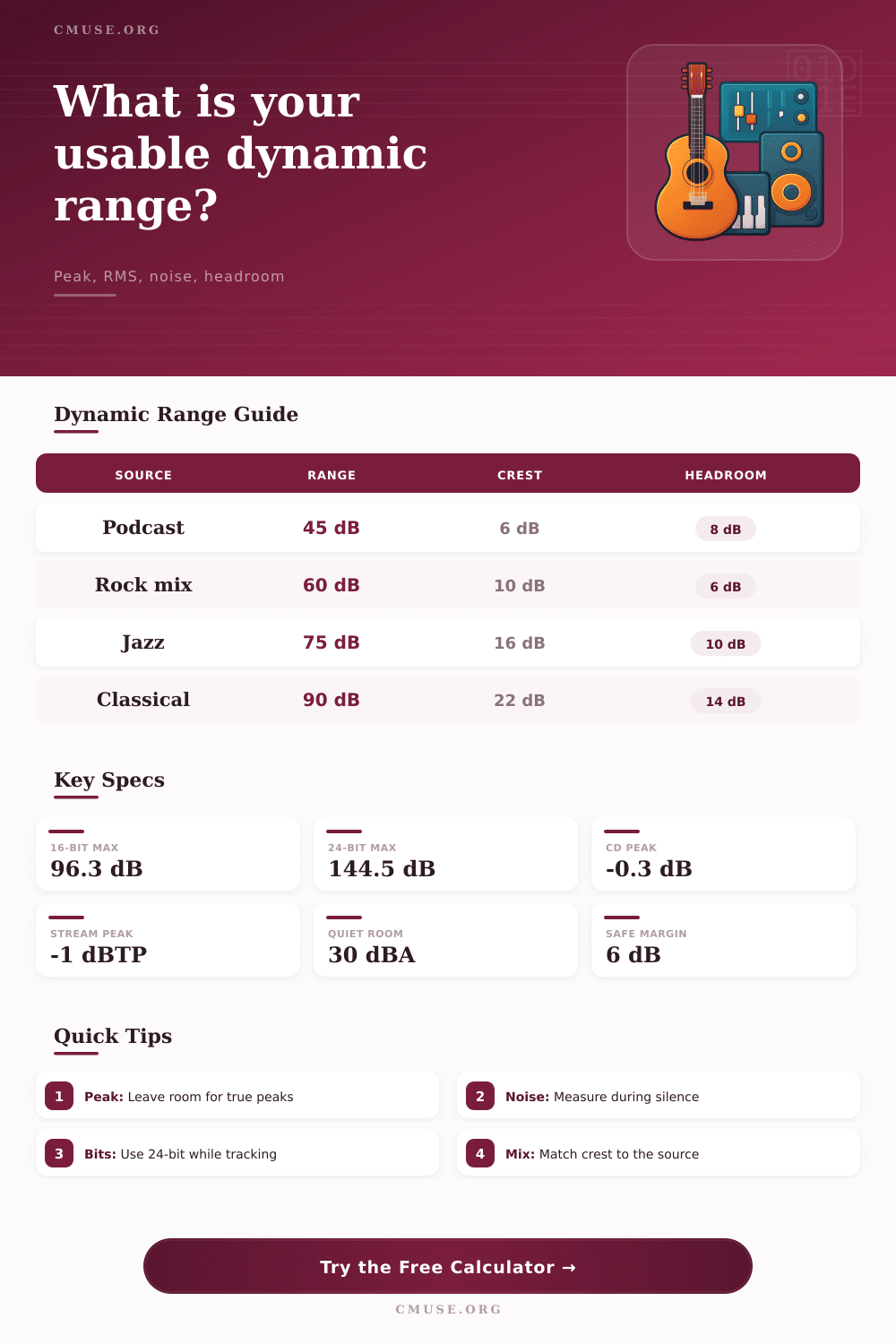
| Podcast voice | 6 to 10 dB | 40 to 55 dB | Consistent speech with edits below the room tone. |
| Pop or rock master | 8 to 12 dB | 55 to 70 dB | Dense music with controlled peaks and stable loudness. |
| Jazz ensemble | 12 to 18 dB | 65 to 85 dB | Acoustic transients with moderate room ambience. |
| Classical master | 18 to 28 dB | 80 to 105 dB | Wide passages where silence and loud peaks both matter. |
| Game effects bus | 10 to 22 dB | 60 to 95 dB | Layered transient assets that need mix engine headroom. |
| Field ambience | 14 to 26 dB | 70 to 100 dB | Natural quiet details with occasional loud events. |
| Reference | Formula Or Value | Audio Meaning | Planning Note |
|---|---|---|---|
| PCM theoretical range | 6.02N + 1.76 dB | Ideal quantization signal-to-noise ratio. | Real converters are lower because analog stages add noise. |
| Crest factor | Peak - RMS | Distance between transient peaks and average level. | Higher values need more limiter or converter headroom. |
| Noise clearance | Quiet signal - noise | How far wanted detail sits above the floor. | Less than 10 dB can feel masked in quiet passages. |
| Analog peak | Ref dBu + peak dBFS | Approximate balanced output at the converter. | Use it to check outboard gear and console headroom. |
| True peak allowance | Target - sample peak | Remaining ceiling before delivery overs. | Negative results mean the file is already above the target. |
| Session | Peak / Average | Noise Floor | Expected Result |
|---|---|---|---|
| Voiceover booth | -3 / -20 dBFS | -78 dBFS | About 69 dB usable with a 6 dB margin. |
| Mastered pop track | -1 / -10 dBFS | -88 dBFS | About 83 dB usable with a compact crest factor. |
| Acoustic trio | -4 / -23 dBFS | -92 dBFS | About 84 dB usable with natural transient space. |
| Symphonic recording | -6 / -31 dBFS | -101 dBFS | About 89 dB usable after conservative headroom. |
| Archive transfer | -2 / -18 dBFS | -62 dBFS | About 55 dB usable before restoration decisions. |
Dynamic range refer to the difference between the quietest and loudest parts of an audio recording. This specification is important for understanding how much room there is between the noise floor and the peak levels of an audio file. The noise floor in audio engineering are the amount of background noise in the audio signal.
The peak levels is the highest point that the audio signal reach. If these are not properly managed, then the quietest parts of the audio will be hard to hear due to the noise floor, and the loud parts of the audio will distort due to the peaks being too high. The crest factor can be measured to show the relationship between the peak and average levels of audio signals.
What Is Dynamic Range in Audio
The crest factor is the difference between the peak and average level of an audio signal. Jazz music have large crest factors because of the loud sounds in jazz music. Speech or podcasts has lower crest factors because there are no loud sounds in speech.
Identifying the crest factor allows engineer to understand how much dynamic range is needed to maintain the natural sound of the audio signal. Finding the highest spike that the audio signal reaches in dBFS can measure the peak level of an audio signal. Headroom should of be left for the peak level to avoid clipping.
Many streaming platforms requires audio engineers to have a true-peak level of -1 dBTP. This means that the peak levels of audio signals cannot go above -1 dBTP. The average level can be measured in RMS or LUFS.
This is a measurement of the steady energy in the audio signal. This value is measured in dBFS and is used to calculate the crest factor along with the peak level. Finally, you can measure the noise floor by recording a silent passage of audio with the same equipment as the audio signal that is to be engineered.
The noise floor is the true bottom of audio signal and not a theoretical value. Human hearing should be considered when engineering dynamic range. Human hearing do not hear all frequencies equally.
You can use A-weighting to adjust the audio measurements for the way the human ear perceives noise. A-weighting adjust the measurements for the sensitivity of the human ear to low frequencies. Safety margins are also included in the dynamic range calculations.
A safety margin provide extra dynamic range to account for loud sounds in audio files. This is calculated by taking the peak level and subtracting the noise floor and the safety margin. Depending on the type of audio signals that will be playing, a different amount of dynamic range will be required.
Speech and podcasts have a dynamic range of 40 to 55 dB. Rock music have a dynamic range of 55 to 70 dB. Jazz music has a dynamic range of 65 to 85 dB.
Classical music has a dynamic range of 80 dB or more. Too little dynamic range for classical music will make it sound compressed. Audio files with too much dynamic range for speech will make the noise floor of the audio signals audibly.
There are mistakes that many audio engineers make with dynamic range. One mistake is to measure the noise floor with the microphones turned off. This does not provide an accurate measurement of the noise floor of the audio signal.
Another mistake is to ignore true-peak headroom. This can lead to audio signal distortion when players attempt to play these audio files. A third mistake is to focus on the theoretical bit depth of audio files without considering the effective resolution.
The effective resolution of audio signals is a measurement of the quality of audio signals after accounting for the noise floor of the signal. Audio signals with too low an effective resolution will have quiet signals that are difficult for the listener to hear. Finally, audio engineers must all balance the crest factor, safety margin, and noise floor.
The dynamic range that is chosen should allow for the specific type of audio signal that will be played back. Audio engineers should manage the dynamic range of audio files so that the peaks of the audio signal are clean and the noise floor is buried within the signal. When the dynamic range is correctly managed, audio files will sound natural to the listeners.