Ldn Calculator
Calculate day-night average sound level with the standard 10 dB night penalty, Leq inputs, or counted SEL events.
Day-Night Sound Level Results
| Input Type | Use When | Formula Core | Output |
|---|---|---|---|
| Day/Night Leq | Continuous monitoring has day and night averages | 10 log10((15 x 10^(Ld/10) + 9 x 10^((Ln+10)/10)) / 24) | Ldn in dB |
| SEL Events | Aircraft, trains, buses, or short counted events | 10 log10((sum 10^(SEL/10)) / 86400) | Event Ldn |
| Multi-Period | Daytime sound varies by shoulder and midday periods | Energy sum of each period, with night penalty only on night | Composite Ldn |
| Ambient Add | Known background Ldn must be combined with a source | 10 log10(10^(source/10) + 10^(ambient/10)) | Total Ldn |
| Ldn Band | Acoustic Read | Typical Context | Check First |
|---|---|---|---|
| Under 45 dB | Very quiet exterior exposure | Remote or highly shielded area | Meter noise floor and wind screen |
| 45-55 dB | Low day-night exposure | Quiet residential edge, studio exterior | Night events, HVAC cycles, low-frequency rumble |
| 55-65 dB | Moderate community exposure | Urban street, rail distance, venue district | Night penalty share and tonal sources |
| 65-75 dB | High day-night exposure | Major road, airport path, active yard | Peak event counts and source schedule |
| Over 75 dB | Very high exposure screen | Close transport corridor or loud operations | Measurement position and octave-band detail |
| Scenario | Day Leq | Night Leq | Approx Ldn |
|---|---|---|---|
| Quiet studio room exterior | 43 dB | 35 dB | 43 dB |
| Apartment HVAC background | 50 dB | 44 dB | 51 dB |
| Busy urban avenue | 66 dB | 56 dB | 66 dB |
| Rail corridor with night service | 70 dB | 63 dB | 72 dB |
| Outdoor music stage day event | 82 dB | 48 dB | 80 dB |
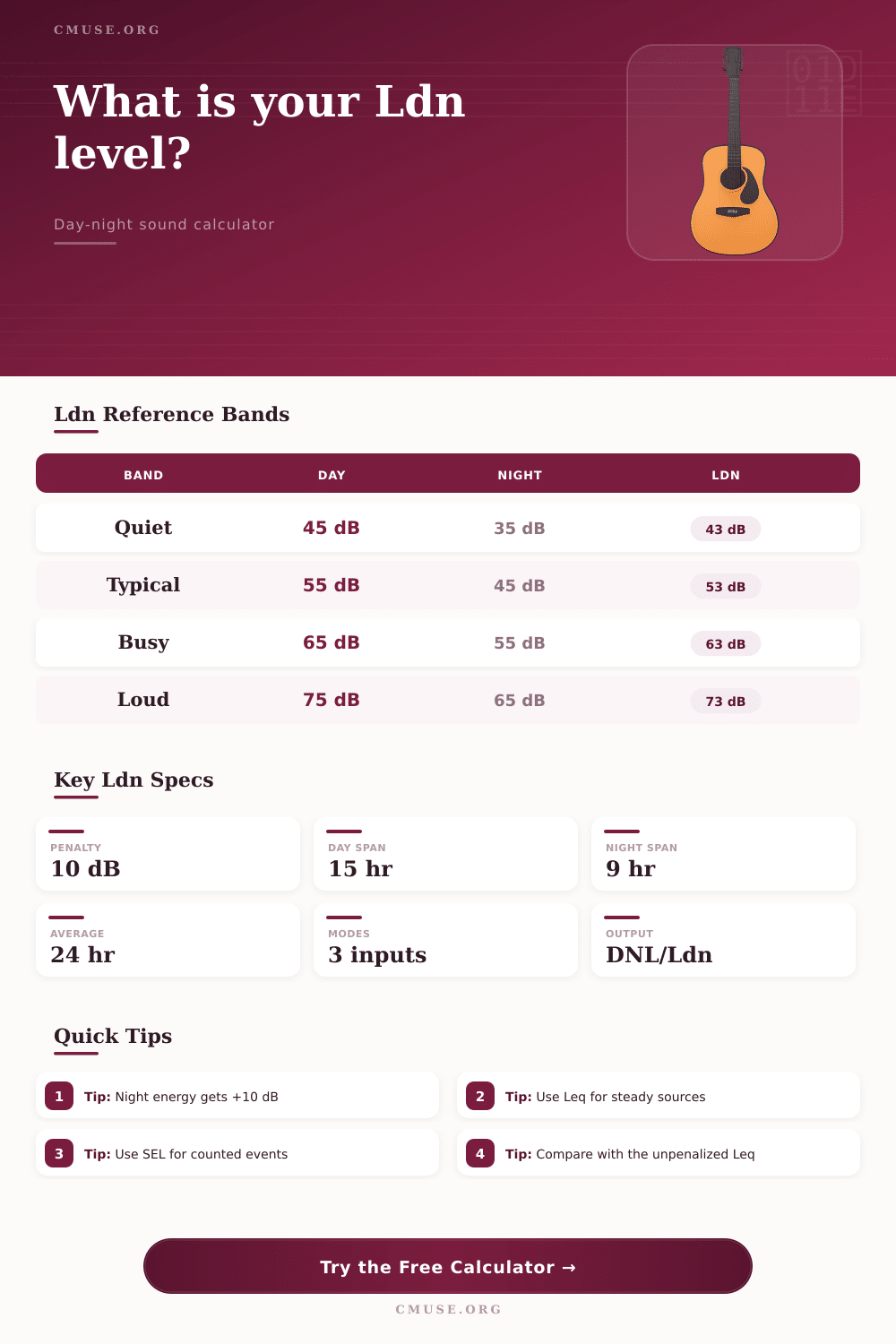
The Ldn metric is used to measure sound level and takes into account the difference between daytime noise and nighttime noise levels. The reason that the Ldn metric is applied to noise is due to the fact that nighttime noise are more disruptive to human sleep than daytime noise is to human activities during the day. In order to reflect this, a 10 dB penalty is applied to all noise that are measured during the nighttime period.
The nighttime period lasts for 9 hour while the daytime period lasts for 15 hours. This 10 dB penalty to the nighttime noise measurements is significant due to the logarithmic nature of decibel; a 10 dB penalty indicate that the nighttime noise energy is mathematically treated as being ten times the energy of the noise that is actualy measured. The Ldn metric is useful for understanding how sound affect a person during a 24-hour period.
What is Ldn and Why It Matters
For instance, if an individual calculates the average sound energy over a 24 hour period (also known as the Leq), the average may appear to be low due to the 15 hour period during which the daytime noise are present. However, the Ldn metric will result in a higher number then the Leq measurements, as the Ldn metric accounts for the 10 dB penalty that is applied to nighttime sound energy measurements. For instance, nighttime sound energy measurements of 45 dB will appear as if the sound energy is 55 dB as a result of the 10 dB penalty.
This single Ldn noise measurement is a useful metric for individuals who is building a home or who are speaking to city planners regarding potential noise pollution in an area. In order to calculate the Ldn metric, there are a variety of different noise measurements that must be obtain. For instance, individuals must measure the daytime Leq and nighttime Leq levels.
The daytime Leq is calculated over a 15 hour period while the nighttime noise is measured over a 9 hour period. In the case that the noise measurements to be evaluated are sporadic (such as airplanes or train noises), the Sound Exposure Level (SEL) event should of be measured instead of the Leq measurements. A person can also use the multi-period mode to divide the day into specific time period, such as morning, midday, and evening.
Using this mode, a person can measure the noise contribution of each time period of the day. The output of an Ldn calculation provides several line of specific information. The primary line of information will be the Ldn value and the unpenalized Leq.
The Ldn value measures the total noise level with a 10 dB penalty, while the unpenalized Leq measures the average noise level without the 10 dB penalty. The noise sharing percentage at night will allow a person to see the percentage of the total noise that occur between 11 pm and 6 am. If the Ldn value is 5 dB higher than the limit set for that space, a person should understand that the noise will be perceived as twice as loud.
The breakdown of the mathematical calculations that result in the Ldn value will allow a person to see how each nighttime noise level increase the final value of the Ldn measurement. When calculating the Ldn measurement, a person must consider a few technical detail. First, the sound meter will need windscreens to block the noise that the wind might create in measurements that are below 45 dB.
Second, if the sound to be measured contain low-frequency sounds, such as a train, then the sound meter will need to use C-weighting to block the low frequencies. Third, the total number of hours of sound measurements will need to add up to 24 hours; otherwise, the average will be incorrect. Finally, the sound measurement should be taken at the height of a human ear, as the sound may reflect off the ground and create a different volume of sound near the wall.
Based off the Ldn measurement, a person can categorize the noise in their area. If the noise is below 45 dB, then the area is considered to be quiet. If the noise is between 55 dB and 65 dB, then the area is considered to have normal noise for an urban area.
If the Ldn measurement reads above 75 dB, then the area is considered to be a loud territory. The Ldn metric allows people to turn noise complaints into data. This data can help the neighbors and the developers in the area to make sound decisions regarding the impact that noise have on the sleep and rest of the residents of that area.