ERB Scale Calculator
Convert frequency to ERB-rate, estimate one auditory filter bandwidth, compare frequency ranges in ERBs, and generate ERB-spaced psychoacoustic grids.
🎧 ERB Presets
🎚 Psychoacoustic Inputs
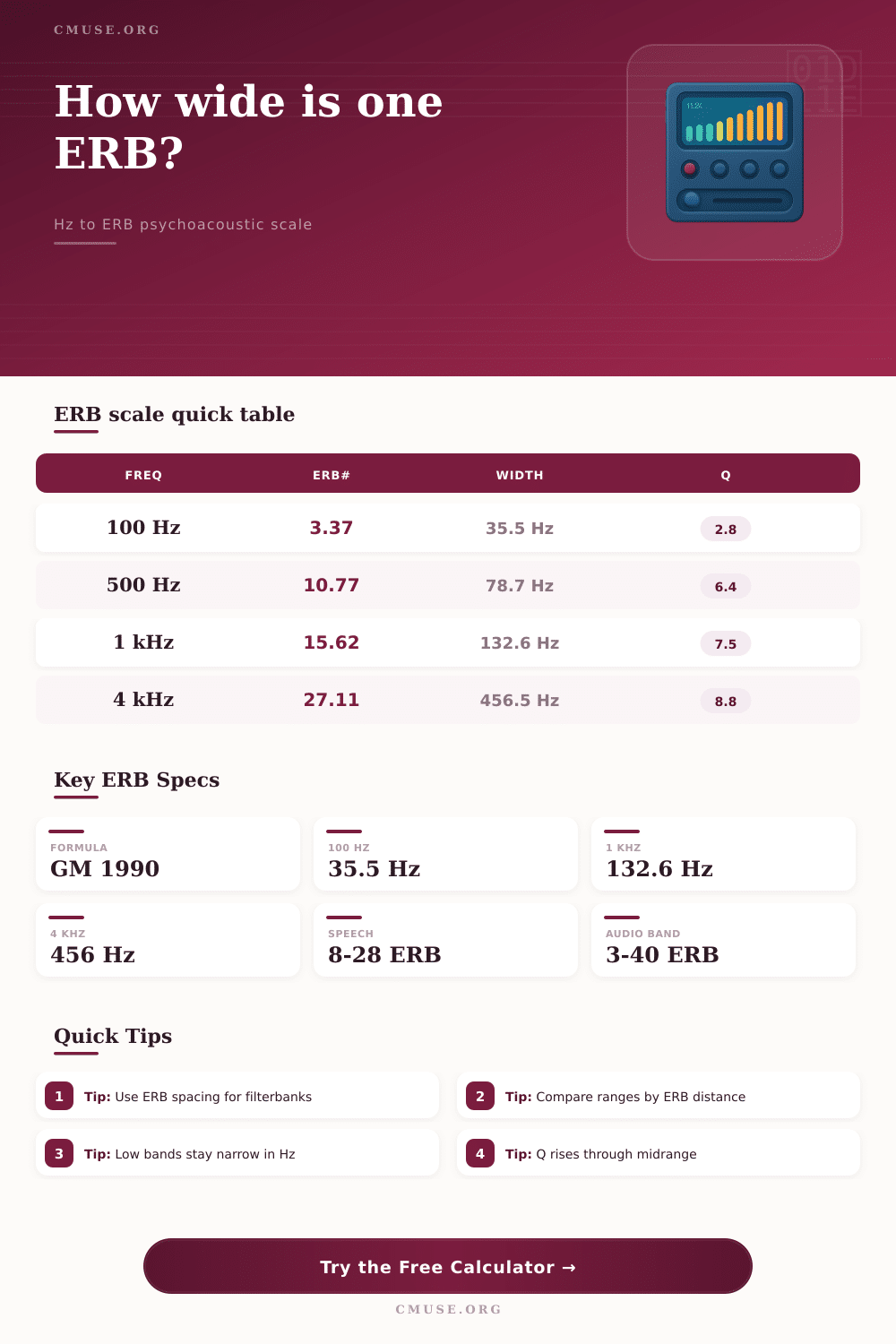
Model: Glasberg-Moore ERB-rate scale. ERB number = 21.4 log10(1 + 0.00437 f), where f is frequency in Hz.
📊 ERB-Spaced Frequency Grid
| Point | ERB-Rate | Frequency | One ERB Width | Q |
|---|---|---|---|---|
| Center | 15.62 | 1000 Hz | 132.6 Hz | 7.54 |
📐 Formula Reference
🎼 Common Frequency Landmarks
| Frequency | ERB-Rate | ERB Width | Auditory Q | Typical Audio Check |
|---|---|---|---|---|
| 50 Hz | 1.93 | 30.1 Hz | 1.66 | Sub bass pitch grouping |
| 100 Hz | 3.37 | 35.5 Hz | 2.81 | Bass fundamentals |
| 250 Hz | 7.06 | 51.7 Hz | 4.84 | Low-mid buildup |
| 500 Hz | 10.77 | 78.7 Hz | 6.35 | Body and warmth |
| 1 kHz | 15.62 | 132.6 Hz | 7.54 | Speech anchor |
| 2 kHz | 21.17 | 240.6 Hz | 8.31 | Presence and intelligibility |
| 4 kHz | 27.11 | 456.5 Hz | 8.76 | Attack and consonants |
| 8 kHz | 33.29 | 888.2 Hz | 9.01 | Sibilance and brightness |
🔎 Range Interpretation Table
| ERB Distance | Meaning | Use In Mixing | Grid Choice |
|---|---|---|---|
| Under 0.5 ERB | Very close auditory spacing | Strong overlap risk for narrow tones | Use 0.25 ERB steps |
| 0.5 to 1 ERB | Within about one filter | Useful for masking checks | Use 0.5 ERB steps |
| 1 to 3 ERBs | Nearby perceptual bands | Good for formant or EQ zones | Use 1 ERB steps |
| 3 to 8 ERBs | Moderate auditory span | Good band-pass design range | Use 1 or 1.5 ERB steps |
| Over 8 ERBs | Broad perceptual region | Useful for speech or instrument bands | Use 2 ERB steps |
🎛 Preset Data Summary
| Preset | Center | Range | Why ERB Helps |
|---|---|---|---|
| Bass Fundamental | 80 Hz | 60 to 120 Hz | Shows how low-frequency auditory filters stay broad relative to pitch. |
| Low-Mid Masking | 250 Hz | 180 to 400 Hz | Compares muddy ranges by perceptual distance instead of raw Hz width. |
| Vocal Formant | 1000 Hz | 700 to 1300 Hz | Maps formant motion onto a cochlear-like spacing. |
| Speech Range | 1500 Hz | 300 to 3400 Hz | Measures how many auditory filters cover speech cues. |
| Sibilance Check | 6500 Hz | 5000 to 8500 Hz | Prevents high bands from looking too wide just because Hz values are large. |
When mixing a vocal track, if you find a harshly resonance at 3 kHz, you might want to use a narrow notch filter to remove that resonance. However, using a narrow notch filter will make the vocal sound sterile because you are treating frequency as if every Hertz on the scale is the same as every other Hertz. A person may think that the distance between 100 Hz and 200 Hz sounds the same than the distance between 3,000 Hz and 3,100 Hz, but the human brain dont perceive it this way.
Instead, the human brain perceives frequency through auditory filters. The narrow EQ adjustments in the low frequencies can be invisible to the human ear but will produce a noticeable change in the high-mid frequencies. The Equivalent Rectangular Bandwidth (ERB) is a psychoacoustic scale that maps a frequency to the resolution of the human cochlea.
Why Use ERB to Mix Sound
The cochlea in the human ear act like a series of bandpass filters that respond to specific frequencies. The ERB scale mimics the way the human cochlea behave. At higher frequencies, the auditory filters in the cochlea becomes wider.
Thus, the ERB scale is not a straight line with every Hertz on the scale being equivalent to every other Hertz. The ERB scale takes into account the fact that the auditory filters in the human ear becomes wider at higher frequencies. When using an ERB rate calculator, the calculator will take the raw Hertz value and convert it to an ERB rate value.
This ERB rate value will be the numbers that represents the human hearing system. If you use the ERB rate calculator to find the bandwidth of a single ERB at a center frequency, the calculation will produce the width of the auditory filter in the cochlea at that center frequency. This bandwidth value are the number that matters in any analysis of auditory filters.
For instance, if two frequencies fall within a single bandwidth of an auditory filter in the cochlea, those two frequencies will blur together in the ear. However, if two frequencies falls within three or four ERBs of each other, the human ear and brain can distinguish between the two frequencies. Thus, understanding the bandwidth of the auditory filters in the human ear will allow a sound engineer to avoid muddy mixes and to create clear mixes.
The aural quality of sound is determine by how many auditory filters are activated in the cochlea. Speech, for instance, is organized with formants that are clusters of energy that correspond to the ERB scale. If a sound designer use a range distance feature on there DAW, they can see how many auditory filters a sound activates.
A frequency range in the high frequencies of sound may appear to be very wide in terms of raw Hertz values. However, it may be a very narrow value on the ERB scale. This is one of the reasons that high frequency sounds may seem concentrated even though they cover alot of the high frequency range in the raw spectrum.
A common mistake in the audio world is to use a constant Q factor for the frequency range of a project. A constant Q factor mean the bandwidth is the same percentage of the center frequency across all ranges. However, the human ear do not work in percentages of a range.
The human auditory system feature a set of auditory filters that are spaced according to the ERB scale. Thus, using an ERB-spaced grid for a project will allow engineers to create a project that align with the auditory system of the human listener. When working on a mastering project, the Hertz values for sibilance and air will be very highly.
A 1,000 Hz wide shelf at 12 kHz may seem like a large amount of space in the mixing console. However, a 1,000 Hz wide shelf at 12 kHz is going to be more smaller in human hearing than the same width of shelf at 200 Hz. This is due to the fact that the high frequency range of sound is more spacious in the ear by nature.
Most engineers dont take note of this because they are focused on the analyzer screen of their DAW instead of the ERB scale. The use of psychoacoustic scales in audio projects, such as the ERB scale, allow engineers to stop guessing at frequency ranges. Whether you are creating a 24-ERB filter bank for hearing research studies or you are trying to understand frequency masking in the human ear, the ERB rate will help to create a common language between the engineer and the human listener.
Furthermore, the ERB rate removes the illusion of the linear frequency scale and demonstrates to engineers the way the cochlea processes sound for the human auditory system. By thinking in terms of auditory filters of the human ear, engineers are working with the physics of the human listener instead of the physics of the audio gear. Thus, engineers should of remember that the human ear is not a linear graph of sound.