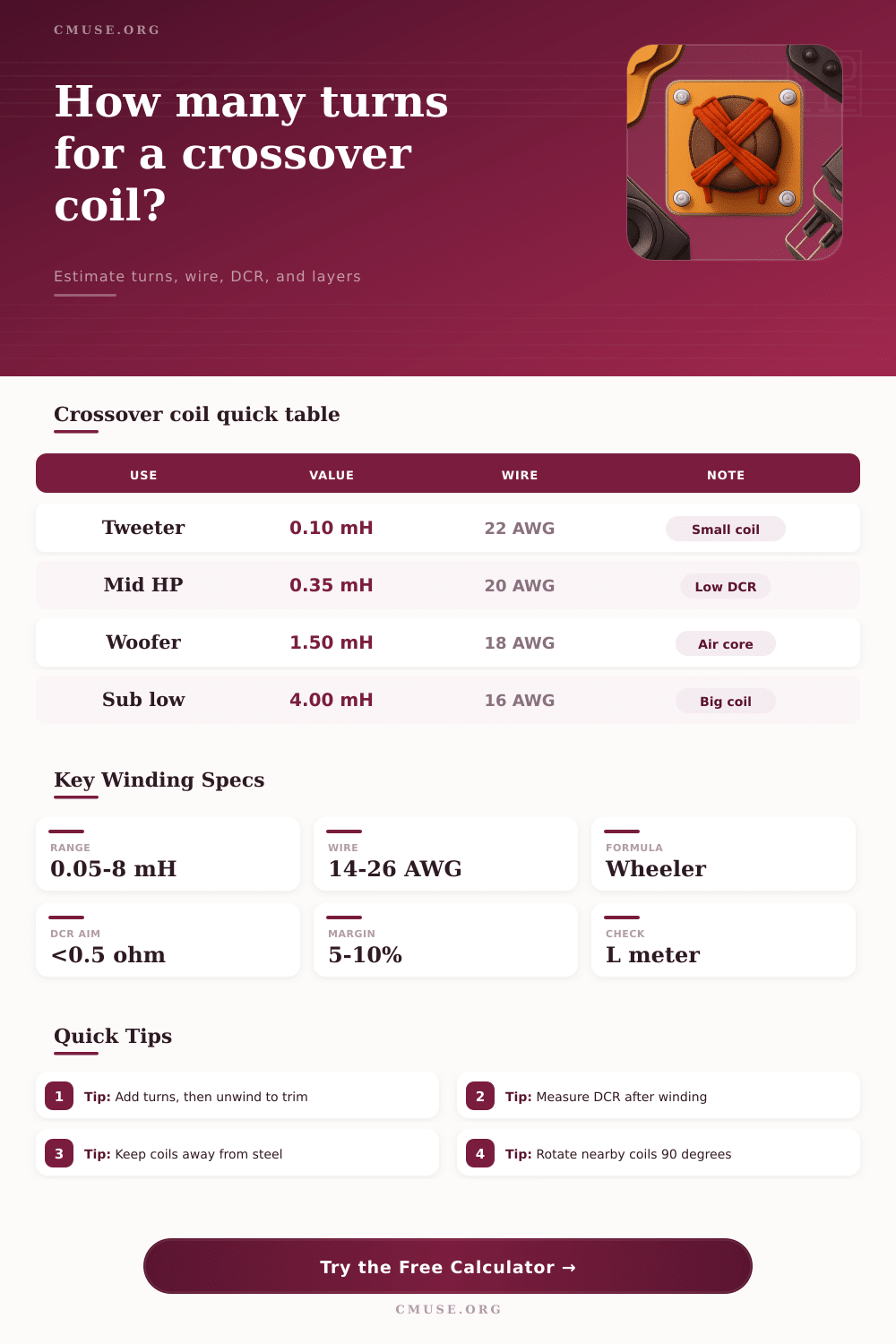
Crossover Coil Winding Calculator
Estimate turns, wire length, winding layers, DCR, current stress, and practical trimming notes for air-core speaker crossover inductors.
🎚 Quick Coil Presets
🧵 Coil Winding Inputs
Winding Plan
📏 Winding Spec Grid
📚 Reference Tables
| AWG | Diameter With Enamel | Ohms Per 1000 ft | Typical Crossover Use |
|---|---|---|---|
| 14 AWG | 0.068 in / 1.73 mm | 2.53 ohms | Large woofer and low-DCR sub coils |
| 16 AWG | 0.054 in / 1.37 mm | 4.02 ohms | High-power woofer low-pass inductors |
| 18 AWG | 0.043 in / 1.09 mm | 6.39 ohms | Common 2-way woofer coils and mid coils |
| 20 AWG | 0.034 in / 0.86 mm | 10.15 ohms | Midrange filters and compact crossovers |
| 22 AWG | 0.027 in / 0.69 mm | 16.14 ohms | Tweeter traps, small shunt coils, low current paths |
| 24 AWG | 0.022 in / 0.55 mm | 25.67 ohms | Small notch or experiment coils where DCR is less critical |
Resistance values are standard copper reference values near 20 C. Enamel diameter varies by insulation build, so final coils should be checked with an inductance meter and ohmmeter.
| Formula / Check | What It Estimates | Equation Used | Practical Note |
|---|---|---|---|
| Wheeler multi-layer | Air-core inductance | L uH = 0.8 r2 N2 / (6r + 9l + 10d) | Dimensions are inches; r is average coil radius |
| Wire resistance | Series DCR | DCR = length ft x ohms per ft | Temperature and solder joints add small changes |
| Reactance | Coil impedance at frequency | XL = 2 pi f L | Useful for checking crossover behavior |
| Copper heating | Power lost in wire | P = I2 x DCR | High DCR reduces woofer damping and level |
| Coil Value | Common Path | Preferred Wire | Winding Advice |
|---|---|---|---|
| 0.05 to 0.22 mH | Tweeter notch, small contour | 22 to 26 AWG | Short coils are sensitive to lead length and meter zeroing |
| 0.27 to 0.82 mH | Midrange or 2-way woofer | 18 to 22 AWG | Keep DCR consistent between stereo pairs |
| 1.0 to 2.7 mH | Woofer low-pass | 16 to 20 AWG | Larger diameter lowers turns but increases wire length |
| 3.3 to 8.2 mH | Sub, baffle step, large woofer | 14 to 18 AWG | Check cabinet space and magnetic spacing before winding |
📈 Common Crossover Coil Scenarios
| Scenario | Target L | Typical DCR Goal | Placement Reminder |
|---|---|---|---|
| Compact bookshelf woofer low-pass | 0.82 to 1.50 mH | 0.25 to 0.60 ohm | Mount away from the input cup transformer or steel hardware |
| Three-way midrange band-pass | 0.33 to 1.00 mH | 0.20 to 0.80 ohm | Match left and right channel coils within the same tolerance |
| Tweeter contour or notch network | 0.05 to 0.30 mH | Often non-critical | Short leads matter because the coil itself is small |
| Large woofer or passive sub filter | 3.0 to 8.0 mH | As low as practical | Rotate this coil 90 degrees from nearby inductors |
🔍 Build Checks
Building an air core inductor requires that you understands the relationship between mathematical formulas and the actual building of the inductor. While the schematic for the speaker crossover circuit may indicate certain target inductance value for the air core inductor, the physical properties of the copper wire that will make up the air core inductor and the plastic bobbin on which the wire will be wound will change the inductance of the completed inductor. For example, if the copper wire have a thick enamel coating or if the turns of the wire is loosely assembled around the plastic bobbin, the inductance of the air core inductor will change.
This change in inductance will change the crossover point for the speaker crossover circuit, which could potentially make the tweeter sound harsh or make the woofer sound sluggishly. You must choose a wire gauge for your air core inductor. The choice of wire gauge for your inductor will balance the size of your inductor with the resistance of the inductor.
How to Build an Air Core Inductor for Speakers
For example, if you choose a heavy wire gauge like 14 AWG, the DC resistance of your inductor will be low. Low DC resistance help the woofer maintain control over the speaker cone. However, using such a heavy gauge wire will make your inductor very large.
You may not have much room within the speaker cabinet to accommodate such a large inductor. Using a thinner wire gauge will make it more easier to wind your inductor. However, the resistance of the air core inductor will be higher with thinner wire.
High resistance in the air core inductor will reduce the output of the inductor, and may change the damping of the speaker driver. The diameter of the bobbin for your air core inductor is another variable that you must consider when you wind your inductor. Using a large diameter bobbin allows for your inductor to reach its target inductance with fewer turns of wire.
Fewer turns of wire means that the resistance of the air core inductor will be lower. However, using a large diameter bobbin for your air core inductor may allow it to act as magnetic antenna for the speaker, which may cause interference with other electronic components within the speaker. Choosing a narrow diameter bobbin for your air core inductor will force the air core inductor to be very tall and skinny.
Air core inductors that is this size may require many layers of wire to reach the desired inductance for the speaker. If an air core inductor requires many layers of wire, it may be difficult to trim the wire if there is too many turns of wire for the inductor to reach its target inductance. Use an inductance calculator to determine the number of turns that your air core inductor should have.
The math to calculate the inductance of an inductor is complex. An inductance calculator allows you to enter the diameter of the bobbin for your air core inductor and the wire gauge for the wire that will make up the air core inductor. The calculator will account for the pack factor of the air core inductor.
The pack factor is a measurement of how much space the wire will occupy within the bobbin. You can wind the wire for your air core inductor either loosely or with sufficient tension to ensure that the turns of wire are as close to the plastic bobbin as possible. If you wind the wire loosely, you are essentially increasing the radius of the air core inductor.
Direct Current Resistance, or DCR, is another measurement of the air core inductor that you should monitor during its assembly. A small amount of extra DCR for the air core inductor that is used in a tweeter notch filter will not have a significant impact on the performance of the speaker system. However, for air core inductors that are used in the low pass filter for the woofer, even a small amount of extra DCR can have a significant impact on the bass frequencies of the speaker system.
If the DCR for the air core inductor becomes too high, it will act as a resistor in series with the woofer driver. This will soften the bass output from the speaker system. To prevent this from occurring, you must ensure that the wire gauge for the air core inductor is sufficiently thick, or that you increase the diameter of the bobbin.
Winding air core inductors often requires several attempts before achieving the target inductance for the inductor. For best results wind the air core inductor to be a slightly higher inductance than the target inductance for the speaker system. Slowly remove turns of copper wire from the air core inductor, measuring the inductance of the air core inductor with an inductance meter after each removal of turns of wire from the inductor.
Continue winding and removing turns of wire until the air core inductor reaches the target inductance. Ensure that the air core inductor within the left speaker cabinet is the same as the air core inductor within the right speaker cabinet. Any difference in the two air core inductors will shift the stereo imaging of the music that is played through the stereo speaker system.
Air core inductors create magnetic fields. If you place two air core inductors too close to each other within the speaker cabinet, their magnetic fields may couple with each other. The coupling between these two magnetic fields will change the inductance values of each of the air core inductors.
To avoid this from occurring, ensure that the air core inductors are separated by at least one diameter of the coil of the inductor, or rotate each air core inductor ninety degrees relative to each other. By either of these methods, the magnetic fields of each of the air core inductors will not interfere with the inductance values of either inductor.