Piezo Tweeter Crossover Calculator
Calculate piezo tweeter array capacitance, series resistor damping, optional shunt load, protection capacitor target, amplifier load, current, and level change at the crossover frequency.
🎚 Quick Piezo Presets
🔊 Piezo Network Inputs
Recommended Piezo Network Parts
📊 Current Design Snapshot
🧮 Piezo Formulas Used
| Calculation | Formula | Input Needed | Meaning |
|---|---|---|---|
| Capacitive reactance | Xc = 1 / (2 x pi x f x C) | Frequency and total capacitance | Piezo impedance magnitude before resistors. |
| Parallel array capacitance | Ctotal = C per piezo x count | Equal piezo elements | Parallel piezos load the amplifier more at high frequency. |
| Series pair capacitance | Ctotal = C per piezo / count | Equal series elements | Series piezos reduce capacitance and raise reactance. |
| Protection capacitor | C = 1 / (2 x pi x Rshunt x Fc) | Shunt resistor and target Fc | Creates a defined first-order high-pass only when the shunt path exists. |
| Amplifier voltage | Vrms = square root (watts x ohms) | Power and reference load | Estimates resistor heating and high-frequency current. |
📐 Typical Piezo Capacitance Reference
| Piezo Type | Typical Capacitance | Common Protection Parts | Design Note |
|---|---|---|---|
| Small disc or bullet piezo | 10 nF to 25 nF | 22-47 ohm series, 470-680 ohm shunt | Light load, often needs level and harshness control. |
| Compact horn piezo | 20 nF to 45 nF | 15-33 ohm series, 220-470 ohm shunt | Useful range for single PA or keyboard cabinet add-ons. |
| Large horn piezo | 40 nF to 80 nF | 10-33 ohm series, 150-330 ohm shunt | Check amplifier load carefully above 10 kHz. |
| Two in parallel | 40 nF to 120 nF | 10-22 ohm series, 150-330 ohm shunt | Output rises but capacitive loading rises too. |
| Four-element array | 80 nF to 240 nF | 10-18 ohm series, 100-220 ohm shunt | Often benefits from series-parallel wiring or extra resistance. |
⚙ Crossover Topology Comparison
| Topology | Parts | What It Controls | Recommendation |
|---|---|---|---|
| Piezo direct to amplifier | No added parts | Relies on piezo capacitance only | Not preferred for PA use because ultrasonic load and harshness are uncontrolled. |
| Series resistor only | One resistor in line | Current limit, amplifier load, and level trim | Good minimum protection; does not create a conventional high-pass crossover. |
| Series resistor plus shunt resistor | Line resistor and branch resistor | Load damping and more predictable response | Useful when adding a blocking capacitor or shaping harsh piezo peaks. |
| Protection cap plus shunt resistor | Cap in series before shunted piezo branch | Defined first-order high-pass frequency | Best choice when you need an actual crossover point for the piezo branch. |
| Series-parallel piezo array | Multiple piezos wired in groups | Total capacitance and coverage | Reduces the extreme capacitance of big parallel arrays. |
🎯 Starting Values by Use Case
| Use Case | Series Resistor | Shunt Resistor | Protection Cap Starting Point |
|---|---|---|---|
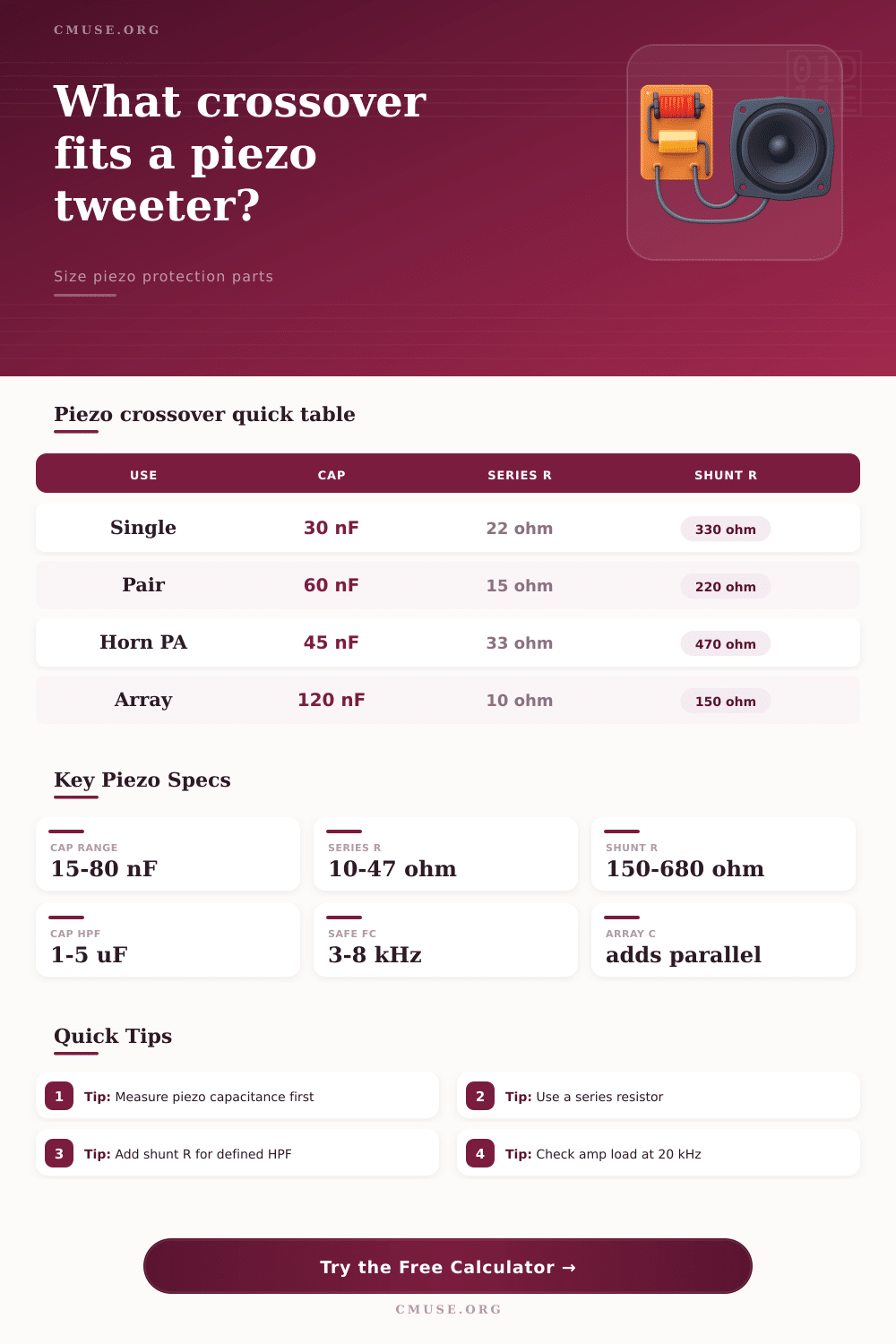
| Single piezo add-on for guitar or keyboard cab | 22 ohm to 47 ohm | 330 ohm to 680 ohm | 1 uF to 3.3 uF for a high crossover feel. |
| Small PA top with one piezo horn | 22 ohm to 33 ohm | 330 ohm to 470 ohm | 2.2 uF to 5.6 uF depending on target Fc. |
| Two piezos in parallel | 15 ohm to 27 ohm | 220 ohm to 330 ohm | 2.2 uF to 4.7 uF is a common practical span. |
| Four piezo PA array | 10 ohm to 22 ohm | 150 ohm to 220 ohm | Use measured capacitance and check 20 kHz load before finalizing. |
| Super tweeter sparkle above main tweeter | 33 ohm to 68 ohm | 470 ohm to 1000 ohm | 0.68 uF to 2.2 uF for a higher, gentler entry. |
📋 Preset Comparison Table
| Preset | Total Capacitance | Target Fc | Main Reason |
|---|---|---|---|
| Single Cabinet Piezo | 30 nF | 3.5 kHz | Balanced starting point for one piezo horn. |
| Dual Parallel Pair | 60 nF | 4.5 kHz | Extra output with a lower series resistor. |
| Four Piezo Array | 112 nF | 5 kHz | Checks high-frequency current in a louder array. |
| Two In Series | 17.5 nF | 3.8 kHz | Reduces capacitance and amplifier loading. |
| Series-Parallel Four | 70 nF | 4.2 kHz | Middle path between loudness and load control. |
| Hi-Fi Super Tweeter | 44 nF | 6.5 kHz | Keeps the piezo mostly above the main tweeter range. |
🔧 Spec Grid
🎛 Load Check Reference
| Total Piezo Capacitance | Xc at 5 kHz | Xc at 10 kHz | Xc at 20 kHz |
|---|---|---|---|
| 20 nF | 1592 ohm | 796 ohm | 398 ohm |
| 50 nF | 637 ohm | 318 ohm | 159 ohm |
| 100 nF | 318 ohm | 159 ohm | 80 ohm |
| 200 nF | 159 ohm | 80 ohm | 40 ohm |
Adding a piezo tweeter to a speaker cabinet require specific electrical components because the piezo tweeter has a different electrical impedance than a voice coil tweeter. A piezo tweeter is different from a voice coil tweeter because a voice coil tweeter have a stable nominal impedance, but a piezo tweeter act like a capacitor. Because a piezo tweeter acts like a capacitor, the resistances of a piezo tweeter drops as the frequency increases.
This heavy load on the amplifier at high frequencies cause the amplifier to work harder than is necessary. Thus, a piezo tweeter cannot be wire directly into a speaker cabinet without using specific electrical component. Many people will attempt to use a single capacitor to block out the low frequency that a tweeter should not output.
How to wire a piezo tweeter to a speaker
However, the capacitor will not be able to handle the capacitive nature of the piezo tweeter. Because the piezo tweeter is capacitive, it will allow the low frequency to pass through the capacitor. Without a fixed load in the circuit, the crossover frequency can be unpredictable.
To create a predictable crossover frequency, you will have to wire a shunt resistor in parallel with the piezo tweeter. The shunt resistor will allow for the protection capacitor to push against a defined target. This will turn the filter into a high-pass filter that allow for a clean crossover frequency between the speaker and tweeter.
A calculator will assist you in determining the correct components for your tweeter array. Calculating the capacitive reactance of the components manually is difficult. However, by plugging in the frequency that you desire for your tweeter array into the calculator, you can determine the reactance of the capacitor that will allow the tweeter to begin producing sound at that frequency.
A person that is creating a PA horn for a keyboard amplifier may want the tweeter to have a lower crossover frequency to allow for more presence in the sound. For a hi-fi super tweeter, however, a higher crossover frequency will allow the tweeter to not interfere with the main speaker in the array. By plugging in the desired crossover frequency into the calculator, you can determine the exact value of the capacitor that will allow for the tweeter to begin to produce sound at that set frequency.
A series resistor is another component that you will have to use to wire a piezo tweeter to a speaker cabinet. A series resistor will manage the overall output level of the tweeter array and protect the amplifier. You will wire the series resistor in line with the piezo tweeter to damp the output that the tweeter will produce.
A piezo tweeter will be very efficiently at converting the energy of the signal into sound. The output of the tweeter will likely be too loud for the rest of the speaker array. Additionally, a series resistor will limit the current that flow through the tweeter at 20 kHz.
Without a series resistor, the tweeter will create a near short circuit to the amplifier when the high energy transients pass through the tweeter. If you are using an array of piezo tweeters, the wiring layout will have to change. If you wire the tweeter array in parallel, the total capacitance will increase, lowering the impedance and increasing the current draw of the tweeter array.
Wiring the tweeter array in series will create the opposite effect. Wiring an array of tweeters in series will reduce the total capacitance of the array, allowing for the amplifier to more easy handle the load of the tweeter array. However, wiring the tweezers in series will reduce the total output of the tweeter array.
A series-parallel arrangement are a wiring layout that many people will use. A calculator will allow you to determine the total capacitance of the tweeter array with a series-parallel arrangement. Another component that you will have to consider in the integration of piezo tweeters into a speaker cabinet is the wattage of the resistors.
Resistors will create heat when the tweeter array is playing music. A resistor that will handle the wattage in an open environment may overheat if it is placed within the sealed speaker cabinet. Calculators will allow you to determine the wattage of the resistors based off the wattage rating of your amplifier.
This will allow you to determine whether you need a large power resistor or a small carbon film resistor. A good practice will be to overspecify the resistors by a factor of two or three in case the tweeter array is used in a high-power PA system. By properly wiring the tweeter array with a shunt and series resistor, you can integrate a piezo tweeter into an audio system in an effectiv manner.