Crossover Resistor Calculator
Calculate resistor values and wattage for speaker crossover L-pads, simple series pads, Zobel impedance equalizers, baffle-step shelves, and notch damping networks.
🎚 Quick Crossover Presets
🔊 Resistor Network Inputs
Part List and Stress Estimate
📊 Resistor Network Spec Grid
📝 Attenuation Reference Table
| Target Cut | Voltage Ratio K | 8 Ohm L-Pad Series | 8 Ohm L-Pad Shunt | Simple Series Resistor |
|---|---|---|---|---|
| 2 dB | 1.259x | 1.65 ohm | 30.9 ohm | 2.07 ohm |
| 3 dB | 1.413x | 2.34 ohm | 19.4 ohm | 3.30 ohm |
| 6 dB | 1.995x | 3.99 ohm | 8.04 ohm | 7.96 ohm |
| 9 dB | 2.818x | 5.16 ohm | 4.40 ohm | 14.5 ohm |
| 12 dB | 3.981x | 5.99 ohm | 2.68 ohm | 23.8 ohm |
The L-pad values assume an ideal 8 ohm resistive driver. Real drivers vary with frequency, so measured impedance improves the starting point.
🔧 Crossover Resistor Use Table
| Network Type | Best Use | What It Changes | Main Risk |
|---|---|---|---|
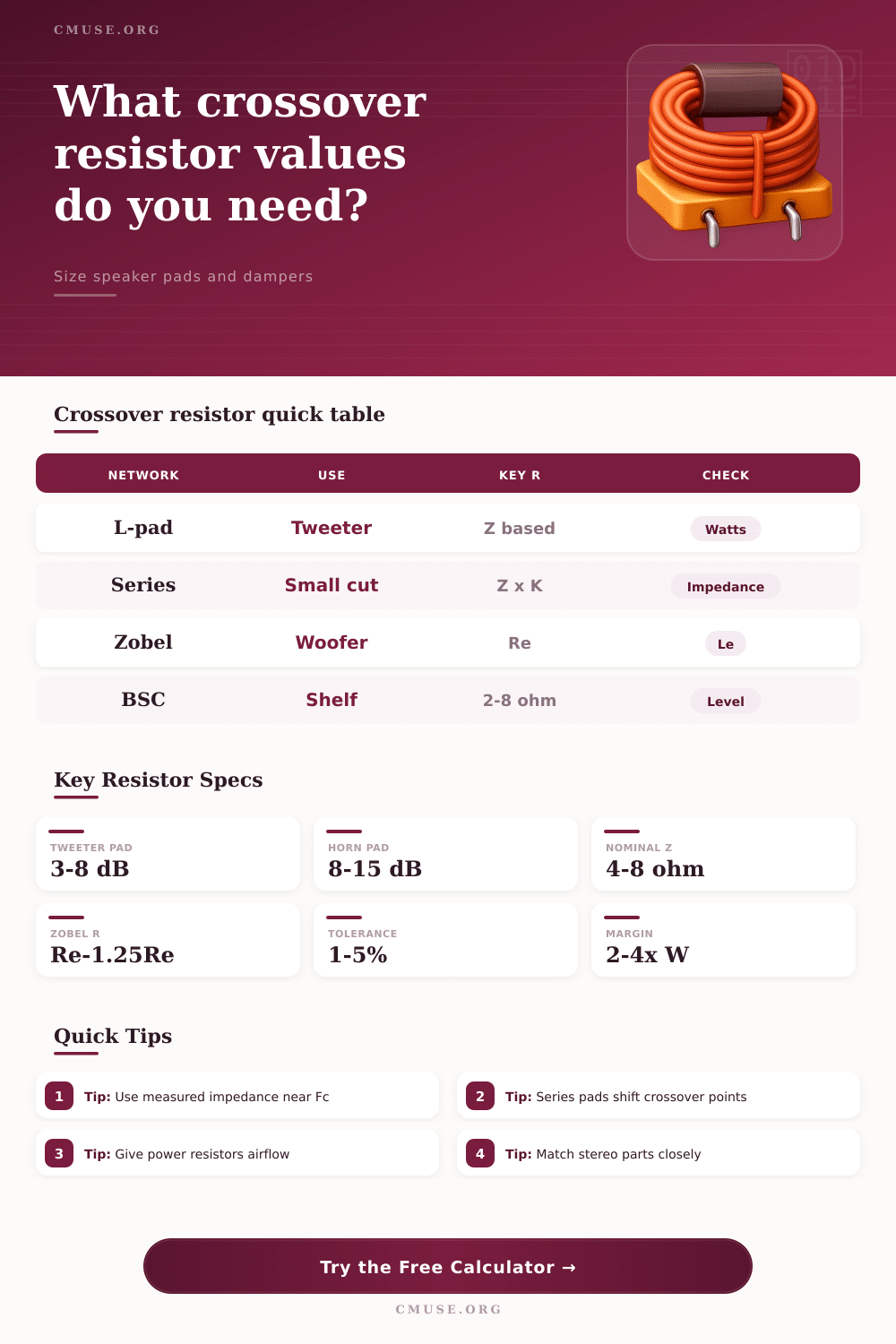
| Constant-impedance L-pad | Tweeter, horn, midrange level matching | Output level while keeping the crossover load near nominal | Heat in the series resistor and low shunt values at high attenuation |
| Simple series resistor | Small tweeter trims, protection, quick voicing tests | Raises apparent impedance and shifts the high-pass corner | Crossover frequency and Q move from the original design |
| Zobel network | Woofer or midwoofer impedance rise compensation | Flattens inductive impedance rise above the working band | Capacitor value depends on accurate Le and Re measurements |
| Baffle-step shelf | Woofer low-pass shaping below the baffle transition | Reduces upper-bass or midband level relative to bass | Too much shelf can make the speaker sound heavy or inefficient |
| Parallel RLC notch | Cone breakup and narrow response peaks | Places a damped shunt path around a selected frequency | Wrong Q can over-cut useful output or miss the peak |
📐 Common Project Size Table
| Project | Typical Driver | Resistor Task | Starting Range |
|---|---|---|---|
| Bookshelf 2-way | 8 ohm dome tweeter | Match tweeter to woofer sensitivity | 2 dB to 6 dB L-pad |
| Studio monitor | 6 ohm tweeter or waveguide | Fine trim while preserving crossover target | 1 dB to 4 dB L-pad |
| PA top cabinet | 8 or 16 ohm compression driver | Large horn attenuation with high wattage | 8 dB to 15 dB L-pad |
| Car component set | 4 ohm tweeter | Small pad or series protection resistor | 2 dB to 6 dB trim |
| Woofer crossover | 4 to 8 ohm midwoofer | Zobel resistor and capacitor for stable filter action | R near measured Re |
| Full-range helper | Breakup-prone cone driver | Damped RLC notch around a narrow peak | Q 0.7 to 1.5 |
💡 Practical Crossover Notes
When building custom speaker, it is possible that one of the driver will be louder then the others. For example, the tweeter may have a more higher sensitivity than the woofer. In this case, the engineer have to reduce the volume of the tweeter.
Adding a resistor in series with the tweeter will alter an impedance that the crossover receives. This will change the crossover frequency, which can ruin the phase alignment of the speaker. In order to maintain the same impedance seen by the crossover, it is necessary to use an L-pad.
Make Speaker Drivers the Same Loudness and Keep the Crossover Working
An L-pad use both a series and a shunt resistor. This configuration allow the L-pad to maintain the total impedance seen by the crossover. By maintaining the total impedance, the crossover will maintain its frequency response.
However, the driver will receive fewer volt from the amplifier. Thus, the L-pad allow the engineer to lower the volume of one of the drivers while maintaining the function of the crossover. The value of the resistor in the L-pad must be calculated using the correct impedance of the driver.
While you can use the nominal impedance of the driver, it is often inaccurate. The nominal impedance is printed on the driver and is an estimate of the impedance of the driver. As an inductive component, the impedance of the driver will increase at more higher frequencies.
Therefore, you must measure the impedance of the driver at the crossover frequency. Using the incorrect impedance will lead to incorrect calculation of the value of the resistors in the L-pad. As a result, the attenuation will not reach the desired level.
Another consideration in the use of resistors in an L-pad is the heat that the resistors will produces. When resistors are included in a circuit, they will turn electrical energy into heat. In some case, this can be problematic.
If a resistor becomes too hot, the resistor can melt the solder or change its resistance value. This could happen with high-output speaker or home theater system. To protect resistors from overheating, you must calculate the wattage margin for the application.
Use a wattage rating that is three or four times the heat dissipation of the resistor. Using a higher wattage rating for resistors will keep the resistors cooler and avoid resistor failure. Another electronic component used in speaker driver is the Zobel network.
With a woofer with a steep rise in impedance, the low-pass filter might not work correct. A Zobel network is comprised of a resistor and capacitor in parallel with the speaker driver. The Zobel network will flatten the impedance rise of the woofer.
To use a Zobel network, you must know the inductance of the woofer’s voice coil and the DC resistance of the driver. Using the correct voice coil inductance and the correct DC resistance will make the woofer behave good. Baffle-step compensation is used to correct the mid-bass response of a speaker.
When sound wave wrap around the front of the speaker cabinet, this can cause an increase in mid-bass frequencies. Using a resistor and inductor, baffle-step compensation can correct this issue. This will allow the speakers to sound more naturaly when playing music in a room.
Using L-pads, Zobel networks, and baffle-step compensation will allow for a balanced soundstage. A balanced soundstage will ensure no driver are louder than the others. Using precise component and ensuring that the left and right channels of the speakers are matched will allow for a flat frequency response and safe component.