Subwoofer Frequency Response Calculator
Estimate low-frequency extension, room mode pressure points, boundary gain, crossover rolloff, EQ effect, and practical SPL headroom for a subwoofer system.
🎵Scenario Presets
🎚Response Inputs
📊Calculated Spec Grid
🔎Spec Comparison Grid
📐Reference Tables
| Alignment | Useful Target | Common F3 Range | Response Character |
|---|---|---|---|
| Sealed Qtc 0.60-0.70 | Critical to overdamped | 28-45 Hz | Smooth, gentle rolloff, accepts EQ well |
| Sealed Qtc 0.80-1.00 | Compact music sub | 35-60 Hz | More punch, possible upper-bass hump |
| Ported 20-28 Hz | Deep cinema extension | 18-28 Hz | Strong low bass, needs high-pass protection |
| Ported 32-45 Hz | Live sound and DJ use | 30-45 Hz | High output in kick and bass guitar range |
| Room Dimension | Axial Mode Formula | Example | Meaning |
|---|---|---|---|
| Length | 565 / length in ft | 12 ft = 47.1 Hz | Front-to-back pressure peak or null |
| Width | 565 / width in ft | 10 ft = 56.5 Hz | Side-to-side pressure peak or null |
| Height | 565 / height in ft | 8 ft = 70.6 Hz | Floor-to-ceiling buildup |
| Metric | 172 / dimension in m | 3.5 m = 49.1 Hz | Same axial estimate in SI units |
| Placement | Boundary Estimate | Best Use | Watch For |
|---|---|---|---|
| Free space | 0 dB | Measurement reference and outdoor checks | Needs more amplifier headroom |
| One wall | 3 dB | Most studio and hi-fi rooms | Front-wall cancellation near crossover |
| Corner | 6 dB | Maximum extension and output indoors | Stronger room modes |
| Nearfield | 4 dB | Desk, edit bay, or mix position support | Localization if crossover is too high |
| Small cabin | 9 dB | Vehicle or very small sealed rooms | Rapid low-bass rise below cabin gain |
| Preset Type | Typical Dimensions | Primary Goal | Secondary Check |
|---|---|---|---|
| Home studio | 10 x 12 x 8 ft | Even 35-90 Hz monitoring | Length and width modes close together |
| Home theater | 14 x 18 x 8 ft | Extension to 20-25 Hz | Port tuning and EQ headroom |
| DJ booth | 6 x 8 x 8 ft | Output from 40-100 Hz | Small-room pressure buildup |
| Small stage | 24 x 18 x 12 ft | Kick range projection | Crossover overlap with mains |
This calculator uses simplified small-signal alignment math, common boundary gain estimates, and axial room-mode formulas. Final response depends on driver excursion limits, enclosure losses, room construction, filters, and the measured listening position.
A subwoofer can has thin or boomy sounds even if the subwoofer itself is supposed to have deep bass. This is often because individuals often ignores the role of the room when they are choosing a subwoofer. People often selects subwoofers based on a single number, such as frequency response of the subwoofer.
However, the frequency response isnt the only factor that can impact the performance of a subwoofer. Additionally, the room that the subwoofer is playing in can change the bass output of the subwoofers. Therefore, the room is just as important as the subwoofer itself.
How the Room and Setup Affect Subwoofer Sound
Managing the air movement within the confined spaces of the subwoofer is more important than the power the subwoofer can create. In order to manage the air movement, you can use a calculator that models the physics of the subwoofer and the room in which it will be used. The parameters of the subwoofer will determine how the driver want to move.
However, the alignment of the box will determine the movement of the driver. For instance, sealed box have a gentle roll off of bass that sounds tight, while ported boxes will boost the bass at a specific frequency. Additionally, sealed boxes offers more precision to the bass that the subwoofers create than do ported boxes.
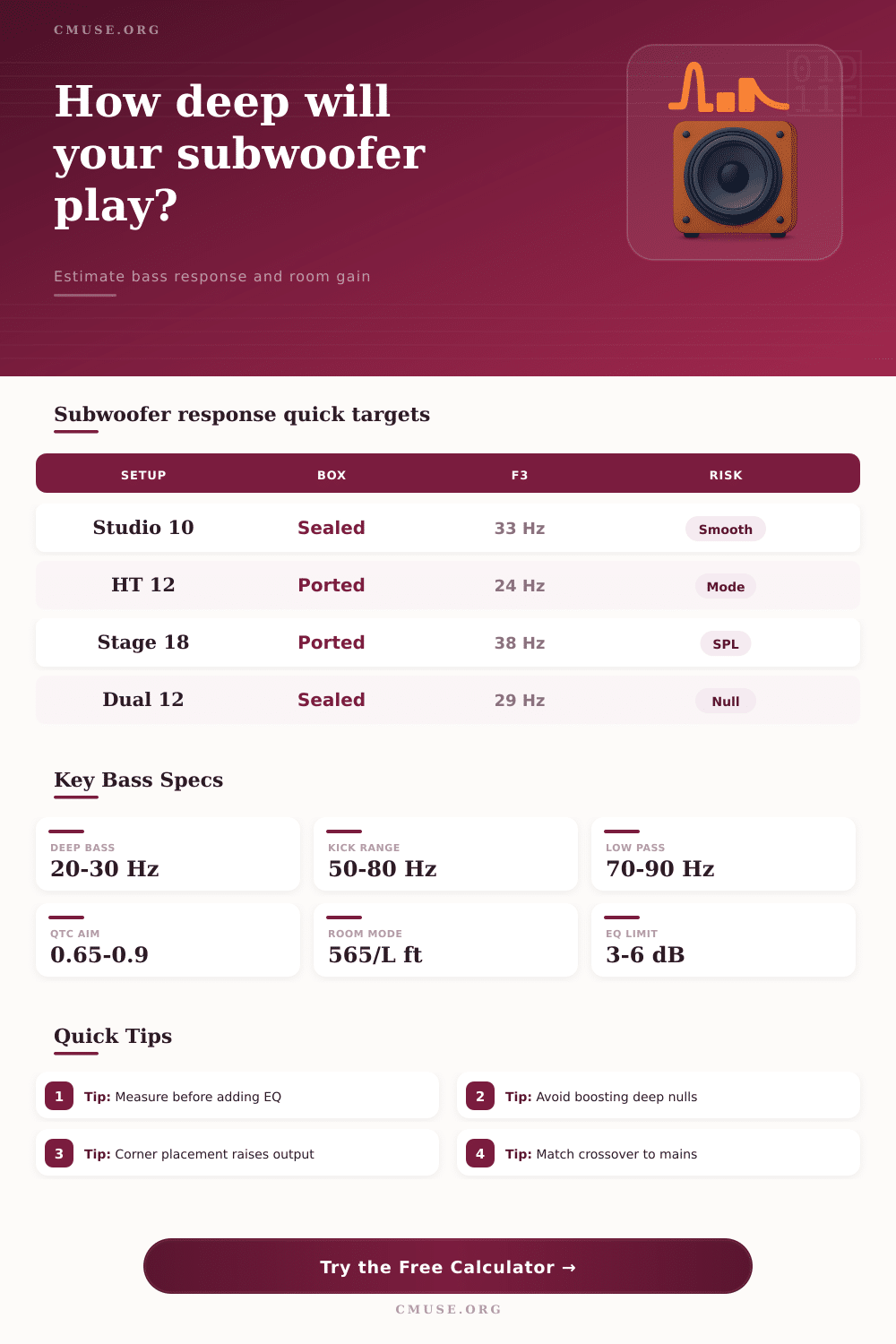
Another factor to consider is the placement of the subwoofer. For instance, if you place a subwoofer into a corner of the room, the boundaries reflecting the sound back into the room will boost the sound. This boundary gain will boost the subwoofer without using more power for the subwoofer.
However, this can also cause problems for the subwoofer in that room modes can be created. Boundary gain will create room modes that result in standing wave in the room that will cause some of the notes played by the subwoofer to boom, while other notes may dissapear altogether. Calculating the mode that will dominate the room can help the subwoofer designer to understand that they should not boost the subwoofer with equalizing if the equalizing boost will target the dominant mode of that room.
For instance, if the dominant mode is 47 Hz, it would not be a good idea to boost that frequency with equalization. Additionally, it would not be a good idea to target a deep null with a boost of equalization because the room itself causes a deep null by canceling out sound waves from the subwoofers. Additionally, if an equalization boost is used to target such a deep null, the amplifier will have to work harder to move the subwoofer to create that boost, and the subwoofer will be working at its physical limit.
Furthermore, since the room itself caused the null, it is impossible to win the battle against those nulls by increasing the power to the subwoofer. Thus, measuring the actual position of the listener in the room will allow the designer to make certain that the subwoofer is performing as it should. Finally, another setting that can have an impact on the sound of the subwoofer is the crossover point.
For instance, if you set the crossover point too high, the bass will sound directionally from the subwoofer. Additionally, you can adjust the low pass filter such that the subwoofer is not easily identifiable by its direction. Additionally, the slope of the crossover should also be adjusted such that the subwoofer and the main speakers does not create a bump or dip in the bass frequencies.
Headroom is the last factor to consider when setting up a subwoofer. Headroom relates to the power that is available to the amplifier of the subwoofer. For instance, adding a 6 dB boost to the bass will ask for more power from the hardware of the subwoofer system.
If the system is already near the limits of the power of the hardware, adding this 6 dB boost will cause clipping of the signal. Thus, understanding the maximum amount of SPL that the system can create will allow the designer to ensure that the system has enough power to reach the deepest bass note. Furthermore, if the system does not have enough headroom, the system will stress the equipment.
Overall, there is a balance that needs to be found between the driver of the subwoofer, the enclosure in which the subwoofer lives, and the room in which the subwoofer is playing. The subwoofer needs to have enough extension in its bass response to provide rumble to the system, but it should also have enough control over the bass to not bleed into the music playing from the main speaker. Thus, planning and placement of the subwoofer are two steps that can be taken to manage the subwoofer, as well as using calculations to manage the subwoofer itself.
Thus, using calculations instead of guessing at what the best settings for the subwoofer will be, the subwoofer will exhibit more predictable behaviors.