Folded Horn Subwoofer Calculator
Estimate quarter-wave path length, exponential flare, throat area, mouth area, horn air volume, rear chamber allowance, and cabinet fit for a folded bass horn.
🔊 Folded Horn Presets
⚙ Horn Design Inputs
📊 Mouth Loading Reference
| Loading condition | Radiation space | Mouth area factor | Best use |
|---|---|---|---|
| Free space | Full sphere | 1.00 x | Outdoor single cabinet, largest mouth requirement |
| Floor half-space | Half sphere | 0.50 x | Stage floor, DJ riser, portable PA use |
| Wall and floor | Quarter sphere | 0.25 x | Theater wall placement or fixed install |
| Corner | Eighth sphere | 0.125 x | Home theater, organ, small room low extension |
| Cabinet stack | Coupled array | 0.25 x | Two to four matched horn modules grouped together |
📏 Typical Driver Sd Values
| Nominal driver | Typical Sd | Balanced throat | Common horn role |
|---|---|---|---|
| 8 inch woofer | 210-230 cm² | 150-260 cm² | Recording room, compact bass reinforcement |
| 10 inch woofer | 330-360 cm² | 230-430 cm² | Small home horn or compact stage monitor low end |
| 12 inch woofer | 500-560 cm² | 350-670 cm² | Home theater, small DJ cabinet, music room sub |
| 15 inch woofer | 800-880 cm² | 560-1060 cm² | Portable folded horn, bass guitar, small club |
| 18 inch woofer | 1150-1250 cm² | 805-1500 cm² | Club subwoofer, cinema module, high output PA |
| 21 inch woofer | 1600-1750 cm² | 1120-2100 cm² | Touring low-frequency horn or coupled array |
🔀 Flare Profile Comparison
| Profile | Formula emphasis | Practical behavior | Cabinet tradeoff |
|---|---|---|---|
| Exponential | S(x) = St x e^(mx) | Predictable loading near cutoff, classic bass horn math | Needs enough mouth area for smooth low end |
| Compact hybrid | Shortened path with faster bends | Useful when size is fixed and cutoff is moderate | More ripple risk, less ideal below tuning |
| Tractrix-style | Slower expansion near mouth | Can sound smooth in a room corner alignment | Longer path and wider final section |
| Conical | Linear area growth | Simple panels, easier folding and layout | Lower acoustic loading than exponential at cutoff |
🎛 Common Folded Horn Sizes
| Project | Target cutoff | Approx path | Design note |
|---|---|---|---|
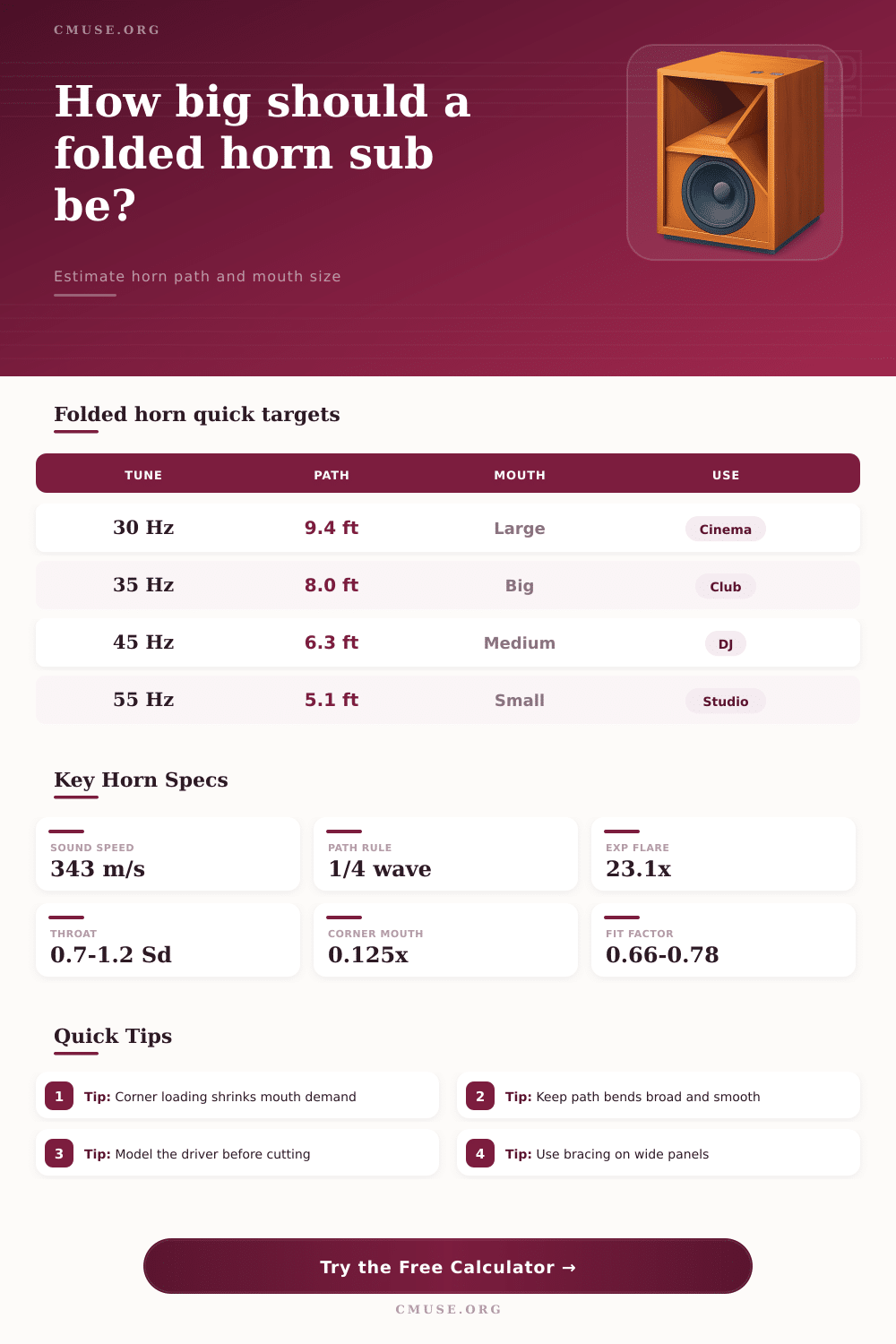
| Studio 8 inch folded horn | 55 Hz | 5.1 ft / 1.56 m | Best with wall support and modest output goals |
| Compact 10 inch sub horn | 45 Hz | 6.3 ft / 1.91 m | Reasonable home size with floor loading |
| 15 inch DJ folded horn | 40 Hz | 7.0 ft / 2.14 m | Portable when cutoff is not pushed too low |
| 18 inch club horn | 35 Hz | 8.0 ft / 2.45 m | Usually needs large panels or cabinet coupling |
| Corner cinema bass horn | 30 Hz | 9.4 ft / 2.86 m | Works best when the room corner acts as the mouth extension |
A folded horn is an type of loudspeaker enclosure that is used to produce low-frequency sound. Folded horn take advantage of the fact that the loudspeaker can be folded into a more smaller cabinet than would otherwise be required by the long path length required of a horn to effectively radiate low frequencies. Many people desires to hear low frequency sound in there spaces.
The standard box or ported box enclosure act as a filter to the driver, but the horn acts as an acoustic transformer that transforms the high pressure of the driver cone into the low pressure of the surrounding room. The requirement of a true low frequency horn is a very long path length, which is often too long for the standard living room. The folded horn can be used to solve this problem, as the horn allow the sound to bend upon itself to provide the necessary long path length, while keeping the horn cabinet small enough to fit through a doorway.
Folded Horn Speakers: How They Work and How to Build Them
The dimension of a folded horn are very important, and if they are not properly set up, the sound will be poorly from the speaker. If the air path is too short, there will be a loss of low frequency sound. Additionally, if the horn is too small in its mouth, it will produce a muddy sound.
The throat is the narrowest portion of the horn, and is the portion of the horn where the diaphragm of the speaker meet the folded horn. The throat portion of the horn act as a bottleneck to increase the loading on the driver cone. However, the loading must be balanced appropriate.
If too much loading is placed on the cone through the throat, the speaker can be damaged and produce a harsh sound. If there is too much loading on the cone, low frequency sound will be lose. The mouth of the folded horn is that portion of the horn that release the sound into the room.
It is a critical component of the horn. Many people makes the mistake of making the mouth of the horn smaller than the cabinet. However, the walls of the room can provide load to the mouth of the horn that allow for a smaller mouth size.
For instance, if the horn is placed into a corner of a room, the walls will provide load to the horn. Additionally, the shape of the horns flare will change the sound that are radiated from the horn. For instance, people use an exponential flare for folded horns to create predictable loading, while a tractrix style flare is used to provide a smooth transition of the sound at the mouth of the horn.
Conical horn are also used because they are easier to build out of plywood. Beyond ensuring that the dimension of the folded horn are appropriate, other considerations based off the physical construction must be made. For instance, turbulence in the folded horn will create standing waves in the sound radiate by the folded horn.
Additionally, if the designer constructs the folded horn without an area for the drivers rear chamber, the sound will lack definition. The rear chamber must have the appropriate volume for the driver to function correct. Final consideration into the construction of the folded horn is its structural integrity.
Due to the low frequencies create by the folded horn, immense pressure will be placed upon the folded horn. Thus, the builder must include bracing in the folded horn to prevent the folded horn from vibrating. If the folded horn do vibrate, it will become an instrument that create certain frequencies rather than an amplifier.
Overall, the folded horn should of been constructed in a way that the path length, mouth size, and cabinet volume is aligned. When these three elements of the folded horn are aligned appropriately, the folded horn will produce high efficiency and high impact sound.