Angled Subwoofer Box Calculator
Calculate wedge enclosure volume, baffle angle, net air space, port length, and panel area for sealed or ported angled subwoofer boxes.
🔊 Wedge Box Presets
📐 Angled Box Inputs
🧮 Current Box Specs
📊 Enclosure Style Comparison
📚 Typical Subwoofer Net Volume Ranges
| Driver Size | Sealed Net Range | Ported Net Range | Common Tuning |
|---|---|---|---|
| 8 inch | 0.25-0.45 ft³ / 7-13 L | 0.50-0.80 ft³ / 14-23 L | 34-40 Hz |
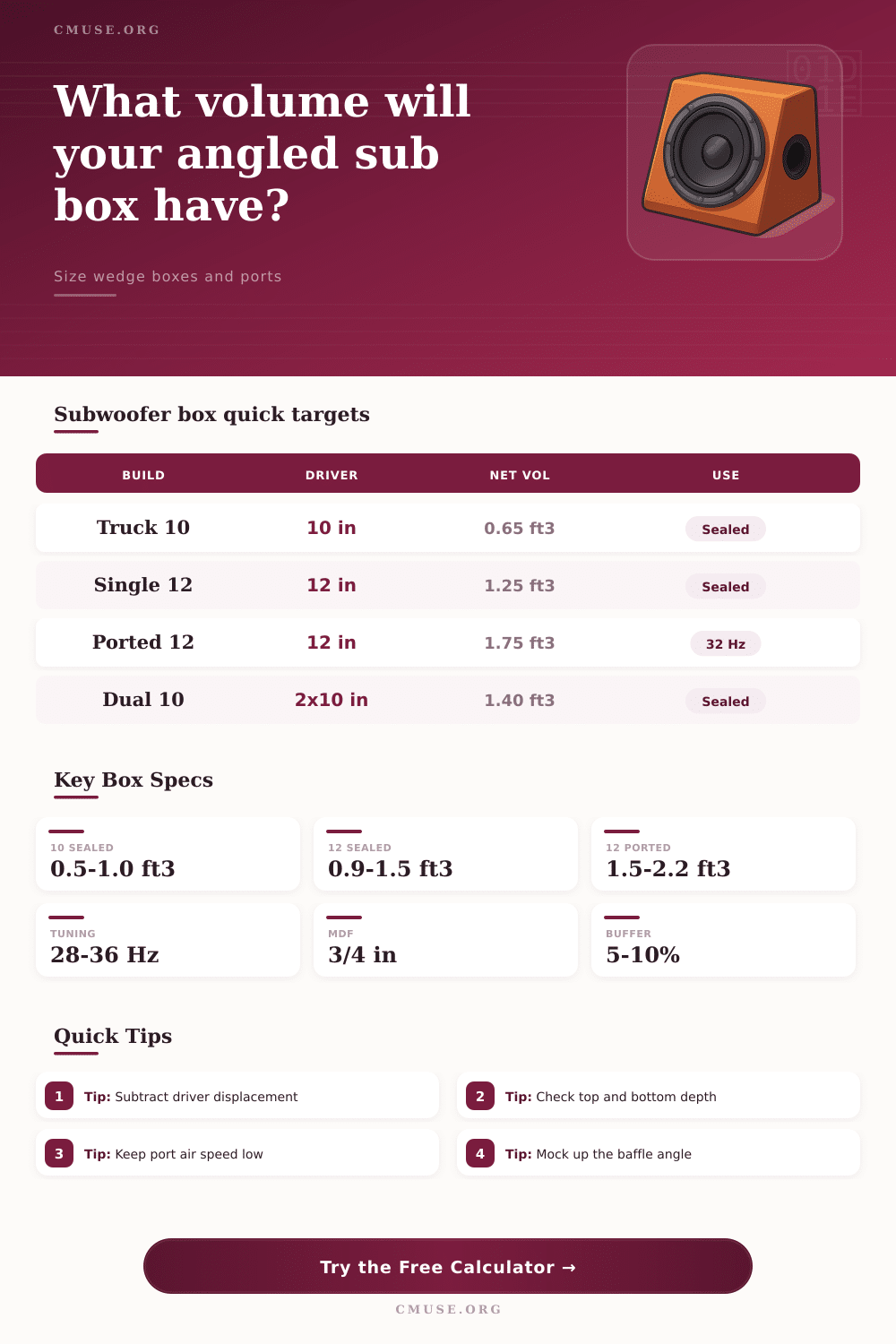
| 10 inch | 0.50-1.00 ft³ / 14-28 L | 1.00-1.50 ft³ / 28-42 L | 32-38 Hz |
| 12 inch | 0.90-1.50 ft³ / 25-42 L | 1.50-2.25 ft³ / 42-64 L | 30-36 Hz |
| 15 inch | 1.75-3.00 ft³ / 50-85 L | 3.00-4.50 ft³ / 85-127 L | 28-34 Hz |
| 18 inch | 3.50-5.50 ft³ / 99-156 L | 5.00-8.00 ft³ / 142-227 L | 26-32 Hz |
📏 Angled Fit Reference
| Vehicle / Space | Typical Wedge Angle | Depth Pattern | Fit Priority |
|---|---|---|---|
| Regular cab truck | 12-22 deg | Very shallow top, deeper floor | Magnet clearance and seat travel |
| Extended cab rear wall | 8-18 deg | Moderate top depth | Width across cab and terminal cup clearance |
| Hatchback cargo slope | 10-25 deg | Back follows seat rake | Rear hatch swing and baffle aim |
| Sedan trunk seatback | 6-16 deg | Large bottom depth | Trunk opening and enclosure height |
| Under-seat compact build | 18-35 deg | Short height, uneven depth | Subwoofer mounting depth |
🌬 Port Area and Length Checks
| Driver Setup | Practical Port Area | Usual Round Port | Design Note |
|---|---|---|---|
| Single 8 inch | 6-10 in² | One 3 in tube | Short boxes may need higher tuning |
| Single 10 inch | 10-16 in² | One 3-4 in tube | Check vent length against top depth |
| Single 12 inch | 16-28 in² | One 4 in tube | Slot ports often package better |
| Single 15 inch | 28-45 in² | Two 4 in tubes | Long ports remove meaningful volume |
| Dual 12 inch | 32-56 in² | Two 4 in tubes | Brace the shared baffle heavily |
🚗 Common Angled Box Project Sizes
| Project | External Dimensions | Target Net Volume | Secondary Spec |
|---|---|---|---|
| Truck single 10 sealed | 20 W x 14 H x 5/9 D in | 0.65 ft³ / 18 L | Approx. 16 deg baffle |
| Behind-seat slim 12 | 24 W x 15 H x 5.5/10 D in | 0.95 ft³ / 27 L | Needs shallow basket |
| Hatchback angled 12 | 28 W x 16 H x 8/13 D in | 1.25 ft³ / 35 L | Seatback-friendly rake |
| Ported 12 round vent | 30 W x 17 H x 10/16 D in | 1.75 ft³ / 50 L | 32 Hz target tuning |
| Dual 12 slanted trunk | 38 W x 17 H x 8/14 D in | 2.40 ft³ / 68 L | Shared chamber sealed |
A wedge enclosure for subwoofers is specificaly design to fit into the area of vehicles that dont have the standard ninety-degree angle. Many vehicles has seats that have a slant to them, as well as the back walls of the vehicles can also be slanted. A wedge enclosure is use to take advantage of the available space in the vehicle for the subwoofer, while at the same time allowing for the passengers to maintain their normal legroom and the drivers to maintain their driving view out of the vehicle.
Calculating the volume of a wedge enclosure for a subwoofer is more difficult then in a rectangular enclosure for a subwoofer. The main reason for the difficulty is that the side of a wedge enclosure are angled, creating a trapezoidal volume with the enclosure. To calculate the volume of a wedge enclosure, you must calculate the average depth between the shallowest depth of the wedge enclosure (at the top of the wedge) and the deepest depth of the wedge enclosure (at the floor of the wedge).
How to Build a Wedge Enclosure for a Car Subwoofer
If you dont calculate the average depth, the volume of the wedge enclosure can end up being incorrect; if the volume is incorrect, the wedge enclosure may not have the correct amount of space for the subwoofer, whether it is too small or too larger. Another factor in the construction of a wedge enclosure for a subwoofer is the concept of displacement. Displacement is the amount of space that object inside of the enclosure take up.
For wedge enclosures for subwoofers, the subwoofer itself take up space within the wedge, as does the port within the wedge enclosure, and the wood bracing within the wedge enclosure also takes up some of the internal volume of the wedge. You must subtract each of these displacement from the gross internal volume of the wedge to determine the net internal volume of the wedge enclosure. If these displacement are not accounted for, the net internal volume will be less than the target net internal volume of the wedge enclosure, which will impact the way in which the subwoofer tuned for that wedge enclosure will perform.
Another decision that you must make in the construction of a wedge enclosure is whether the wedge enclosure will be a sealed wedge enclosure or a ported wedge enclosure. Ported wedge enclosures can allow the subwoofer to move more air and create more sound output then a sealed wedge enclosure. However, the sealed wedge enclosure can be easier to build into the spaces within a vehicle.
Furthermore, sealed wedge enclosures do not require a long port to the subwoofer to allow for air movement, which can also make it easier to build into the available space within a vehicle. The sealed wedge enclosure will tend to produce a more “ tight” and musical sound from the subwoofer, while the ported wedge enclosure may produce slightly more bass. However, the sound quality may suffer if the port within the wedge enclosure is in contact with the slanted walls of the vehicle.
Another factor to consider in the construction of a wedge enclosure is the baffle angle of the wedge enclosure and the mounting depth of the subwoofer. The baffle angle is the angle of the sides of the wedge enclosure. The mounting depth of the subwoofer is the distance from the front of the subwoofer to the back of the magnet of the subwoofer.
If the wedge enclosure is too shallow, the magnet of the subwoofer may make contact with the back wall of the vehicle. Thus, it is important to ensure that the mounting depth of the subwoofer is less than or equal to the available space within the wedge enclosure. If the mounting depth of the subwoofer is too great in comparison to the wedge enclosure, the subwoofer will not fit within the wedge enclosure.
When cutting the wood for a wedge enclosure, allowance must be made for the thickness of the saw blade, as well as for any inaccuracy in measuring the dimensions of the wood. It is necessary to use a cutting buffer in constructing the wedge enclosure to allow for the thickness of the saw blade; if you plan the dimensions of the wedge enclosure for the wood after the saw blade thickness is deducted from the dimensions, it may be impossible to cut the wood to the dimensions required to build the wedge enclosure. Thus, the person can build the wedge enclosure according to the dimensions calculated in constructing the wedge enclosure.
Furthermore, it is also possible to refer to tables that contain the dimensions and the net internal volumes of various wedge enclosures of different dimensions. If the net internal volume of the wedge enclosure calculated by the individual is very different from the reference tables of net internal volumes of wedge enclosures of certain dimensions, it will be necessary to adjust the external dimensions of the wedge enclosure prior to cutting the wood. The construction of a wedge enclosure requires that the individual plan for the displacement of the components of the wedge enclosure, as well as for the angle of the baffle.
If the individual constructing the wedge enclosure plans for these two aspect of construction, the wedge enclosure will have the correct amount of net internal volume. If the wedge enclosure has the correct amount of net internal volume, the subwoofer will perform according to the specification of the subwoofer.