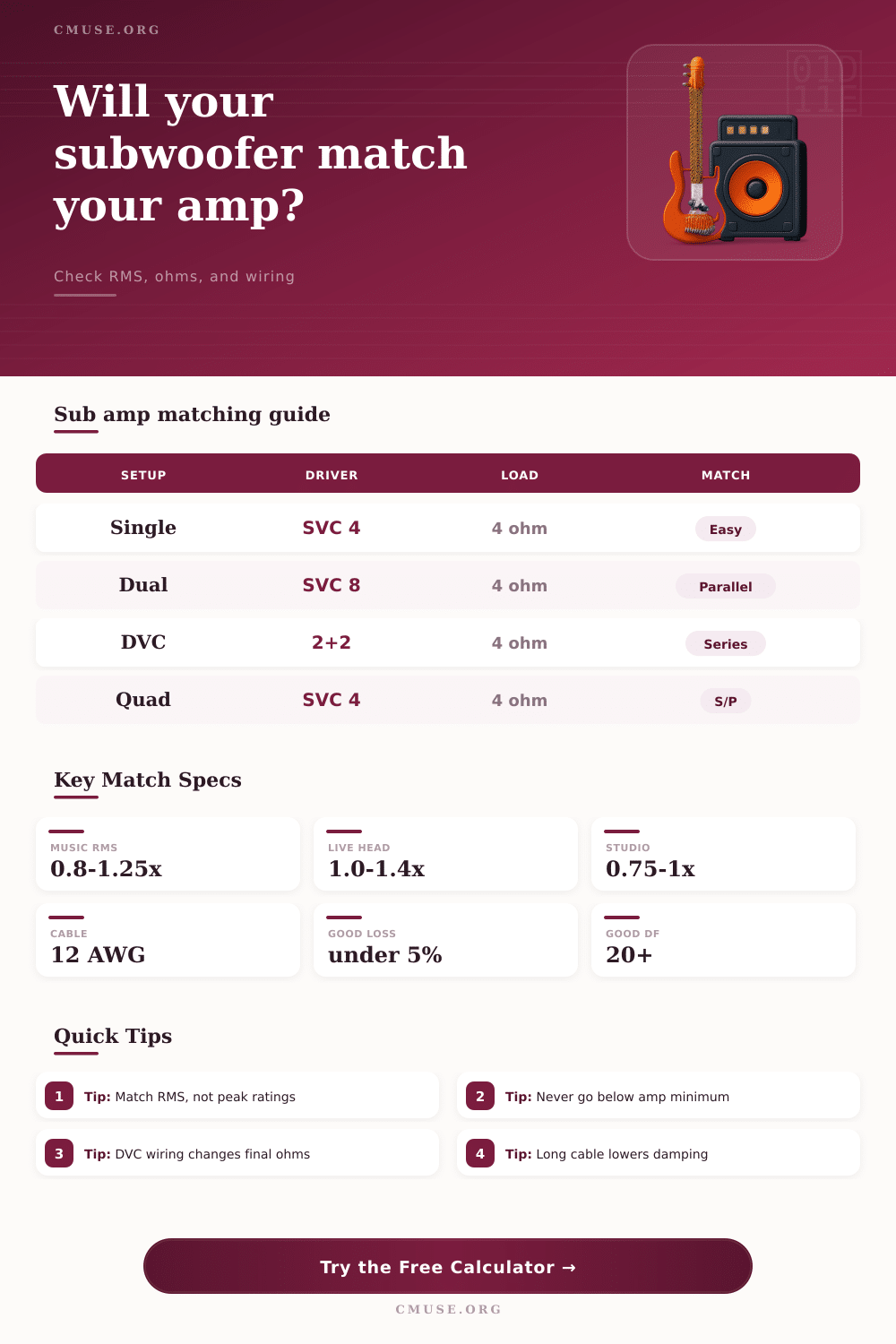
Match Subwoofer to Amp Calculator
Check subwoofer impedance, RMS power match, amplifier stability, cable loss, current draw, and damping factor before pairing a sub with an amp.
🔊 Real-World Matching Presets
🎛 Subwoofer and Amplifier Inputs
📊 Spec Comparison Grid
📐 RMS Headroom Reference
| Use Profile | Typical Amp RMS vs Sub RMS | Best For | Watch Point |
|---|---|---|---|
| Studio monitoring | 75-100% | Nearfield subwoofers, controlled level checks | Prioritize low noise and limiter accuracy |
| Music playback / DJ | 80-125% | Full-range music with moderate crest factor | Keep clipping lights off during bass-heavy tracks |
| Home theater LFE | 85-130% | Movie effects with short bursts and calibration | Room correction can add heavy low-band boost |
| Live sound with limiter | 100-140% | PA subs with DSP limiting and high crest peaks | Limiter threshold must protect the driver |
| Car audio SPL | 120-160% | Short demonstrations and high-output systems | Heat, voltage sag, and excursion limits matter |
🔗 Subwoofer Wiring Load Table
| Driver Setup | Wiring Method | Final Load Formula | Example Result |
|---|---|---|---|
| One SVC driver | Direct | Z final = Z driver | One 4 ohm sub = 4 ohms |
| One DVC driver | Coils in series | Z driver = coil + coil | DVC 2+2 = 4 ohms |
| One DVC driver | Coils in parallel | Z driver = coil / 2 | DVC 4+4 = 2 ohms |
| Two equal drivers | All parallel | Z final = Z driver / count | Two 8 ohm subs = 4 ohms |
| Two equal drivers | All series | Z final = Z driver x count | Two 4 ohm subs = 8 ohms |
| Four equal drivers | Series-parallel | Z final = 4 x Z driver / count | Four 4 ohm subs = 4 ohms |
⚡ Current and Cable Reference
| Output Power | Load | Speaker Current | Useful Cable Target |
|---|---|---|---|
| 300 W | 8 ohms | 6.1 A RMS | 14 AWG is usually comfortable for short runs |
| 600 W | 4 ohms | 12.2 A RMS | 12 AWG keeps loss modest on typical stage runs |
| 1000 W | 2 ohms | 22.4 A RMS | 10 AWG or shorter runs help preserve damping |
| 2000 W | 1 ohm | 44.7 A RMS | 8 AWG and stable amp design become important |
🎚 Common Sub/Amp Pairing Examples
| Scenario | Subwoofer Load | Sub RMS Total | Practical Amp Target |
|---|---|---|---|
| Single home theater sub driver | 4 ohms | 300-600 W | RMS close to driver rating with limiter or plate amp controls |
| Two passive PA subs per channel | 4 ohms from two 8 ohm boxes | 800-1600 W | Enough RMS for both boxes without dropping below amp minimum |
| DVC car sub daily system | 2 or 4 ohms depending on coils | 500-1200 W | Stable mono amp with electrical headroom and clean gain setting |
| Four club subwoofers | Series-parallel for target load | 2000-4000 W | Separate channels or DSP-limited amp channels for thermal control |
Matching an amplifier to a subwoofer require an understanding of the impedance and power rating of each device. The impedance and power ratings of an amplifier and a subwoofer will determine in what way the two devices will function together. Many people who are attempting to match an amplifier to a subwoofer will think that matching a 500-watt subwoofer to a 500-watt amplifier is a sufficient match.
However, this is typically an incorrect assumption. An amplifier must be able to manage the electrical resistance that a subwoofer will present to it; this electrical resistance is known as impedance. Impedance is the electrical resistance that an amplifier create when it attempts to push electrical current into a subwoofer.
How to Match an Amplifier to a Subwoofer
Subwoofers typically have a nominal impedance value, which is typically measured in ohm. The impedance of a subwoofer can change with the changing frequency of the sound that the player plays through the subwoozer. If a person wires a subwoofer in a way that creates an impedance value that is lower than the minimum impedance that the amplifier can handle, the amplifier will attempt to push more current through the subwoofer than its internal component can handle.
As a result, the amplifier will overheat. An amplifier that overheats may automatically shift into a protection mode to prevent damage to itself. If a person use subwoofers that have dual voice coils, the person can change the impedance by wiring those subwoofers in different way.
If the dual voice coil subwoofers are wired in series, the impedance created by the subwoofers will increase. However, if the person wires the dual voice coil subwoofers in parallel, the impedance will decrease. If more than one subwoofer is added to the system, the impedance will change in the same way, but the change will be compounded.
The impedance can become very low if subwoofers are wired in a parallel configuration. It can also become very high if the subwoofers are wired in series. Subwoofers can be wired in any number of way, but the final impedance that the system creates will determine whether the amplifier efficiently recieve power from the subwoofers or whether it struggle to supply that power to the subwoofers.
Another factor to consider in matching amplifiers to subwoofers is the power ratings of the devices. The manufacturer of those products often describes the power of both amplifiers and subwoofers in a variety of different ways. The power of a subwoofer can be rated in terms of its peak power, maximum power, and RMS power.
Peak power and maximum power indicate the power that the subwoofer can handle for very short period of time. RMS power, on the other hand, indicates the power that the subwoofer can handle over long periods of time. For this reason, the RMS power of the amplifier should be matched to the RMS power of the subwoofer.
In addition, it is typically safer to use an amplifier whose RMS power ratings are higher than those of the subwoofer. This is because if an amplifier does not have enough power to fully operate the subwoofer, it can lead to clipping of the signal that is being sent to the subwoofer. Clipping of the signal will create heat in the subwoofer, which can lead to the destruction of the voice coil of that subwoofer.
The requirement for headroom, or the difference between the power ratings of the amplifier and subwoofer, depend upon the specific use to which the audio system is to be put. For instance, if a person is to use the audio system in a home theater, it may not require as much headroom as a system that will be used for live sound system that must run for many hour over time. The specific needs of each system will determine the thermal requirement of the subwoofers.
In addition to the requirements for headroom, the quality of the speaker cables that connect the amplifier to the subwoofer should also be considered. Poor quality speaker cables can add to the electrical resistance in the system. If the speaker cables add too much resistance to the system, they may limit the amount of power that reaches the subwoofer.
This can reduce the damping factor of the system. The damping factor is the ability of the amplifier to control the movement of the cone of the subwoofer. In order to create a successful audio system that connects an amplifier to a subwoofer, it is important that the total impedance of the system is stable and that the power ratings of each device are aligned with the power ratings of the other device.
A calculator that determines the total impedance and power ratings of a system can help ensure that the impedance of the system remains above the minimum threshold required by the amplifier. By ensuring that both the impedance and the power level of the system are stable and within an appropriate range, you can significantly reduce the risk of overheating the amplifier or damaging the subwoofer. By following these step, it is possible to ensure that the amplifier and the subwoofer will work together in a sustainable manner.