Subwoofer Port Area Calculator
Estimate vent area, per-port diameter, slot dimensions, air-speed margin, and tuning length for a bass-reflex subwoofer enclosure.
🔊Build Presets
⚙Port Area Inputs
📏Port Style Spec Grid
📊Port Velocity Reference
| Peak Speed | Mach at 20°C | Typical Use | Design Note |
|---|---|---|---|
| Under 17 m/s | Under 0.05 | Studio and hi-fi | Lowest audible vent noise target |
| 17-22 m/s | 0.05-0.06 | Home theater and daily music | Good balance for normal playback |
| 22-28 m/s | 0.06-0.08 | Loud systems with flares | Check flare radius and port clearance |
| Over 28 m/s | Over 0.08 | SPL-focused checks | Model carefully; chuffing risk rises |
📝Area Per Box Volume Reference
| Port Type | Starting Area | Metric Equivalent | Best Fit |
|---|---|---|---|
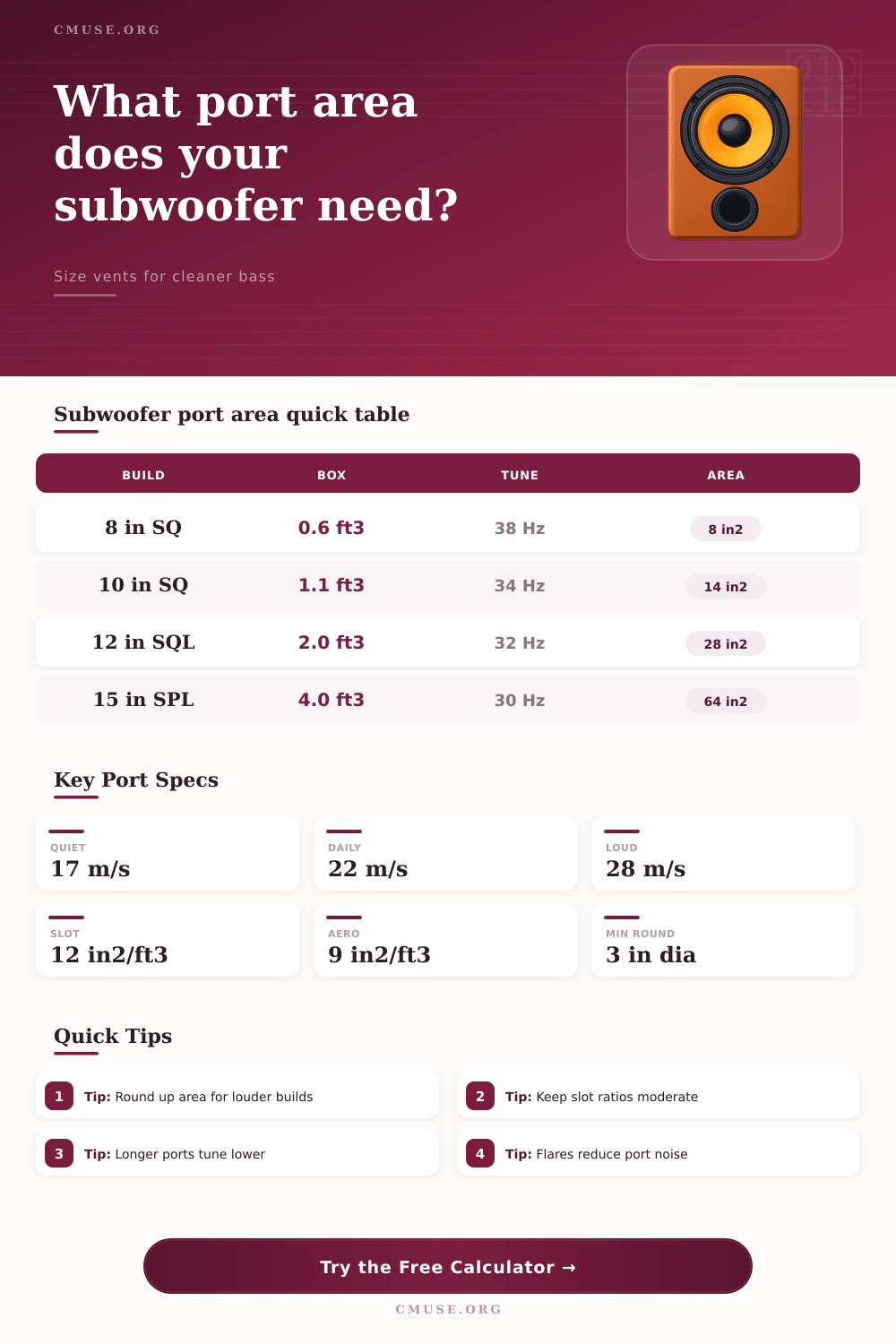
| Single flared aero | 8-10 in²/ft³ | 114-143 cm²/100 L | Compact boxes with rounded ends |
| Straight round tube | 9-12 in²/ft³ | 129-171 cm²/100 L | Moderate output, simple cutting |
| Rectangular slot | 12-16 in²/ft³ | 171-229 cm²/100 L | Large shared wall vents |
| High-output slot | 16-20 in²/ft³ | 229-286 cm²/100 L | Long throw drivers and loud tuning |
⚖Port Style Comparison Grid
| Style | Area Adjustment | Length Behavior | Recommendation |
|---|---|---|---|
| Flared aero | Allows about 10% less area | Often shortest for same noise target | Use when round cutouts and flares fit |
| Straight round | Baseline area plus small margin | Predictable and easy to replace | Keep diameter large enough per port |
| Slot port | Add about 15% more area | Can become long as area rises | Keep height-to-width ratio under 1:8 |
| Kerfed slot | Add about 10% more area | Bends need centerline length | Good for large boxes with smooth turns |
🎶Common Subwoofer Box Examples
| Example Build | Driver and Box | Tune | Typical Port Area |
|---|---|---|---|
| Compact 8 in | 8 in, 0.55-0.75 ft³ | 36-40 Hz | 7-10 in² total |
| Balanced 10 in | 10 in, 1.0-1.3 ft³ | 32-36 Hz | 12-18 in² total |
| Daily 12 in | 12 in, 1.6-2.4 ft³ | 30-34 Hz | 24-36 in² total |
| Loud 15 in | 15 in, 3.2-4.8 ft³ | 28-33 Hz | 45-75 in² total |
| Theater 18 in | 18 in, 5.0-8.0 ft³ | 20-28 Hz | 65-120 in² total |
🔢Equivalent Round Port Diameter Table
| Total Area | One Round Port | Two Round Ports | Metric Area |
|---|---|---|---|
| 12 in² | 3.91 in dia | 2.76 in each | 77 cm² |
| 24 in² | 5.53 in dia | 3.91 in each | 155 cm² |
| 36 in² | 6.77 in dia | 4.79 in each | 232 cm² |
| 48 in² | 7.82 in dia | 5.53 in each | 310 cm² |
| 72 in² | 9.57 in dia | 6.77 in each | 465 cm² |
Port chuffing occurs when air pass through a subwoofer port at a velocity that is too high for the size of the port. Port chuffing create a whistling noise in the subwoofer because the air are moving too quick through the port. To avoid port chuffing, ensure the area of the port is large enough to allow the air to move through the subwoofer smoothy.
The goal of creating a port is to allow the subwoofer to have a specific tuning frequency while avoiding chuffing noise. To calculate the area of the port, consider the physics of the air movement and the physical space within the subwoofer box. If the port is too small for the subwoofer box, the air will move too fast through the port, creating chuffing noise.
Avoid port chuffing by choosing the right port size and length
However, if the port is too large, then the large port will take up most of the subwoofer box, preventing the air from adequately filling the box. Many people that design subwoofer boxes guess at the proper size for the port. Guessing at the size for the port can create either a noisy subwoofer, or a port that is to long to fit within the subwoofer box.
The area of the port are related to the excursion of the driver of the subwoofer. The excursion is the distance that the cone of the driver move in and out of the subwoofer box. If the excursion of the driver is high, then a large amount of air will move in and out of the subwoofer box.
Therefore, if the driver has high excursion, a larger area for the port is required to allow for movement of the air. If high excursion drivers is used, the designer must account for the high excursion in the design of the subwoofer box. A calculator that consider the specifications of the driver can calculate the area of the port, eliminating the need to calculate the fluid dynamics of the air movement in the subwoofer.
The style of the port can impact the area of the port that is required for the subwoofer box. The most common type of port is a round tube. Flared aero port use flares to allow for the smooth transition of air moving through the port.
Because the flares allow for the smooth transition of the air, the port chuffing creates less noise. For these reasons, a flared aero port can have a slightly smaller area than a round tube port. Slot ports are a different style of port from those that use round or flared tubes.
Slot ports are built into the walls of the subwoofer box. Slot ports are often rectangular in shape, and rectangular slot ports can experience turbulence near the corners of the slot port. Because slot ports is more likely to experience turbulence, the area of slot ports should be larger than round or flared ports.
Additionally, the height and width of slot ports should be monitored, as using too narrow a slot port will restrict the movement of air through the subwoofer. The tuning frequency is related to the length of the port, but the length of the port is also related to the area of the port. If the area of the port is increased to avoid port chuffing, the designer must also increase the length of the port to maintain the tuning frequency of the subwoofer.
Many subwoofer box designer will increase the area of the port to even out the air movement within the subwoofer box, but will often forget to increase the length of the port. Such a modification will lower the tuning frequency of the subwoofer. The area and length of the port must both be modified to ensure that the tuning frequency of the subwoofer is not affect.
Air velocity is one of the measurements for the speed at which air move through the port. Air velocity can be used to determine if the subwoofer will create noise. High air velocities will create chuffing noise through the port.
Therefore, if air velocity measurement find that the air velocity within the subwoofer box is high, the area of the port must be increased to even out the air movement through the subwoofer box. This method of even out the air movement in the subwoofer box is a safe means of preventing the subwoofer from creating whistling noise. In building a subwoofer box, some compromises must be made between the various design considerations of the subwoofer box.
For instance, the ideal type of port for the subwoofer box may not be able to physically fit within the vehicle in which the subwoofer box will be used. In such cases, you can raise the tuning frequency of the subwoofer, you can shrink the box itself in size, or you can add a second port to the subwoofer. Each of these change will impact the design of the subwoofer in some way.
The goal of adjusting the area of the port and the length of the port in relationship to one another is to allow the speed of the air movement within the subwoofer box to match the movement of the driver of the subwoofer, preventing the subwoofer box from creating wind noise.