Subwoofer Polyfill Calculator
Estimate loose fill weight, packing density, displacement-adjusted box volume, and apparent acoustic volume for sealed, ported, passive radiator, and bandpass subwoofer enclosures.
🔊 Quick Subwoofer Presets
🎛 Box and Fill Inputs
🧵 Fill Material Spec Comparison
📊 Reference Tables
| Fill Strategy | Typical Density | Metric Density | Best Use |
|---|---|---|---|
| Wall lining only | 0.25 lb/ft³ | 4.0 kg/m³ | Ported walls, bandpass chambers, reflection control |
| Light loose fill | 0.50 lb/ft³ | 8.0 kg/m³ | Passive radiators, shallow boxes, first listening pass |
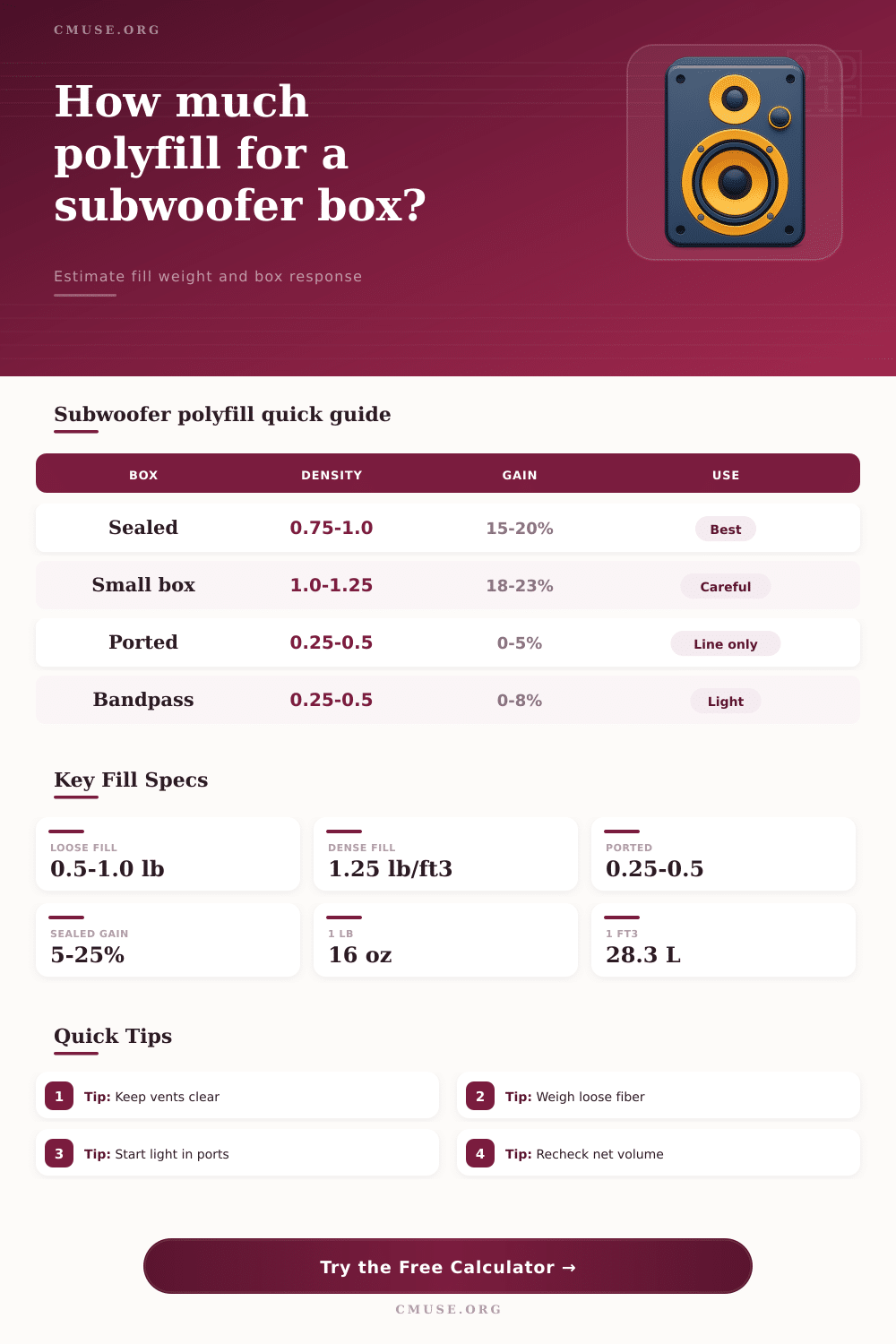
| Moderate sealed fill | 0.75 lb/ft³ | 12.0 kg/m³ | Most sealed subwoofer cabinets |
| Full sealed stuffing | 1.00 lb/ft³ | 16.0 kg/m³ | Sealed boxes needing more apparent volume |
| Dense small-box stuffing | 1.25 lb/ft³ | 20.0 kg/m³ | Undersized sealed boxes with careful listening checks |
| Enclosure Type | Safe Fill Range | Apparent Volume Effect | Important Guardrail |
|---|---|---|---|
| Sealed | 0.50-1.25 lb/ft³ | About 5-25% | Do not pack so tightly that the cone back is loaded unevenly |
| Small sealed | 0.75-1.50 lb/ft³ | About 10-25% | Verify excursion and tone after adding dense fill |
| Ported | 0.10-0.50 lb/ft³ | Usually 0-5% | Keep fiber away from slot vents, flares, and tuning pipes |
| Passive radiator | 0.25-0.75 lb/ft³ | About 0-10% | Leave passive cone and spider area unobstructed |
| Bandpass | 0.10-0.50 lb/ft³ | About 0-8% | Treat only the chamber intended for damping |
| Common Subwoofer Box | Net Volume | Moderate Fill | Full Fill |
|---|---|---|---|
| Compact 8 in sealed | 0.35 ft³ / 9.9 L | 0.26 lb / 0.12 kg | 0.35 lb / 0.16 kg |
| Car 10 in sealed | 0.65 ft³ / 18.4 L | 0.49 lb / 0.22 kg | 0.65 lb / 0.29 kg |
| Home 12 in sealed | 1.15 ft³ / 32.6 L | 0.86 lb / 0.39 kg | 1.15 lb / 0.52 kg |
| Large 15 in sealed | 2.25 ft³ / 63.7 L | 1.69 lb / 0.77 kg | 2.25 lb / 1.02 kg |
| Daily 12 in ported | 1.60 ft³ / 45.3 L | Line only | Avoid full fill |
| Material Type | Calculator Factor | Handling Note | Use Case |
|---|---|---|---|
| Loose polyester fiberfill | 1.00 mass factor | Fluff evenly and weigh before placing | General sealed subwoofer damping |
| Polyester batting sheets | 1.08 mass factor | Staple or glue to walls when lining | Ported walls and removable panels |
| Dacron acoustic batting | 1.02 mass factor | Good wall coverage with tidy edges | Vented or bandpass chambers |
| Long-fiber wool blend | 0.85 mass factor | Higher absorption per loose mass | Compact sealed hi-fi boxes |
| Recycled cotton or denim mat | 1.15 mass factor | Works more like lining than loose fill | Large panels and shallow cabinets |
| Open-cell acoustic foam lining | 1.30 mass factor | Use as lining, not as loose stuffing | Reflection control near walls |
| Displacement Item | Typical Imperial | Typical Metric | Calculator Use |
|---|---|---|---|
| 8 in subwoofer driver | 0.02-0.05 ft³ | 0.6-1.4 L | Add to driver and brace displacement |
| 10 in subwoofer driver | 0.04-0.08 ft³ | 1.1-2.3 L | Add to driver and brace displacement |
| 12 in subwoofer driver | 0.07-0.14 ft³ | 2.0-4.0 L | Add to driver and brace displacement |
| 15 in subwoofer driver | 0.12-0.25 ft³ | 3.4-7.1 L | Add to driver and brace displacement |
| Round or slot port | 0.03-0.25 ft³ | 0.8-7.1 L | Add to port or passive displacement |
If you find that the bass from your subwoofer is sounding too tight, you can use polyester fiberfill to treat the subwoofer box. The fiberfill will not change the dimensions of the subwoofer box. However, it will make the subwoofer sound as though it is operating within a subwoofer box that is larger than the physical dimensions of the box.
This method allows you to even further tune your subwoofer without having to rebuild the subwoofer box itself. Polyester fiberfill work in that when sound waves hit the walls of the subwoofer box, they reflect off of the walls and immediately return to the subwoofers vibrating cone. If you fill the subwoofer box with polyester fiberfill, the sound waves has to travel through the fibers.
How to Use Polyester Fiberfill in a Subwoofer Box
This slows the sound waves and absorbs some of the sound energy. By slowing the movement of the sound waves, the subwoofer will act as if it has more volume than the physical dimensions of the subwoofer box allow. The amount of polyester fiberfill that you use is important.
Using too much fiberfill will make the bass sounds thin. If you stuff the subwoofer box too densely with the polyester fiberfill, you will overdamp the subwoofer boxs driver. Overdamping the subwoofer box driver will result in a loss of sound dynamics from the subwoofer.
You can use a calculator that takes into account the dimensions of the subwoofer box as well as the materials that you will use to stuff the subwoofer box to calculate the amount of polyester fiberfill that you should use. This will ensure that you dont have to guess at how much polyester fiberfill to use in your subwoofer box. When calculating the amount of polyester fiberfill for your subwoofer box, you must account for the displacement of the subwoofer boxs components.
The gross internal volume of the subwoofer box is the total internal volume of the empty wooden subwoofer box shell. However, if you take into account the space that the subwoofer, the bracing for the subwoofer, and the port tube for the subwoofer take up, you get the net internal volume of the subwoofer box. The internal volume of the subwoofer box is a calculation that takes into account the amount of air that the subwoofer box can contain.
If you do not account for the displacement by the subwoofer and hardware, you will use the wrong amount of polyester fiberfill for the subwoofer box. The type of material that you use inside the subwoofer box will change the acoustic properties of the subwoofer. For sealed subwoofer boxes, the most common material that people use is loose polyester.
However, other materials, such as batting sheet and acoustic foam, have different acoustic properties different than loose polyester fiberfill. For instance, you can use acoustic foam in a sealed subwoofer box to stop the formation of standing waves along the walls of the subwoofer box. However, acoustic foam does not have the same effect on increasing the apparent volume of the subwoofer box as does loose polyester fiberfill.
Because a pound of wool will have a different acoustic effect within the subwoofer box than a pound of synthetic polyester fiberfill, the calculation tool will have different factors relating to the mass of the material that the user will use in the subwoofer box. For ported subwoofer boxes, the rules for stuffing the subwoofer box with polyester fiberfill are different than those that apply to sealed subwoofer boxes. You should not stuff a ported subwoofer box in the same way that you stuff a sealed subwoofer box.
Stuffing the ported subwoofer box with polyester fiberfill will ruin the tuning of the subwoofer box. All that you should of do with a ported subwoofer box is add a light lining of polyester fiberfill to the interior walls of the subwoofer box to stop the reflections of sound wave that bounce within the subwoofer box. Even with the addition of polyester fiberfill to a ported subwoofer box, the gains in sound quality will be minimal compared to the gains in sound quality that you can achieve by stuffing a sealed subwoofer box with polyester fiberfill.
You can use polyester fiberfill to treat your subwoofer with incremental attempts at adding the fiberfill. Start with a moderate amount of polyester fiberfill and play a known track with strong bass characteristic. Listen for the difference in sound quality.
If the bass is still sounding too tight, add more polyester fiberfill. However, do not add more polyester fiberfill if the bass begins to sound muddy or if the bass notes from the music no longer have the same punch as they did before you started adding the polyester fiberfill. The use of polyester fiberfill allows you to even further tune your subwoofer to your liking.
Youll find that the results are actualy very good.