Subwoofer Power Calculator
Estimate amplifier watts, per-sub load, voltage, and current from listening distance, room volume, SPL target, sensitivity, sub count, placement, impedance, and headroom.
🔊 Subwoofer Presets
⚙ Power Inputs
📊 Subwoofer Power Rules
🎚 Sensitivity and Wattage Reference
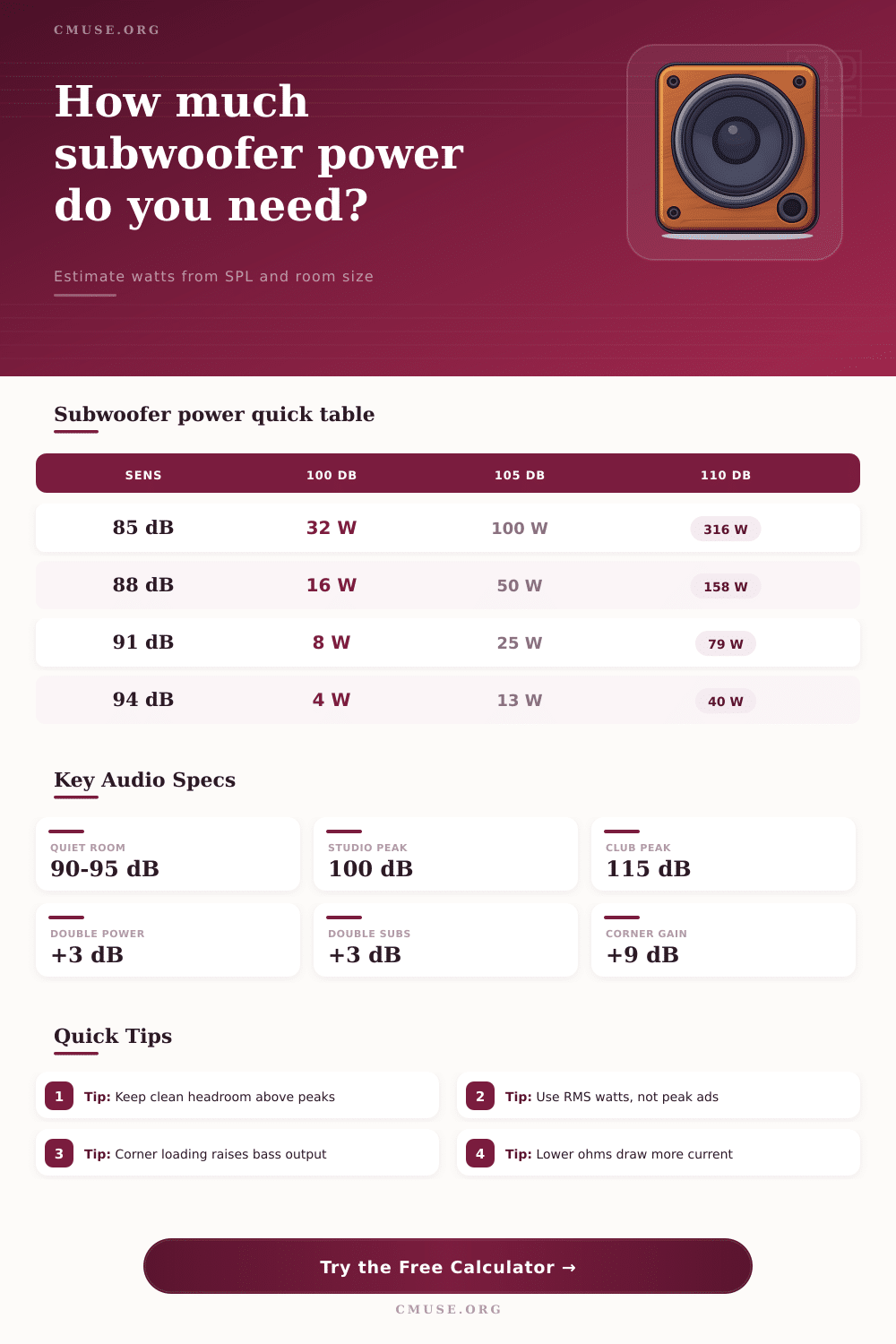
| Sub Sensitivity | 100 dB at 1m | 105 dB at 1m | 110 dB at 1m |
|---|---|---|---|
| 85 dB @ 1W/1m | 32 W | 100 W | 316 W |
| 88 dB @ 1W/1m | 16 W | 50 W | 158 W |
| 91 dB @ 1W/1m | 8 W | 25 W | 79 W |
| 94 dB @ 1W/1m | 4 W | 13 W | 40 W |
🏛 Room Volume Gain Assumptions
| Room Volume | Metric Volume | Low-Bass Gain Used | Typical Space |
|---|---|---|---|
| Under 1,200 ft³ | Under 34 m³ | +5 dB | Desk room or booth |
| 1,200-2,200 ft³ | 34-62 m³ | +3 dB | Bedroom studio |
| 2,200-4,000 ft³ | 62-113 m³ | +1.5 dB | Living room |
| Over 4,000 ft³ | Over 113 m³ | +0.5 dB | Open venue zone |
⚡ Electrical Load Table
| Power per Sub | 8 Ohm Load | 4 Ohm Load | 2 Ohm Load |
|---|---|---|---|
| 100 W RMS | 28.3 V / 3.5 A | 20.0 V / 5.0 A | 14.1 V / 7.1 A |
| 300 W RMS | 49.0 V / 6.1 A | 34.6 V / 8.7 A | 24.5 V / 12.2 A |
| 600 W RMS | 69.3 V / 8.7 A | 49.0 V / 12.2 A | 34.6 V / 17.3 A |
| 1000 W RMS | 89.4 V / 11.2 A | 63.2 V / 15.8 A | 44.7 V / 22.4 A |
🔍 Subwoofer Spec Comparison Grid
Sealed Box
Efficiency: Lower
Extension: Smooth rolloff
Power Need: Higher for deep bass
Best Fit: Tight studio monitoring
Ported Box
Efficiency: Higher near tune
Extension: Strong tuned output
Power Need: Moderate
Best Fit: Music rooms and cinema
Bandpass
Efficiency: High in passband
Extension: Narrower range
Power Need: Moderate to high
Best Fit: DJ impact bands
Horn Loaded
Efficiency: Very high
Extension: Size dependent
Power Need: Lower per dB
Best Fit: Stage and venue use
📏 Common Subwoofer Power Scenarios
| Scenario | Seat Distance | Peak SPL Target | Typical Headroom |
|---|---|---|---|
| Desk 2.1 monitoring | 3-5 ft / 0.9-1.5 m | 90-98 dB | 3 dB |
| Home studio nearfield | 6-8 ft / 1.8-2.4 m | 98-105 dB | 6 dB |
| Practice room bass support | 8-12 ft / 2.4-3.7 m | 100-110 dB | 6 dB |
| Small venue front fill | 15-25 ft / 4.6-7.6 m | 110-118 dB | 10 dB |
Matching an amplifier to a subwoofer requires an understanding of several different variable that relate to the power requirements of a subwoofer. Factors like the physics of the room in which the subwoofer is to be deployed, the efficiency of the subwoofer, and the amount of air that the subwoofer will need to move in order to create the desired sound will impact the amount of power that the amplifier supply. If the amplifier supplies too little power to the subwoofer, the bass output will be thin.
If the amplifier supplies too much power to the subwoofer, the amplifier may work beyond the physical limit of the subwoofer, which can lead to distortion or even a blown voice coil from the subwoofer. Wattage is a measurement of the potential of an amplifier to produce sound energy, not a measurement of the volume of that sound. The efficiency or sensitivity of a subwoofer is a measure of how much noise the subwoofer will produce with one watt of power at a distance of one meter.
How to Match an Amplifier to a Subwoofer
Subwoofers tend to lose some of their sound energy with distance. If the subwoofer is placed at three feet from the listener but the listener move to ten feet from the subwoofer, the amplifier has to work harder to produce the same amount of sound energy at the new distance. Thus, distance is a factor in subwoofer placement and power requirement.
The room in which the subwoofer is placed can also impact the sound that is produced. The room itself act as a musical instrument that amplifies the sound from the subwoofer. In small rooms, sound energy reflects off of the walls, which tend to boost the volume of sound that the subwoofer creates.
Because the volume is naturaly boosted within small rooms, less power is required to achieve high level of sound. In massive open rooms, there is no gain from sound reflecting off of the walls. Thus, more raw wattage has to be used to fill the massive open room with sound energy compared to a small room.
Another factor that can impact the power requirements of a subwoofer is the placement of the subwoofer itself. If placed into a corner, the sound will reflect off of the walls and the floor, which will boost the output of sound energy by the subwoofer. Because placement into a corner will boost the sound output, the amplifier can reduce the power requirements.
The downside to this placement is that the bass can sound boomy and lacking in precision, but the advantage is that the placement increases the sound output with less power from the amplifier. Headroom can also factor into the power relationship between the amplifier and the subwoofer. Headroom is an indicator of the amount of power that the amplifier can provide beyond the target sound level.
If the target levels of the subwoofer are 105 decibels yet the amplifier can only provide 105 decibels, the amplifier will be working at the limits of its headroom and may provide clipping at high volume. Clipping is a phenomenon that occurs when the amplifier is forced to produce high volumes beyond its capability. If an amplifier clips, its sound waves have square-edged waves rather than smooth curves.
These square-edged sound waves can rapidly overheat the voice coil of the subwoofer. Thus, headroom allow for the amplifier to provide high volumes without clipping. Technically, the impedance of a subwoofer is one more factor that must be consider in the matching of amplifier to subwoofer.
Impedance is a measurement of how much resistance there is in the subwoofer to the current from the amplifier. Impedance is measured in units of ohm. Impedances that are low indicate that the amplifier will require more current to the subwoofer.
More current place strain on the amplifier, even if the amplifier is rated to provide sufficient wattage to the subwoofer. Therefore, the voltage and current of the amplifier relative to the impedance of the subwoofer should be checked prior to connecting the two devices. Overall, an audio technician should establish a general understanding of the relationship between the amplifier and the subwoofer.
Matching an amplifier to a subwoofer requires an understanding of how the distance between the subwoofer and listener, the size of the room, headroom, placement of the subwoofer in that room, and the impedance of that subwoofer will impact its power requirements. By finding such a relationship, an audio technician can provide an amplifier and subwoofer that work together in a manner that provide sufficient volume yet dont permit the power to become destructive to the devices.