Subwoofer Placement Calculator
Estimate practical subwoofer positions, room mode pressure zones, crossover wavelength, and listening-seat risk from your room dimensions.
🎯 Room Presets
🔊 Placement Inputs
Placement Coordinates
Sub 1: 3.0 ft from front, 4.0 ft from left. Use the same offsets mirrored for matched dual placements.
Crossover Check
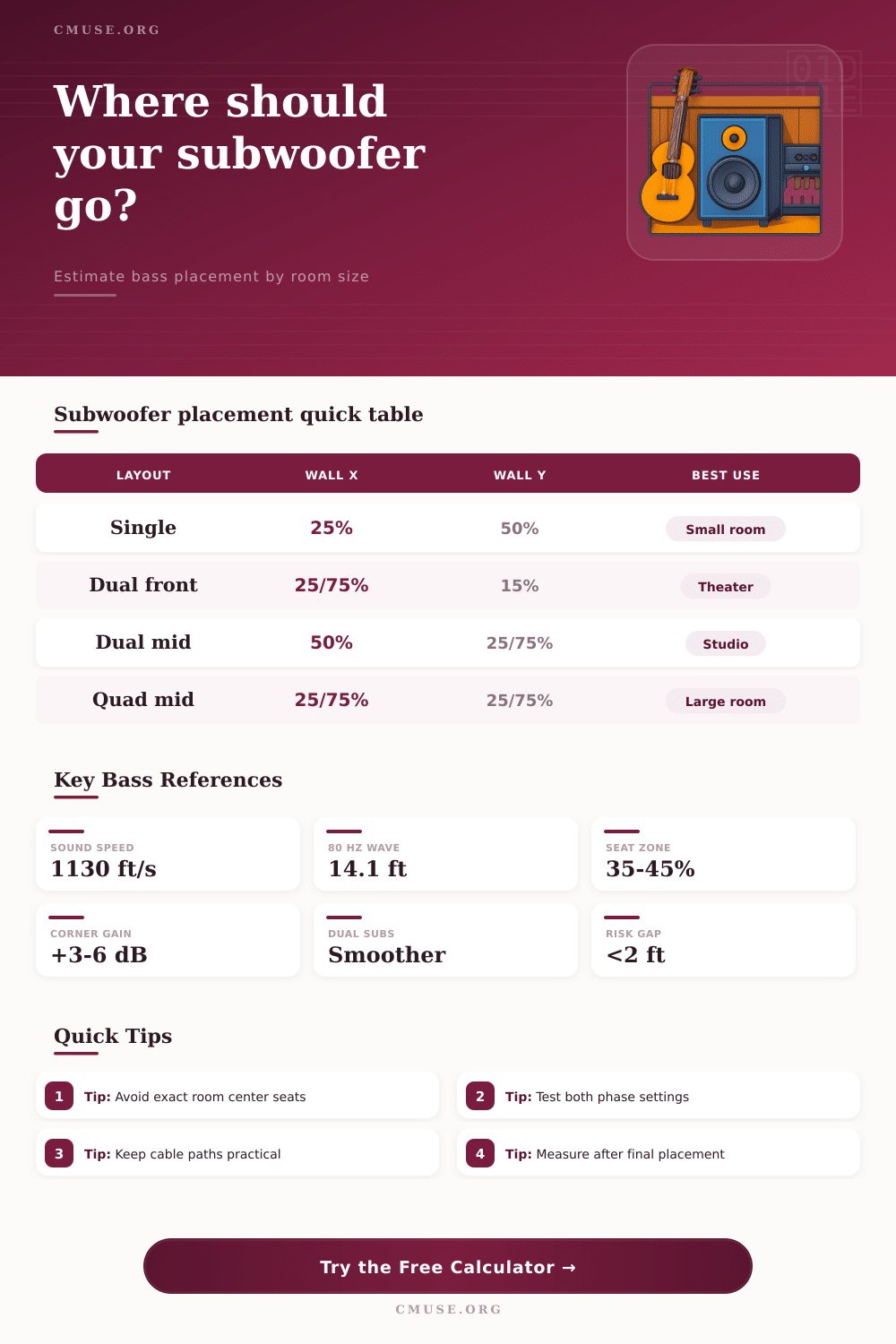
At 80 Hz, wavelength is 14.1 ft and quarter wavelength is 3.5 ft. Keep the main seat and sub alignment within the phase window where possible.
📏 Bass Reference Grid
📊 Placement Fraction Reference
| Subwoofer Layout | Length Position | Width Position | Typical Strength |
|---|---|---|---|
| Single front quarter | 15-25% from front | 25% or 75% width | Balanced first test point |
| Single front corner | 5-10% from front | 5-10% from side | Higher boundary output |
| Dual front quarter | 10-15% from front | 25% and 75% width | Smoother side-to-side bass |
| Dual side midpoints | 50% from front | 0% and 100% width | Strong width-mode control |
| Four wall midpoints | 0% and 100% length | 50% width plus side mids | Broad seat consistency |
🎛 Layout Comparison Grid
| Layout Type | Sub Count | Mode Control | Best Room Match |
|---|---|---|---|
| Corner loaded single | 1 | Low to moderate | Small rooms needing output |
| Front quarter single | 1 | Moderate | Studios and desks |
| Symmetric front pair | 2 | Moderate to high | Theater and mix rooms |
| Side midpoint pair | 2 | High width smoothing | Rectangular sealed rooms |
| Wall midpoint array | 4 | High multi-seat smoothing | Large rooms and control rooms |
🎵 Room Mode Reference
| Dimension | Formula | Example 12 ft | Placement Meaning |
|---|---|---|---|
| Length axial mode | 565 / length ft | 47.1 Hz | Front-back bass peaks |
| Width axial mode | 565 / width ft | 47.1 Hz | Left-right bass peaks |
| Height axial mode | 565 / height ft | 70.6 Hz at 8 ft | Floor-ceiling coupling |
| Second axial mode | 1130 / dimension ft | 94.2 Hz | Can affect crossover blend |
| Quarter wavelength | 282.5 / frequency | 3.5 ft at 80 Hz | Phase alignment distance |
📡 Crossover Wavelength Table
| Crossover | Full Wavelength | Quarter Wave | Placement Note |
|---|---|---|---|
| 60 Hz | 18.8 ft / 5.7 m | 4.7 ft / 1.4 m | More forgiving spacing |
| 70 Hz | 16.1 ft / 4.9 m | 4.0 ft / 1.2 m | Good for larger mains |
| 80 Hz | 14.1 ft / 4.3 m | 3.5 ft / 1.1 m | Common AV crossover |
| 100 Hz | 11.3 ft / 3.4 m | 2.8 ft / 0.9 m | Needs tighter alignment |
| 120 Hz | 9.4 ft / 2.9 m | 2.4 ft / 0.7 m | Sub position becomes easier to localize |
🏚 Common Room Size Table
| Room Type | Dimensions | Likely First Mode | Suggested Start |
|---|---|---|---|
| Bedroom studio | 10 x 12 x 8 ft | 47-71 Hz | Front quarter point |
| Project studio | 12 x 16 x 9 ft | 35-63 Hz | Dual front quarters |
| Practice room | 14 x 18 x 9 ft | 31-63 Hz | Single quarter or dual front |
| Control room | 15 x 22 x 10 ft | 26-57 Hz | Dual symmetric subs |
| Stage playback | 20 x 16 x 12 ft | 28-47 Hz | Four midpoint array |
Subwoofer placement is an process of managing the low frequency sound waves that is created by the subwoofer. Placing subwoofers are necessary in managing the low frequency sound waves due to the physical nature of those sound waves; low frequency sound waves are a physical phenomenon in that they tend to interact with the wall, the ceiling, and the floor of the room in which they are playing. These interact sound waves can cause the room to function in a manner similar to a musical instrument, which can further impact how the bass sound within that room.
Many people places there subwoofers in a location within the room in response to the placement of furniture within that room. Placing subwoofers in these location, however, often leads to issues with uneven bass within the room. Even bass level within the same corner of the room may even be even with one another, but sound levels may be different in different parts of the room.
How to Place a Subwoofer in a Room
This issue is caused by the formation of room modes, which is created when the sound waves that are reflected off the walls of the room interact with the incoming sound waves. These two intersecting sound waves may create massive peak in the volume of that reflected sound wave, or they may cancel each other out and create a dead zone in that reflected sound wave. These peaks and dead zone explain why the sound may be loud in one area of the room but quiet in another part of the same room.
Calculators allow people to calculate the pressure zone within a room, which avoids these peaks and dead zones. The dimension of a room will influence how standing wave of sound occur within the room. If a subwoofer is placed into the center of a room, it may lead to the formation of a massive null in the volume of sound at the listening position, especially if the dimensions of the room create such a null at that position.
However, by using percentage offset from the center of the room, these nulls can be avoided. By offsetting the placement of the subwoofer from the center of the room from the center line of those room dimensions, the room will not interfere with the subwoofer, thus creating more consistant sound from that subwoofer. Another consideration in the placement of subwoofers is the crossover frequency of the subwoofers.
The crossover frequency impact the sound that the listeners of the music system hear, especially the perception of where the bass is coming from. By using a higher crossover frequency, the wavelength of the bass produced by the subwoofers is shorter and the bass is more directionally. If the subwoofer is too far from the main speaker, though, the bass will not feel as connected to the music then desired.
Calculators can calculate the wavelength of the crossover frequency of the subwoofers, and provide a phase window within which the placement of the subwoofers will create the best sound. Another consideration in the placement of subwoofers is the boundary condition within which they will be placed. One way in which sound can be boost within a room is by placing the subwoofers in the corners of the room.
However, by placing the subwoofers in the corners of the room, the precision of the bass may be decrease. For instance, a sealed room will reflect more sound energy than an open plan living room. Furthermore, an open plan living room will allow for that sound energy to escape into the remainder of the house.
Using boundary settings on placement calculators allow people to estimate whether the boundaries within the room will boost the sound (gain), or if the sound will leave the room. In many cases, only one subwoofer will be placed in the listening area. However, using two or even three subwoofers will help to even out the bass within that area.
Using multiple subwoofers allow people to target different mode within the room at the same time. Furthermore, subwoofers will even out the bass that may be created by one subwoofer alone. By using multiple subwoofers, each individual in the room will hear the same bass as each other, which is a benefit over the spatial point of sound that a single subwoofer can emit.
Finally, as awesome as placement calculators are, ears are the last tool that should of be use to fine tune the placement of the subwoofers. The calculators dont account for element in the room, such as heavy curtain or bookshelves. For example, at the calculated coordinate of the subwoofers, the bass may sound boomy.
In this instance, the subwoofers should be moved a few inches away from the room wall. Conversely, if the bass sound thin at the calculated coordinates, the subwoofers should be moved closer to one of the boundary within the room. To create the best placement for the subwoofers, though, the concepts of geometry and timing must be understood and applied to mastering the placement of those subwoofers in a way that work with the sound wave in the room, instead of against them.