Audio Impedance Matching Calculator
Check speaker cabinet loads, line-level bridging, transformer reflection, voltage delivery, and damping factor before connecting audio gear.
🎧 Matching Presets
🎚 Impedance Inputs
📊 Core Audio Matching Specs
🔌 Speaker Wiring Reference
| Equal Load Setup | Formula | 8 Ohm Example | Use Case |
|---|---|---|---|
| Single cabinet or driver | Z total = Z | 8 ohms | Direct amp-to-cabinet match |
| Two cabinets in parallel | Z total = Z / 2 | 4 ohms | Higher current draw, louder multi-cab rigs |
| Two cabinets in series | Z total = Z x 2 | 16 ohms | Raises load when amp tap is higher |
| Four drivers series-parallel | Z total = Z | 8 ohms | Common 4-driver guitar cabinet wiring |
| Four drivers all parallel | Z total = Z / 4 | 2 ohms | Only for amps rated for very low loads |
📻 Common Audio Impedance Ranges
| Connection Type | Typical Source Z | Typical Load Z | Matching Target |
|---|---|---|---|
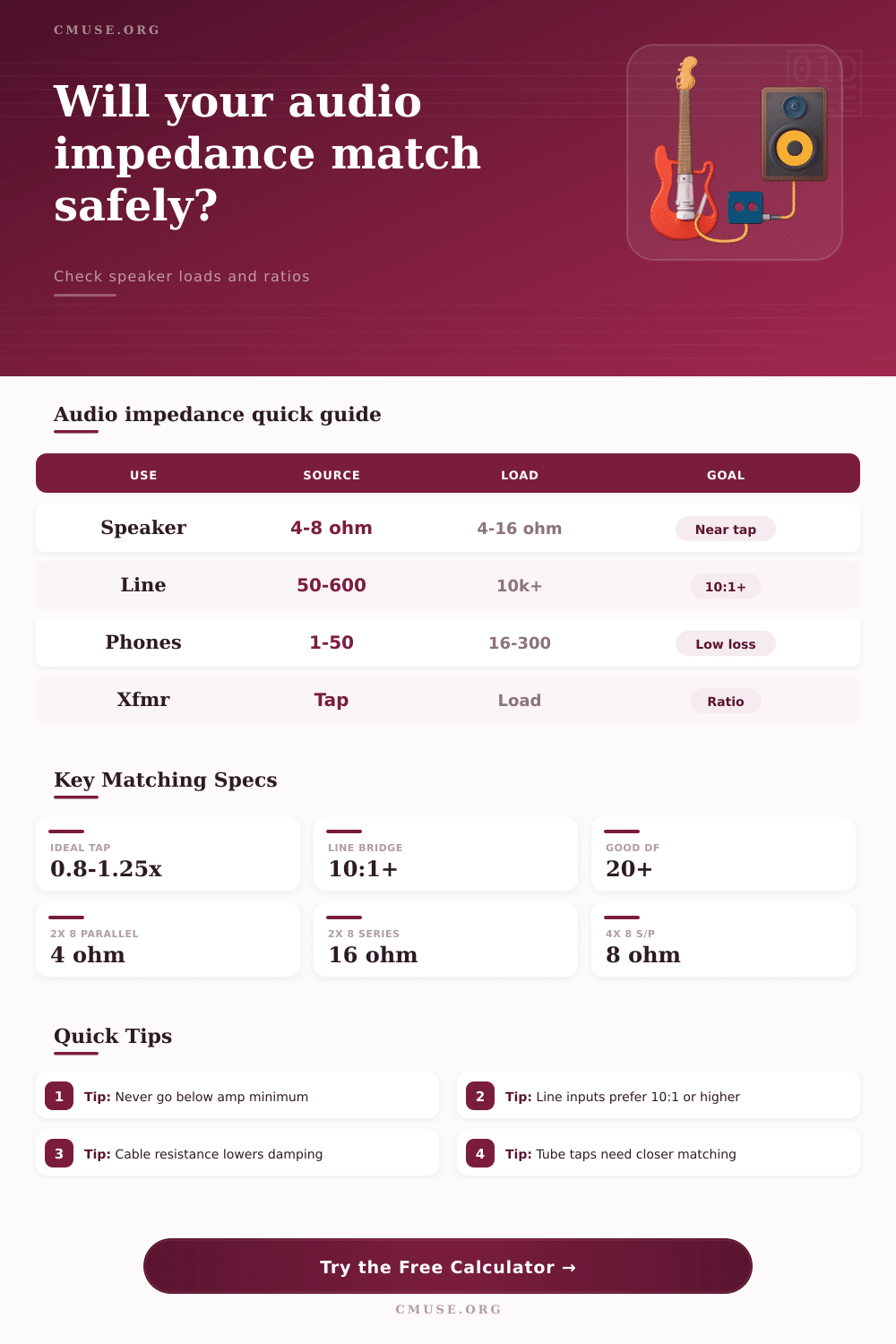
| Solid-state power amp to speaker | 0.02-0.2 ohm | 4-16 ohms | Load at or above amp minimum |
| Tube amp output tap to cabinet | Tap based | 4, 8, or 16 ohms | Cabinet near selected output tap |
| Line output to preamp or interface | 50-600 ohms | 10k-100k ohms | Load at least 10x source |
| Headphone output to headphones | Below 1-50 ohms | 16-300 ohms | Low source Z for flat response |
| Mic transformer or DI transformer | Varies by winding | Reflected by ratio | Use turns ratio squared |
⚙ Transformer Ratio Reference
| Primary:Secondary Turns | Impedance Multiplier | 8 Ohm Secondary Reflects | Practical Reading |
|---|---|---|---|
| 1:1 | 1x | 8 ohms | Isolation without impedance change |
| 1.414:1 | 2x | 16 ohms | Raises apparent load one common step |
| 2:1 | 4x | 32 ohms | Large step-up in reflected impedance |
| 1:2 | 0.25x | 2 ohms | Lowers apparent primary impedance |
| 3.54:1 | 12.5x | 100 ohms | Useful for line or specialty interfaces |
🎶 Spec Comparison Grid
| Spec | What It Measures | Good Range | When It Matters |
|---|---|---|---|
| Load-to-tap ratio | Actual load divided by amp tap or minimum rating | 0.8x to 1.25x | Speaker cabinets and tube output taps |
| Bridge ratio | Input load divided by source output impedance | 10:1 or higher | Line outputs feeding interfaces, mixers, or pedals |
| Damping factor | Speaker impedance divided by source plus cable resistance | 20 or higher | Woofer control and speaker cable losses |
| Voltage delivery | Load voltage after source and cable series resistance | 95% or higher | Long cables, headphones, passive splitters |
| Transformer reflection | Secondary load multiplied by turns ratio squared | Near source target | Output transformers, DI boxes, matching transformers |
📝 Common Project Checks
| Scenario | Entered Values | Calculated Load | Main Check |
|---|---|---|---|
| Two 8 ohm cabinets on 4 ohm amp | 8 ohm x 2 parallel | 4 ohms | Good if amp is rated for 4 ohms |
| Four 8 ohm drivers in one cabinet | 8 ohm x 4 series-parallel | 8 ohms | Common balanced guitar cabinet load |
| 100 ohm line out to 10k input | 100 ohm source, 10k load | 100:1 bridge | Strong voltage bridging match |
| 8 ohm tap driving 16 ohm cabinet | 16 ohm single load | 2.0x target | Usually lower power; check amp guidance |
| 2:1 transformer with 8 ohm load | Ratio squared = 4x | 32 ohms reflected | May require different tap or winding |
Impedance are a measure of electrical resistance. Impedance is a measure of how much electricity is restricted from flowing through an circuit. Impedance is an important concept with audio devices because the impedance of an amplifier need to match with the impedance of the speaker that is connected to that amplifier.
If the impedance levels of the amplifier and the speaker are not matched, then there can be a loss of volume from the speaker, there can be changes to the tone of the speaker, or the components of the amplifier may be damaged. One of the main reasons that the components of an amplifier may be damaged is because the amplifier cannot handle an amount of electrical current that the speaker demand from the amplifier. Many people is concerned about low impedance loads in audio equipment.
Matching amplifier and speaker impedance
Low impedance loads are dangerous for solid state audio amplifiers. The reason that solid-state audio amplifiers become damaged when the impedance load is too low is that the low impedance load require the amplifier to push more electrical current through the speakers than the components of the amplifier are able to handle. As a result, the amplifier overheat, and the overheating of the components can lead to the failure of those components.
Amplifiers have calculators that allow the user to calculate the total impedance of the speaker wiring that is connected to the amplifier. Using this calculator will help the user to avoid loading the amplifier with an impedance load that is too low for the amplifier to handle. The way that you wire your speakers will impact the total impedance that is presented to the amplifier.
If you wire the speakers in a way that creates more paths for the electrical current to flow through the speakers, then the total impedance will decrease. For instance, if you wire two eight ohm speakers in parallel with each other, the total impedance will decrease to four ohms. If, however, you wire the speakers in series with each other, the electrical current will have to pass through each speaker, and the total impedance will be the sum of the impedance levels of each speaker.
The rules regarding impedance is slightly different for line-level audio gear and headphones. For devices such as headphones and line-level audio gear, the impedance rules are different because the device relationships involve voltage rather than electrical current and power. For these devices, the input impedance of the device to which the audio gear is connected should be much higher than the output impedance of the device from which the audio gear emanate.
The standard ratio between these two impedances is a ten to one ratio. If the input impedance is too low relative to the output impedance of the device that is emitting the audio signal, then the low input impedance will load down the device that is emitting the signal. Loading the source device down will result in a reduction of the level of the signal that is emanating from that device, as well as the reduction of the high frequencies contained in that signal.
Transformers are devices that change voltage levels. Using a transformer also changes impedance. The transformer changes the impedance by reflecting the impedance load that is connected to it, and the impedance that the transformer reflects is related to the square of the turns ratio of the transformer.
Many devices, such as DI boxes, use transformers to change the impedance level between two devices. Because even a small change in the turns ratio of the transformer creates a large change in the reflected impedance level of the device, the use of transformers is an efficient way to change the impedance of audio gear to allow for proper matching of components. However, mistake can be made in the use of impedance with transformers.
The damping factor of an amplifier is a measurement of the control that the amplifier has over the movement of the speaker cone. If the resistance levels of the source device and the cables connected between the device and the speaker are too high relative to the impedance level of the speaker, then the damping factor will be low. A low damping factor can cause the movement of the speaker cone to be uncontrolled.
An uncontrolled movement of the speaker cone results in a less precise response to bass frequency. It is important to be aware of the resistance levels of the cables that is connected between the audio source and the speaker. The resistance levels of those cables will increase as the length of those cables increases.
Using longer cables can introduce issues related to lowering the damping factor of the system. The concept of managing impedance is that you want to ensure that electricity can flow through the components of audio devices, but that the electricity does not stress the components. Thus, you must ensure that the impedance levels of your speakers match the requirements of your amplifier, and that the impedance levels of your audio source devices matches the requirements of your audio destination devices.
By correctly managing the impedance of your audio devices, you ensure that they will efficiently perform their task, and that they will not fail or become damaged in the process.