Minor Chord Progression Chart Calculator
Compare minor-key loops, cadence pull, and harmonic color before you lock the chart.
Pick a musical mood, then var the calculator reshape the loop, cadence, and harmonic density.
Each field changes the chart readout, the scale reference, and the final cadence score.
| Measure | Method | Result | Why it matters |
|---|---|---|---|
| Key | Selected tonic | A minor | Sets the harmonic center |
| Degree | Roman | Chord | Role |
|---|---|---|---|
| 1 | i | Am | Tonic |
| Family | Color note | Cadence pull | Best use |
|---|---|---|---|
| Aeolian | Flat 7 | Medium | Verse flow |
| Harmonic | Raised 7 | Very high | Strong ending |
| Melodic | Raised 6/7 | High | Glossy hooks |
| Dorian | Natural 6 | Medium | Grooves |
| Phrygian | Flat 2 | Low-medium | Dark tension |
| Locrian | Flat 5 | Low | Edge cues |
| Family | Roman loop | Mood | Use |
|---|---|---|---|
| Smoke and Velvet | i-VI-VII-i | Warm lift | Hooks |
| Cinematic Descent | i-bVI-bVII-V | Wide pull | Scenes |
| Late-Night Pop | i-III-VII-VI | Open rise | Choruses |
| Folk Drift | i-iv-VI-v | Soft sway | Verses |
| Dark Trap Loop | i-bVI-bVII-i | Heavy loop | Beats |
| Lush Ballad | i-VI-III-VII | Gentle color | Ballads |
| Modal Chase | i-VII-VI-VII | Cool motion | Vamps |
| Bridge Suspense | iv-bVI-i-V | Rising strain | Bridge |
| Ambient Hover | i-v-VI-VII | Soft haze | Pads |
| Final Cadence | i-iv-V-i | Clear close | Ends |
| Target | Typical feel | Best chord move | Chart use |
|---|---|---|---|
| 0 to 25 | Loose | i-VI-VII | Ambient loops |
| 26 to 50 | Soft pull | i-iv-VI | Verses |
| 51 to 70 | Balanced | i-VI-V | Hooks |
| 71 to 85 | Firm | iv-V-i | Choruses |
| 86 to 100 | Strong | V-i | Final bars |
| Bars | Beats | At 90 BPM | Chart shape |
|---|---|---|---|
| 2 | 8 | 5.3 sec | Quick hook |
| 4 | 16 | 10.7 sec | Standard loop |
| 8 | 32 | 21.3 sec | Verse span |
| 12 | 48 | 32.0 sec | Long bridge |
| 16 | 64 | 42.7 sec | Full section |
Use this minor chord progression chart to compare natural, harmonic, and modal paths, then choose progressions that feel tighter, darker, more open, and easier to finish cleanly.
Minor chord progressions is chord sequences created in the context of using minor keys to create a specific mood within a song. Many musicians uses minor chord progressions to create tension within there songs. The tension that is expressed within a minor chord progression relies upon the musician’s harmonic choice within the song.
Musicians can use different type of minor scales to create different types of minor chord progressions. One of the scales that a musician can use within a minor chord progression is the natural minor scale, also known as an Aeolian mode. The natural minor scale creates a somber feeling within the song due to the presence of the flat seventh note within that scale.
How to Make Minor Chord Progressions
Another scale that can be used is the harmonic minor scale, wherein the musician raise the seventh note of the natural minor scale. This creates a dominant chord within the progression that indicates a sense of resolution when reached. The Dorian mode contain a bright sixth note that adds a sense of groove to the minor chord progression.
The Phrygian mode also contains a flat second note that creates a different mood within a song. However, the musician must choose these scales carefuly so that the minor chord progression doesnt lose it’s structure. The shape of a minor chord progression is important in how the listener perceives it.
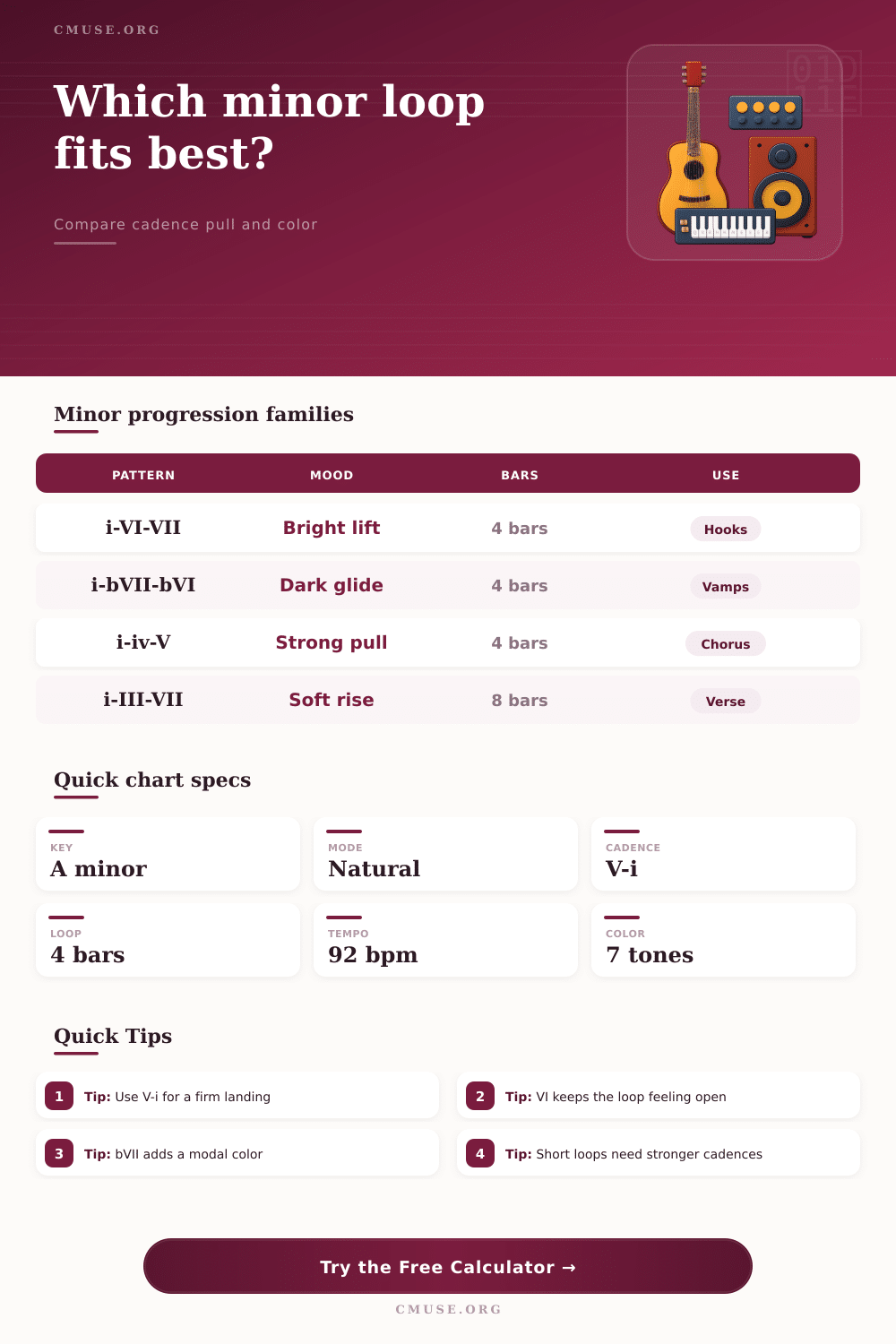
One of the shapes of a minor chord progression is the i-VI-VII progression, which circle back to the tonic starting chord. This type of chord progression is useful for incorporating repetitive hook into a song. A i-bVII-bVI chord progression is another shape that can be utilized within a minor chord progression.
This type of progression creates a sense of ambiguity in the listener. Another common chord progression is the i-iv-V progression, which incorporate the use of a dominant chord within the progression. The length of a minor chord progression can also vary.
Shorter chord progressions have a certain firmness to them, whereas longer chord progressions may utilize gentler chord motion within the song due to the time they have to develop. Cadence is the way in which a minor chord progression end. The strength of the cadence of a chord progression will indicate to the listener how much resolution the composition provide to the tension created within the chords.
A V-i cadence within a minor chord progression will indicate a strong feeling of resolution. A i-VI cadence indicate a soft resolution to the chord progression. This type of cadence is often used to build tension within a song before it resolve.
However, this cadence is often risky if the musician use it within a short minor chord progression. Another type of resolution is the use of borrow chords within a progression that utilizes minor chords to create a specific mood. Another factor affecting the sound of a minor chord progression is the tempo.
The tempo will determine the length of the progression. A four-bar loop at 90 BPM will last approximately 11 second, whereas a 16-bar loop at 70 BPM will last approximately 34 seconds. In addition to tempo, the density of the progression can also change.
A musician can accomplish this by utilizing different voicings or inversions for each chord within the progression. These inversions will allow the progression to have more smoother transitions between each chord in the progression. Finally, one of the most important aspect of creating a minor chord progression is that the musician matches their musical intent with the musical outcome of the composition.
To create a verse that has a swaying feeling without a resolution, utilize the Dorian mode with a low cadence target. Chords should of been composed with the use of the harmonic minor scale when the musician intends to create a firm pull within the song to the tonic. For trap beat, the Phrygian mode will create a dark loop for the beat.
However, too many color will make the chord progression sound muddy, so ensure that the progression does not use too many of these different scales. Many musicians who compose minor chord progressions makes certain mistake. One of the most common is overloading the chord progression with borrowed tones.
Using borrowed chords within a progression will dilute the inherent identity of the minor chord progression. Another mistake is to ignore the relationship between the length of the loop and the tempo. It is also possible to make the mistake of forgetting that different section of a song require different levels of cadence strength.
To properly create a progression with the desired outcome, the musician should listen to their progression while play it on the piano.