Common chord progression chart calculator
Compare Roman numeral motion, chord symbols, transposition, and cadence endings across common chord progressions. Build the chart first, then tune the voicing and feel.
Preset Progressions
Chart Inputs
The chart uses the selected key, family, cadence, and voicing to build a readable Common progression map. Roman numerals, Nashville numbers, and chord symbols are shown together for quick comparison.
Results
Full breakdown
Progression Chart
The selected notation view is highlighted in the table below. The final two slots are shaped by the chosen cadence ending.
| Slot | Roman | Nashville | Chord symbol | Function |
|---|
Reference Tables
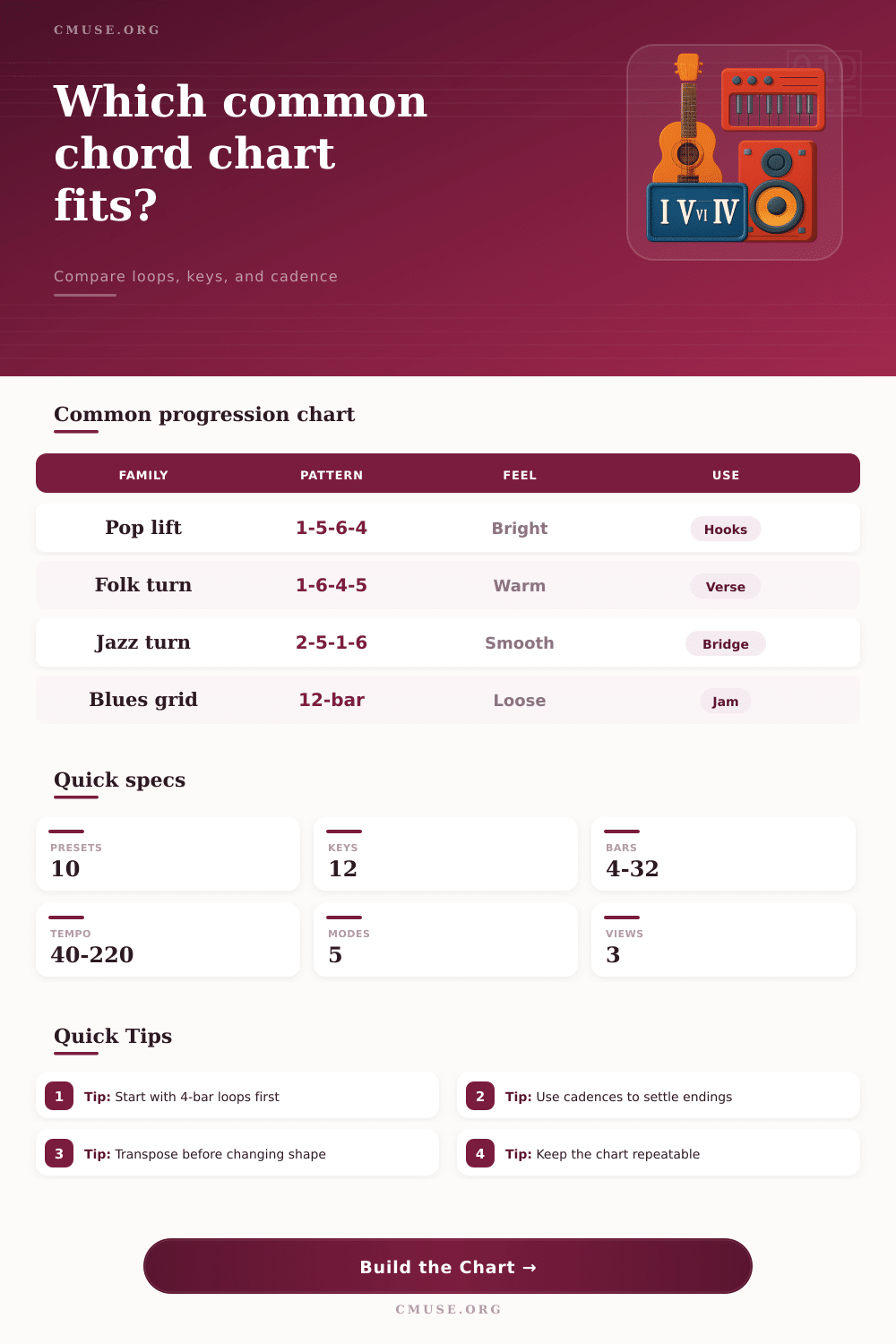
Common progression families
| Family | Formula | Feel | Typical use |
|---|---|---|---|
| Sunlit Pop Hook | I-V-vi-IV | Bright lift | Hooks and choruses |
| Campfire Folk Turn | I-vi-IV-V | Singable flow | Verses and campfire songs |
| Anthem Lift | vi-IV-I-V | Big rise | Chorus lift |
| Jazz Turnaround | ii-V-I | Strong resolution | Standards and endings |
| Classic Blues Grid | I-I-I-I / IV-IV-I-I / V-IV-I-V | Bluesy push | 12-bar blues forms |
| Minor Descent | i-bVII-bVI-V | Dark motion | Minor vamps |
| Mixolydian Road | I-bVII-IV-I | Open-road groove | Riffs and rock loops |
| Dorian Glide | i-IV-bVII-IV | Modal color | Minor loops with lift |
| Neo-Soul Circle | I-iii-vi-ii-V | Richer motion | Neo-soul and R&B |
| Worship Swell | I-V-vi-IV | Open build | Slow builds and pads |
Major key triads
| Degree | Roman | Quality | Example in C |
|---|---|---|---|
| 1 | I | Major | C |
| 2 | ii | Minor | Dm |
| 3 | iii | Minor | Em |
| 4 | IV | Major | F |
| 5 | V | Major | G |
| 6 | vi | Minor | Am |
| 7 | vii | Diminished | Bdim |
Minor key triads
| Degree | Roman | Quality | Example in A minor |
|---|---|---|---|
| 1 | i | Minor | Am |
| 2 | ii | Diminished | Bdim |
| 3 | III | Major | C |
| 4 | iv | Minor | Dm |
| 5 | v | Minor in natural minor, major in harmonic minor | Em or E |
| 6 | VI | Major | F |
| 7 | VII | Major | G |
Common cadence endings
| Cadence | Ending | Sound | Best use |
|---|---|---|---|
| Authentic | V-I | Final and settled | Clean song endings |
| Plagal | IV-I | Gentle release | Worship and ballads |
| Deceptive | V-vi | Unexpected turn | Verse or chorus variation |
| Turnaround | I-V | Loop-back energy | Blues and repeated forms |
| Backdoor | bVII-I | Warm modal close | Soul and jazz colors |
Instrument/audio spec comparison grid
Tips
Chord progressions is sequences of chords played in a specific order. Chord progressions provides the structure for a composition. Many songwriters use chord progressions to create a sense of movement and stability within there song.
There are many ways to learn to use chord progressions within a song. The most common chord progressions are the I-V-vi-IV chord progression, which pop music uses. Each chord within the I-V-vi-IV chord progression provide a sense of movement within the song.
How Chord Progressions Work
However, the I-vi-IV-V chord progression can be used to create a different mood within the song. This chord progression is often used in folk music because it creates a warmer feeling then the I-V-vi-IV chord progression. The only difference between these two chord progressions is the order of the chords.
Therefore, the different chord progressions can alter the mood within the song. Cadences are chord movement used at the end of a musical phrase. Authentic cadences use a V chord followed by a I chord to provide a sense of finality within the song.
Plagal cadences use a IV chord followed by a I chord to provide a softer ending within the song than an authentic cadence. A deceptive cadence use a V chord followed by a vi chord to create a sense of surprise within the song because the listener expect a I chord to be played. A musician can select a cadence according to the ending that is desired within a chord progression.
The key for a chord progression can impact the playability of the song. For instance, musicians often use the key of G major within songs because it is easy to play on a guitar. However, other keys may require more difficult finger movements to play the chords on an instrument, potentially leading to fatigue within the musician playing the song.
Additionally, the key of a song can be changed through the use of transposition. Transposition allows for a musician to play the same chord progression but change the pitch of each chord according to the musicians vocal range or the range of there instrument. Voicings for a chord progression can also alter the sound of the song being played because voicings refer to the different ways in which the notes within each chord can be arranged.
Modes for a chord progression use a different type of scale to create a different sound for the chord progression. For example, using a major mode for a chord progression will create a bright sound for the song. A natural minor mode will create a darker sound for the song.
Additionally, modes such as the Dorian and Mixolydian modes can also be used to create a different tonal color for each chord progression. An A minor descent can be used to create a downward movement within a song. Additionally, a neo-soul circle of chords can be used to create a sense of tension within the song.
The length of a chord progression loop can have an impact upon the songs structure. Most chord progression loops will be four or eight bars long. However, different musical styles may use different lengths for their chord loops.
For example, blues music may use a chord progression loop that is twelve bars long. Additionally, the density for a chord progression can be adjusted. For example, using one chord per bar for a song will create more breathing room for the musicians playing the song.
Using two or four chords per bar will create a busier sounding song. There are some mistakes in writing chord progressions that musicians should avoid. Using complex voicings for chord progressions too early in a song may create a challenging soundscape for listener.
Ignoring the playability of a chord progression may make it challenging to play for the musician. Finally, avoiding the use of cadence within a chord progression will make it feel as if the chord progression is floating without ever landing. The instrument that is used to play a chord progression will impact the way in which the chord progression sounds.
For example, a steel-string acoustic guitar will have a bright sound to its chords making it appropriate for pop music hooks. A nylon-string guitar will have more sustain to its chords making it appropriate for ballads. Additionally, electric guitars and different types of electric guitars may change the tone of a chord progression.
The voicing for each chord should be matched to the tone of the instrument that is being used to play each chord progression. Youll find that the instrument the musician uses can change everything. It isnt just about the notes but how they sounds.
One should of considered the tunings too. Making sure your chords sounds naturaly good is alot of work. The moddern musician must know these things.
Its actualy a complex process. The guitars tone is vital. It makes the music feel more luxurius.
The chords can dissapears if you dont play them right. You cant just play any chord. The chord progression is better than others if you use the right scales.
You should of checked the key first. The music sounds better when the chords is right. The melody is better than the chords sometimes.
It’s a lot of things to keep in mind.