Piano Chord Progression Chart Calculator
Map keys, voicings, tempo, and bar counts into a piano-ready progression chart with repeatable loop notes and printable references.
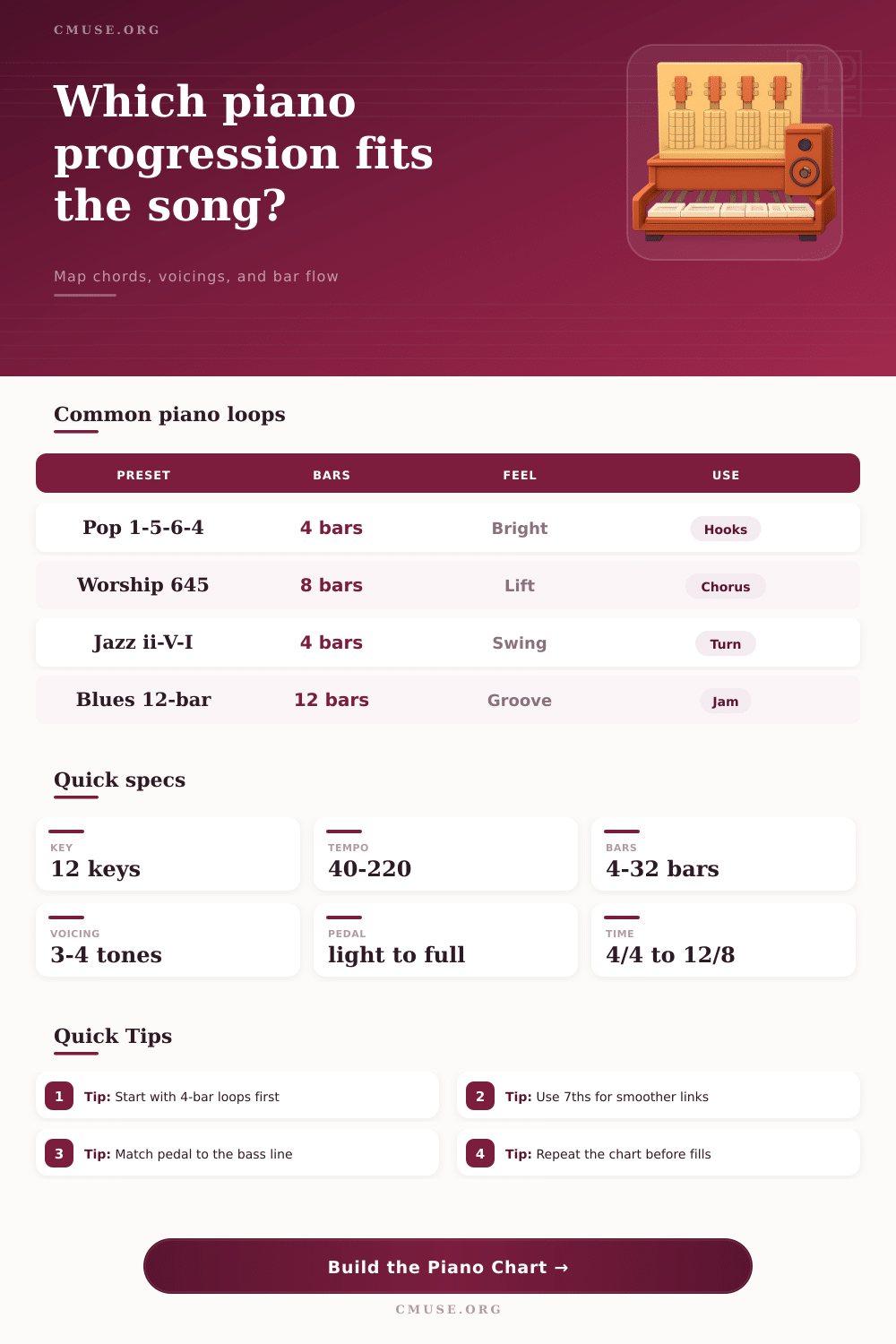
Choose a piano template, then compare chord shape, tempo, and register before the chart gets crowded.
| Bar | Degree | Chord | Voicing | Function |
|---|
| Family | Pattern | Mode | Use |
|---|---|---|---|
| Pop lift | I-V-vi-IV | Major | Hooks |
| Worship swell | I-vi-IV-V | 6/8 | Chorus pad |
| Jazz turn | ii-V-I-vi | Major7 | Comping |
| Blues turn | I-IV-I-V | 4/4 | Shuffle |
| Style | Tones | Span | Best use |
|---|---|---|---|
| Triads | 3 notes | 7 st | Clean loops |
| Seventh shells | 3 notes | 10 st | Jazz comp |
| Rootless 9ths | 3 notes | 14 st | Modern comp |
| Open tenths | 3 notes | 16 st | Ballads |
| Chart size | Bars | Runtime | Use |
|---|
When you play an piano, you must create chord progressions. A chord progression could be simple or complex, but a chord progression always determines the mood that you want to create in your composition. For example, major chords will create a feeling of resolution in your composition, but a Dorian mode chord progression will create a feeling of mystery.
Each mode utilize different scales, and thus will change the tension and the release of the chords within the progression. Additionally, the chords you play will also depend upon the patterns you play with your left hand, as certain left hand patterns will add stability to your composition, while others will add movement. Voicing style determine the sound of your chords.
How to Make Piano Chord Progressions
Using triads in your chords will limit you to only seven semitones, which will allow you to quickly create loops within your songs. Using open tenths will allow your chords to have a widely sounding voicing, which may be apropiate for ballads. Use the lower register of the piano for loud sounds, whereas use the higher register for bright sounds.
Additionally, use light depth for the pedals to allow your notes to have a crisp start, or use full pedal depth for your chords to have a sustain sound. Using the wrong voicing style and pedal depth at the same time can cause your chords to sound muddy. The preset buttons will load pre-set templates into your song.
These templates has been proven to contain the perfect chord progressions for various musical genre. Some are designed for songs that is to be classified as pop music, while others may be used for worship music. These templates will have a preset number of beats and tempo associated with them, so you can immediately begin to tweak the preset template to your song specifications.
For instance, you can change a 4/4 time signature to a 12/8 time signature to change the groove of your song. The generated chart will display specific information about your song. The chart will display the names of the chords, the degrees of each chord, the voicings for each chord, the function label for each chord (such as “home” or “resolve”), the chord progression that will loop to create your song of any length, and the total time that your song will play at the chosen tempo.
You can even print this generated chart for your musical rehearsal. Many people makes mistakes when they play chord progressions. One of the most common is to use complex voicings for your chords without having an understanding of chord structure and function.
Stick to playing triads and seventh shells as they will be easier to play. Another mistake is to ignore the time signature of your song. For example, a 3/4 time signature requires more different playing techniques than a 4/4 time signature.
Additionally, ensure that your use of the pedals match that of your bass line. If you use a walking bass line, dont use a half-pedal for your bass notes as they may become blurry. When playing in a band, the other members of the band will utilize your chord progression.
Depending upon the vocalist, you could use a Mixolydian chord progression for your vocalist to add support to there vocals. Alternatively, use a Dorian mode chord progression if you would like room for improvisations from your band members. The length of your chord progression should match the goal of your song.
For example, you may use four bars of chord progression for a musical hook in your song, but the band may use sixteen bars of chord progression for a chorus. Additionally, the tempo of your song will affect the energy that your song puts out; slow tempos are best used for ballads, but fast tempos are best used for jazz songs. The tables included in this article may help you with understanding the various musical styles.
These tables include information regarding the different musical modes and their use in music. Additionally, the article provides a voicing guide to help you understand the distance between the notes in your chords in the context of semitones. You can use this guide to make a decision between using chords with seven semitones or sixteen semitones.
Other tables include common length tables to help you with your song structure decisions of whether to use an eight bar verse or a sixteen bar chorus. These tables will save you from any mathematical calculation. Play the generated chart to listen to how the chords sound and tweak the inputs to your software until the chord progression sound correct.