Guitar Chord Progression Chart Calculator
Map common loops, capo shapes, and song forms into clean playable guitar charts you can compare quickly.
📍 Presets
🔧 Chart Inputs
🎸 Live Chart Output
🧩 Chord Family Spec Grid
📊 Reference Tables
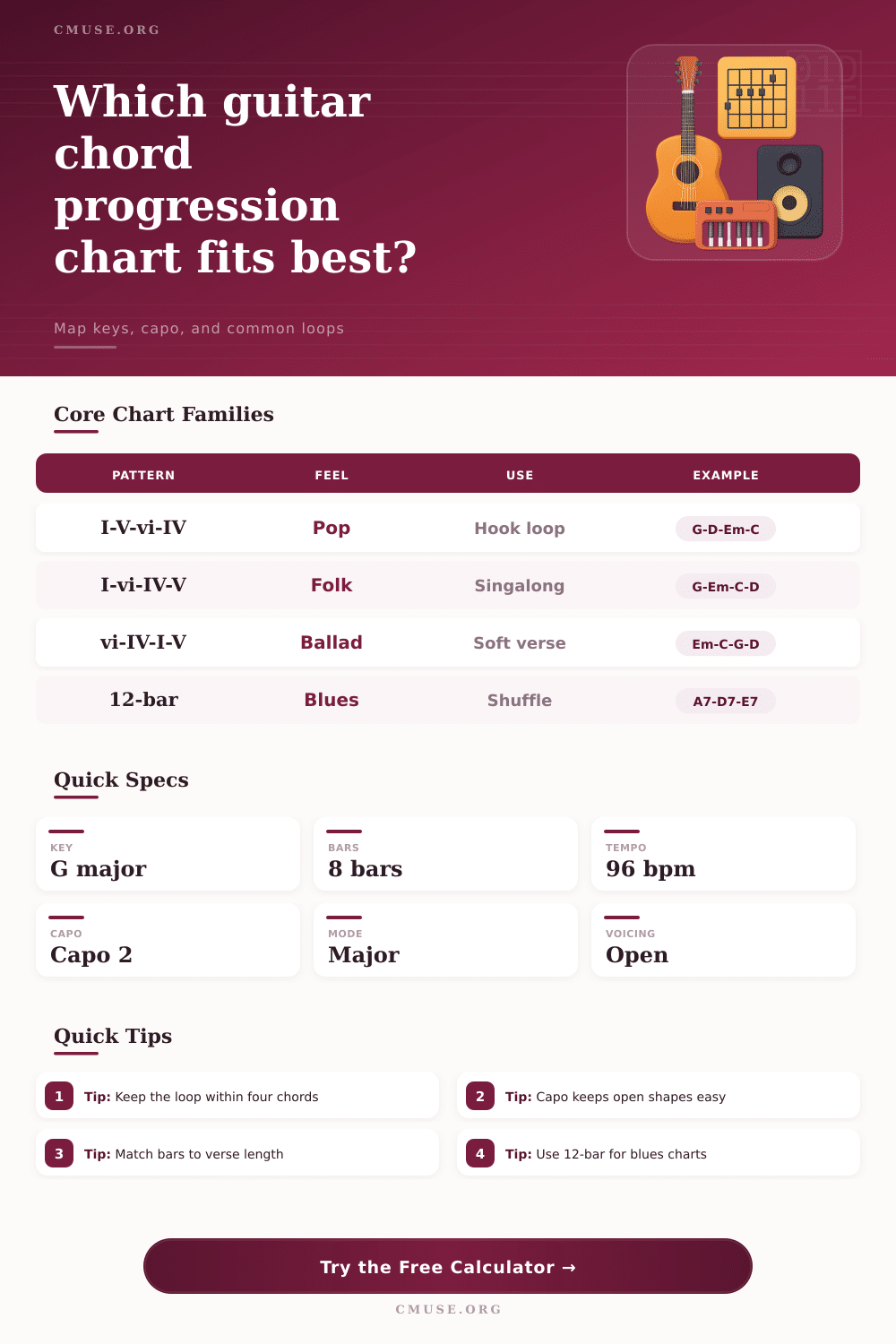
| Pattern | Degrees | Use | Example in G |
|---|---|---|---|
| Pop Loop | I V vi IV | Hook-friendly chorus loop | G D Em C |
| Folk Loop | I vi IV V | Singalong verse bed | G Em C D |
| Ballad Turn | vi IV I V | Soft lift into the chorus | Em C G D |
| Circle | vi ii V I | Smooth harmonic motion | Em Am D G |
| Anthem Lift | I V vi IV | Wide, steady chorus pull | G D Em C |
| 12-Bar Blues | I I I I IV IV I I V IV I V | Classic blues chart shape | G7 C7 D7 |
| Capo | Shape | Sounding key | Common use |
|---|---|---|---|
| 0 | Open shapes | Same key | Direct charts |
| 2 | G shapes | A | Bright lift |
| 3 | G shapes | Bb | Easy vocal move |
| 5 | C shapes | D | Ringy open voicings |
| 7 | C shapes | E | Higher chorus feel |
| 9 | D shapes | F# | Lead-singer key |
| Type | Symbol | Tone | Best use |
|---|---|---|---|
| Major | C | Clear and stable | Home chord |
| Minor | Am | Moody and soft | Verse color |
| Dominant 7 | G7 | Pulls forward | Blues turns |
| Minor 7 | Em7 | Gentle motion | Soul charts |
| Sus / add9 | Dsus4 | Open shimmer | Modern pop |
| Slash chord | C/G | Floating bass | Lifted hooks |
| Bars | Count | Feel | Chart note |
|---|---|---|---|
| 4 | Short loop | Hook cycle | Best for choruses |
| 8 | Verse length | Balanced | Most common chart span |
| 12 | Blues form | Call and response | Classic guitar grid |
| 16 | Full form | Section wide | Two eight-bar phrases |
💡 Quick Tips
Chord progressions is a sequence of chords played in a specific order. Chord progressions are use to create a sense of movement within a song. Chord progressions provide the foundation for the melody within a song, and chord progressions provides the listener with an understanding of the structure of that piece of music.
Many person use a four-chord loop when composing a chorus for their pop song. The four-chord loop use the I-V-vi-IV chord progression. The I-V-vi-IV chord progression creates a sense of tension within the song, and the release of that tension when the progression return to the I chord.
How Chord Progressions Work for Songs and Guitar
That is why pop music composition commonly uses this chord progression. Other chord progressions exist for other genres of music. For example, folk music use the I-vi-IV-V chord progression because it sound warm when played and has an easy melody to follow.
Blues music uses the twelve bar blues chord progression that relies upon dominant seventh chords to create its specific blues rhythm. Chord progressions may be difficult to use if they does not match your vocal range or the tempo of your song. At high tempo, barre chords can be difficult to play.
Open chords allow for the ringing of the top string of the guitar. Musicians often use open chords in the key of G major or C major. If you want to change the key of the song without changing the shape of your finger on the guitar strings, you can use a capo.
A capo is a tool that can be placed upon the neck of the guitar. Using the capo will raise the pitch of each of the guitar strings while allowing you to keep the same chord shape upon the guitar strings. For instance, if you place the capo upon the second fret and play the chord for G major, you will produce the sound of A major.
Aside from the chord progression that you use, the rhythm at which you play your chord also matters. For instance, pop music composition often uses 4/4 time. Blues music uses a 12/8 time signature to produce a swing beat for the genre.
Half time can be used to change the speed of the song. Playing in half-time will produce a ballad that feel slower and heavier with each chord played. The number of bars of each chord progression should match the structure of the song.
For instance, verse may have eight bars of each chord progression while choruses use four bars each. Complex chords, such as major seventh chords may be difficult to play at high tempo for your song. Preset chord progressions may aid in the songwriting process of songwriters.
For instance, some songwriter love to use the Andalusian descent in a minor key to produce a specific sound for their composition. Others use jazz turnarounds for their soul music to produce a smooth sound. Using complex chords within your song progression is a common mistake when writing your first song.
Instead, use four chord for your first composition. After you have mastered your chord and your song has developed, you can add complex chords, such as suspended chords or slash bass chord. Additionally, make sure that your guitar is in tune before you play your chords or your chord progression will sound incorrect.
One way to improve your chord progression playing is to practice using a metronome. A metronome will allow you to play your song at a steady beat and maintain your song’s tempo when playing your chords. Additionally, pay attention to how the chord progressions interact with the lyric within your song.
Using major chords will produce a happy feeling with your lyrics while using minor chord will produce a sad feeling with your lyrics. If you are playing with other musicians, use a capo to ensure that everyone can play along with your song. Provide each musician in your band with printed chart that display your chord progressions.
If you change one chord within your song, it will change the tension within the music. Therefore, experiment with changing chord within your composition to observe how the tension of the song change.