Chord Progression Chart Calculator
Map Roman numerals, chord names, cadences, and written-view transposition in one clean chart so you can compare loops before the arrangement gets crowded.
Preset Progression Charts
Chart Inputs
Choose a key, then shape the chart family, voicing, and ending so the result reads like a real progression chart instead of a generic loop list.
Progression Chart Preview
| Slot | Roman | Chord | Function |
|---|
Chart Snapshot
Common Progression Families
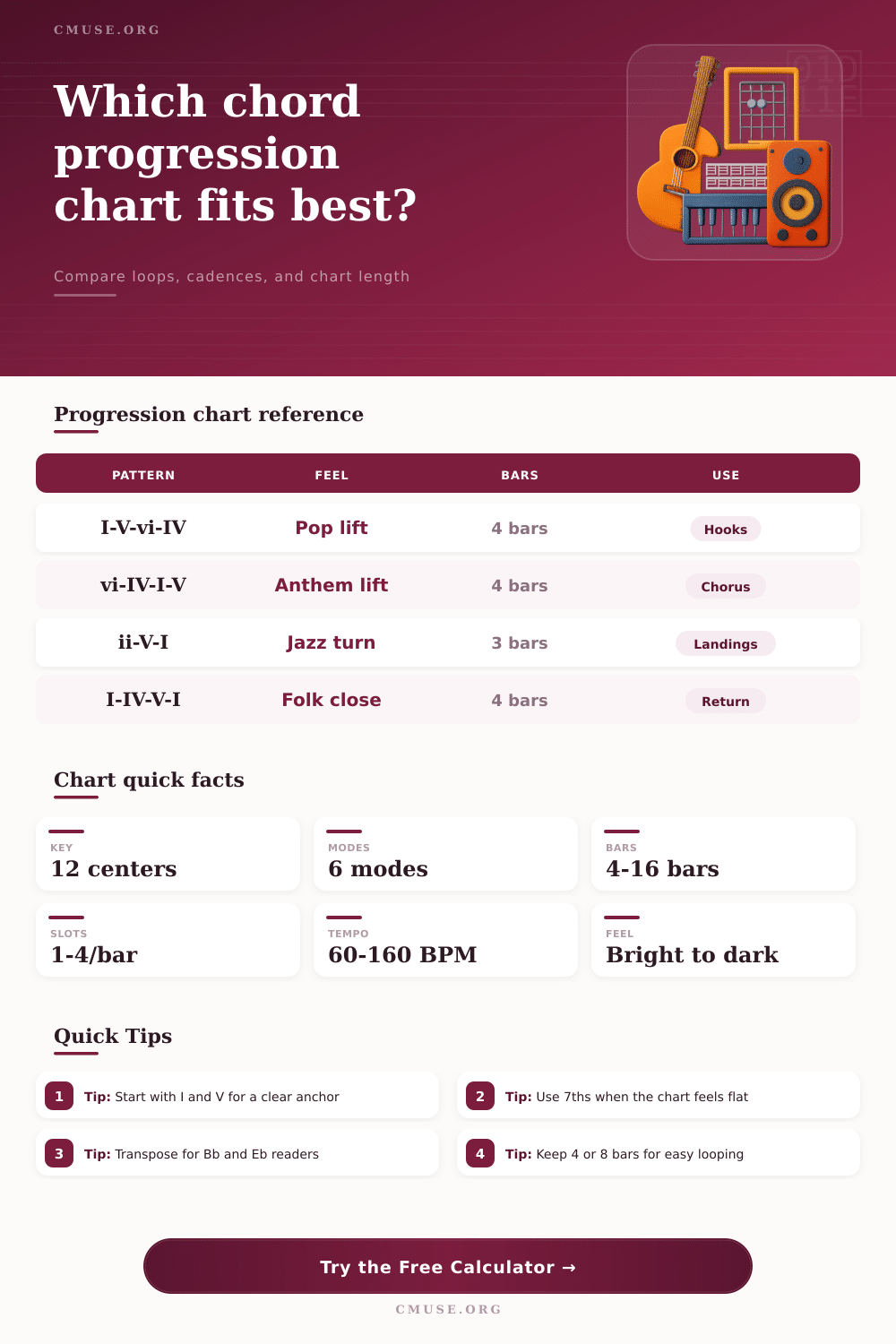
| Pattern | Feel | Bars | Use |
|---|---|---|---|
| I-V-vi-IV | Pop lift | 4 bars | Hooks |
| vi-IV-I-V | Anthem lift | 4 bars | Chorus |
| ii-V-I | Jazz turn | 3 bars | Landings |
| I-IV-V-I | Folk close | 4 bars | Return |
| i-bVII-bVI-bVII | Minor loop | 4 bars | Dark lift |
| I-iii-vi-ii-V | Neo-soul | 5 bars | Glide |
| I-V-vi-iii-IV-I-IV-V | Worship swell | 8 bars | Pad bed |
| I-IV-I-V | Blues form | 12 bars | Blues |
Mode Degree Map
| Mode | Degree map | Color | Typical close |
|---|---|---|---|
| Major | I ii iii IV V vi vii dim | Bright | V-I |
| Natural minor | i ii dim III iv v VI VII | Dark | V-i |
| Harmonic minor | i ii dim III iv V VI vii dim | Strong pull | V-i |
| Dorian | i ii bIII IV v vi dim bVII | Cool | i-v |
| Mixolydian | I ii iii dim IV v vi bVII | Open | bVII-I |
| Lydian | I II iii #IV dim V vi vii dim | Shimmer | V-I |
Cadence and Borrowed Color
| Type | Marker | Effect | Best use |
|---|---|---|---|
| Authentic | V-I / V-i | Strong close | Endings |
| Plagal | IV-I / iv-i | Gentle close | Hymn feel |
| Half | ii-V / ii-v | Open hold | Suspense |
| Deceptive | V-vi / V-VI | Surprise turn | Lift |
| Backdoor | bVII-I | Soul close | Warm finish |
| Color | Marker | Effect | Best use |
|---|---|---|---|
| Secondary dominant | V/V | Sharp pull | Lead-in |
| Modal borrow | bVII | Wider color | Anthem |
| Neapolitan | bII | Dark setup | Tension |
| Tritone sub | bII7 | Jazz edge | Turnaround |
Quick Tips
Use this chord progression chart calculator to compare Roman numerals, cadence endings, and key changes quickly. It helps you build clearer loops, reharmonize ideas, and print cleaner charts for songs.
A chord progression chart displays the musical note or the chords that make up a chord progression. A songwriter can use the chord progression chart to transform musical idea into repeatable structures that contain both musical and lyrical elements. When songwriters is still sketching out the musical progressions for a composition, they may find that their musical section do not feel complete; in such instances, they should use a chord progression chart to plot the Roman numeral to each musical note.
The I-V-vi-IV chord progression is one of the most common chord progression used in music. This chord progression begins on the tonic chord (I), moves to the dominant chord (V), moves to the relative minor chord (vi), and then end on the subdominant chord (IV). The reason this chord progression work is because of the smooth voice leading between each chord; the voice leading between each chord progression allows each chord to lead into the next without making any jarring musical leaps.
How to Use a Chord Progression Chart
In addition, this chord progression create a sense of tension that keeps the listener interested but does not overwhelm the listener. Cadence are the conclusions to musical phrases. An authentic V-I cadence is one of the most common cadence in music.
Songwriters can use this type of cadence when they desire to conclude a musical section. A plagal cadence, which feature IV-I chords, is one of the less common cadence types; it is much gentler than an authentic cadence and often used in worship music. A deceptive cadence occur when a composer move from V chords to vi chords instead of tonic (I) chords.
This type of cadence create a sense of surprise in the listener when it is played. Matching the right type of cadence to the right chord progression is essential to writing a well structured song. A chord progression chart can assist songwriters in recognizing these cadence types before committing to the song.
Musical modes can alter the sound of chords within a chord progression. For instance, the major mode use all major chords, but the Dorian mode feature minor chords with a major IV chord. The Mixolydian mode feature a flat-seven (bVII) note that give the chord progression a bluesy sound.
The Mixolydian mode differ from the major mode because of the flat-seven note. The harmonic minor mode feature a raised leading tone that create a sense of tension in the song. This mode is often used for creating cinematic musical tension.
The modes alter the degree within a musical scale, which subsequently alters the notes of each chord within the chord progression. Voicing refer to the way in which musicians play the notes that make up each chord. A triad chord progression is one of the simplest chord structures and is often used for folk music.
Seventh chord can be added to a chord progression, and they add depth to the music if the chord progression does not contain much musical movement (static). Chords with sus and add9 voicings introduce some ambiguity to the chords since these voicings suspend the third note in each chord. Such voicings work best within slow musical tempo.
Borrowed chords can also be used within a song to introduce variety to a chord progression. For instance, a secondary dominant chord, such as a V/vi chord, increase the tension towards a minor chord. Modal borrowing allow musicians to use chords from different mode within a piece of music.
For instance, using a bVII chord within a major key. The tempo and the musical rhythm of songs can have a major effect on the chord progression that is written for a composition. For instance, 104 BPM with straight-eighth note is common in pop music.
In contrast, 136 BPM with a swing beat is common in jazz music. The number of bars within a section of music can also have an impact on chord progression. For instance, four bar of music may be used for musical hooks.
Eight bar of music may be used for musical development. Sixteen bar of music may be used for musical returns. In addition, changing the number of chords within a bar can also change the density of chord.
Transposition involve changing the key of a musical piece. For instance, if the song is to feature horn, the horn player may have to transpose it into a key such as Bb or Eb to read the music. A complete chord progression chart should include the Roman numeral for each chord and each chord symbol.
The Roman numeral will allow a person to understand the function of each chord within the chord progression. A common mistake when songwriters create musical chord progression is that they dont find a balance between tension and release in the chord progression. Using too many chord that create tension without a means of releasing that tension will eventually fatigue the listener.
Using only tonic chord will stall the momentum of the song. A good starting point for songwriters is to use I and V chord. After establishing an anchor for the song, songwriters can introduce the iii or vi chord for color.
Furthermore, songwriters should print their chord progression chart and play the chord progression against the melody until they find the correct musical pull within the composition. A chord progression chart provide songwriters with an understanding of why one chord progression is successful while another is not. Thus, using a chord progression chart in the songwriting process will save songwriter time in the songwriting process.