End Fire Sub Array Calculator
Balance spacing, delay, wavelength, and footprint so the array launches forward cleanly. Compare presets, inspect the breakdown, and check the build fast.
Full breakdown
Frequency and wavelength guide
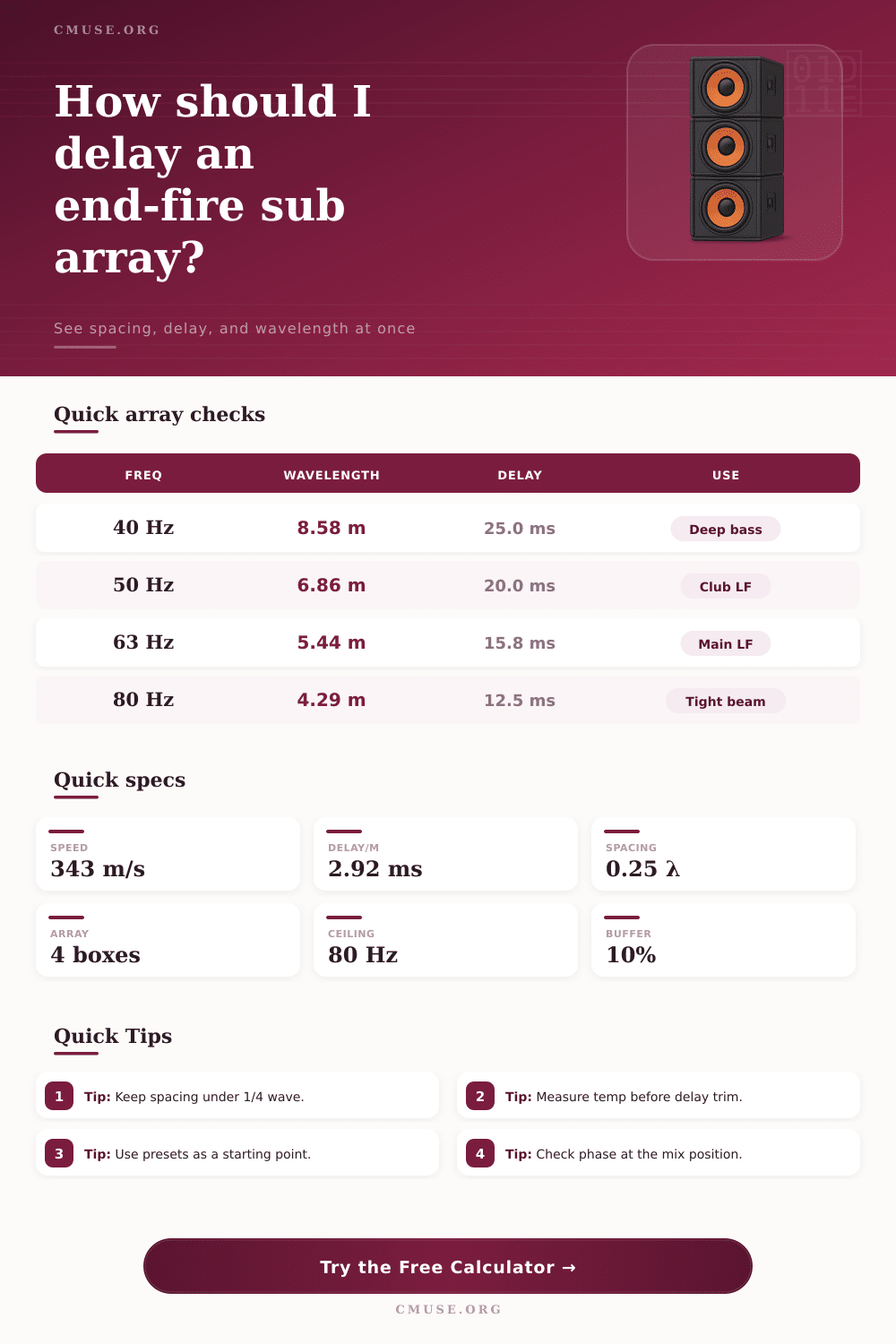
| Frequency | Wavelength at 20°C | Quarter wave | Typical use |
|---|---|---|---|
| 40 Hz | 8.58 m / 28.1 ft | 2.14 m | Deep infra |
| 50 Hz | 6.86 m / 22.5 ft | 1.72 m | Club low end |
| 63 Hz | 5.44 m / 17.9 ft | 1.36 m | Main punch |
| 80 Hz | 4.29 m / 14.1 ft | 1.07 m | Tight beam |
| 100 Hz | 3.43 m / 11.2 ft | 0.86 m | Short array |
Spacing and delay reference
| Centre spacing | Delay at 20°C | Phase at 63 Hz | Spacing rule |
|---|---|---|---|
| 6 in / 0.15 m | 0.44 ms | 10.0° | Very tight |
| 12 in / 0.30 m | 0.87 ms | 20.1° | Safe start |
| 18 in / 0.46 m | 1.31 ms | 30.1° | Watch lobes |
| 24 in / 0.61 m | 1.74 ms | 40.2° | Needs care |
| 30 in / 0.76 m | 2.18 ms | 50.2° | Large span |
Common build sizes
| Subs | Typical spacing | Length span | Good for |
|---|---|---|---|
| 2 | 0.20 to 0.28 m | 0.55 to 0.90 m | Small rooms |
| 4 | 0.22 to 0.30 m | 1.0 to 1.6 m | Clubs |
| 6 | 0.25 to 0.33 m | 1.5 to 2.5 m | Medium throws |
| 8 | 0.28 to 0.36 m | 2.1 to 3.5 m | Wide venues |
Cabinet family comparison
| Cabinet type | Width | Band | Notes |
|---|---|---|---|
| Compact 18-in | 24 in | 45-95 Hz | Low profile |
| Dual 18-in | 48 in | 35-85 Hz | Big impact |
| Horn-loaded 18-in | 28 in | 40-100 Hz | Efficient |
| Cardioid 18-in | 30 in | 45-90 Hz | Rear control |
| Touring 21-in | 30 in | 32-80 Hz | High output |
| Infra 21-in | 32 in | 28-60 Hz | Very low |
| Slim 15-in | 18 in | 55-120 Hz | Tight stack |
| Hybrid 2x18 | 52 in | 35-90 Hz | Wide footprint |
The table values are reference starting points. The calculator will always recompute delay, wavelength, and spacing from your live inputs.
Tip: Keep spacing tight enough that the center-to-center distance stays under about one quarter wavelength at the target frequency.
Tip: Recheck temperature and humidity before the final delay trim. Small air-speed changes can move the phase enough to matter.
An end-fire subwoofer array is a system of subwoofers that is arranged in a line to direct the sound forward. An end-fire array are used instead of simply employing a single subwoofer for a sound system because each subwoofer is omnidirectional; each sound wave radiate in every direction from the subwoofer. These sound waves can becomes disorganized when they radiate in such a way.
The end-fire array utilizes precise delays to each subwoofer to force each sound wave to radiating in a single direction, causing the sound waves to add together in the forward direction, but canceling each other out in the other directions. The distance between each subwoofers is another critical component for the end-fire array. The distance between each subwoofer array should of be set to the speed of sound and the desired frequency.
How End-Fire Subwoofer Arrays Work
If the distance between each subwoofer is set incorrect, the end-fire array will emit side lobes, peaks of sound that radiate in other directions from the desired direction. The side lobes will occur if the distance between each subwoofer is not kept to one quarter of the wavelength of the sound frequency. If the distance between the subwoofers is too great, the phase will wrap around the sound array, and the bass frequencies will emanate upward from the stage instead than forward.
The physical dimension of the venue also impact the construction of an end-fire array. For instance, if the stage is rectangular in shape, it will require a different density of subwoofers to an end-fire array than a circular stage. Furthermore, the size of the subwoofers will also impact the construction of an end-fire array.
For example, a slim fifteen-inch subwoofer can be utilized in an end-fire array in relatively tight spaces on the stage. An eighteen-inch subwoofer, however, may not be able to be utilized in the same degree. Furthermore, the size of the subwoofer array will impact the distance between each subwoofer, and, therefore, the length of the end-fire array itself.
In addition to the physical aspects of the venue in which the end-fire array will be deployed, other environmental factor may impact that array. For instance, the effect of humidity and temperature can impact the speed of sound. Sound travels at a certain speed in air that is seventy degrees, but sound travels at a different speed in air that is ninety degrees.
Thus, the delays between each subwoofer will have to be adjusted according to the current temperature of the performance venue. If the delays between each subwoofer are not adjusted according to the temperature of the environment, the end-fire array will not be accurate in the sound that it radiate. An end-fire array can be constructed in a manner that incorporate some common mistakes.
For instance, a common mistake for those constructing an array is to attempt to eyeball the delays between each subwoofer, as opposed to calculating the delays that are required according to the air conditions at the performance stage. Furthermore, another common mistake is to ignore the quarter-wave ceiling when determining the distance between the subwoofers in the array. Should the end-fire array ignore the quarter wave ceiling, the end-fire array may excite side lobes at the crossover frequency.
Finally, a third common mistake is to not utilize presets for the construction of such an end-fire array. Presets for the delays between each subwoofer and the total span of the end-fire array can help to significantly speed in which the array is constructed. Finally, an end-fire array can be constructed in a way that incorporate some trade-offs.
For instance, an end-fire array can direct the sound forward in excellent amounts, but it may not have the same total output as a cardioid array. Furthermore, adding more subwoofers will increase the throw of the sound, but it will also require additional digital signal processing channel to manipulate the delays of the sound from each subwoofer. Furthermore, if you construct an end-fire array with closer proximity between the subwoofers, more control is gained over the low-end of the sound system, but the proximity to each subwoofer may reach the physical limit of that subwoofer system.
Finally, using angles to the subwoofers to direct the sound may help to even further control the sound radiating from the stage, but steering that sound beam may cause a loss of the sound rejection that is projected in the rear of the stage.