Subwoofer Array Calculator
Plan spacing, delay, footprint, and coverage for real low-frequency arrays, from compact club stacks to end-fire, cardioid, and gradient festival builds.
📌 Quick Presets
⚙ Calculator Inputs
Breakdown
📐 Cabinet Family Specs
📋 Array Style Comparison
| Style | Spacing | Delay | Best use |
|---|---|---|---|
| Broadside | 0.50 x λ | 0 ms | Wide sum |
| End-fire | 0.25 x λ | 1 box | Long throw |
| Cardioid | 0.25 x λ | Rear delay | Rear null |
| Gradient | 0.33 x λ | 0.65 x | Smooth tilt |
📈 Frequency Reference
| Hz | Quarter-wave | Delay | Note |
|---|---|---|---|
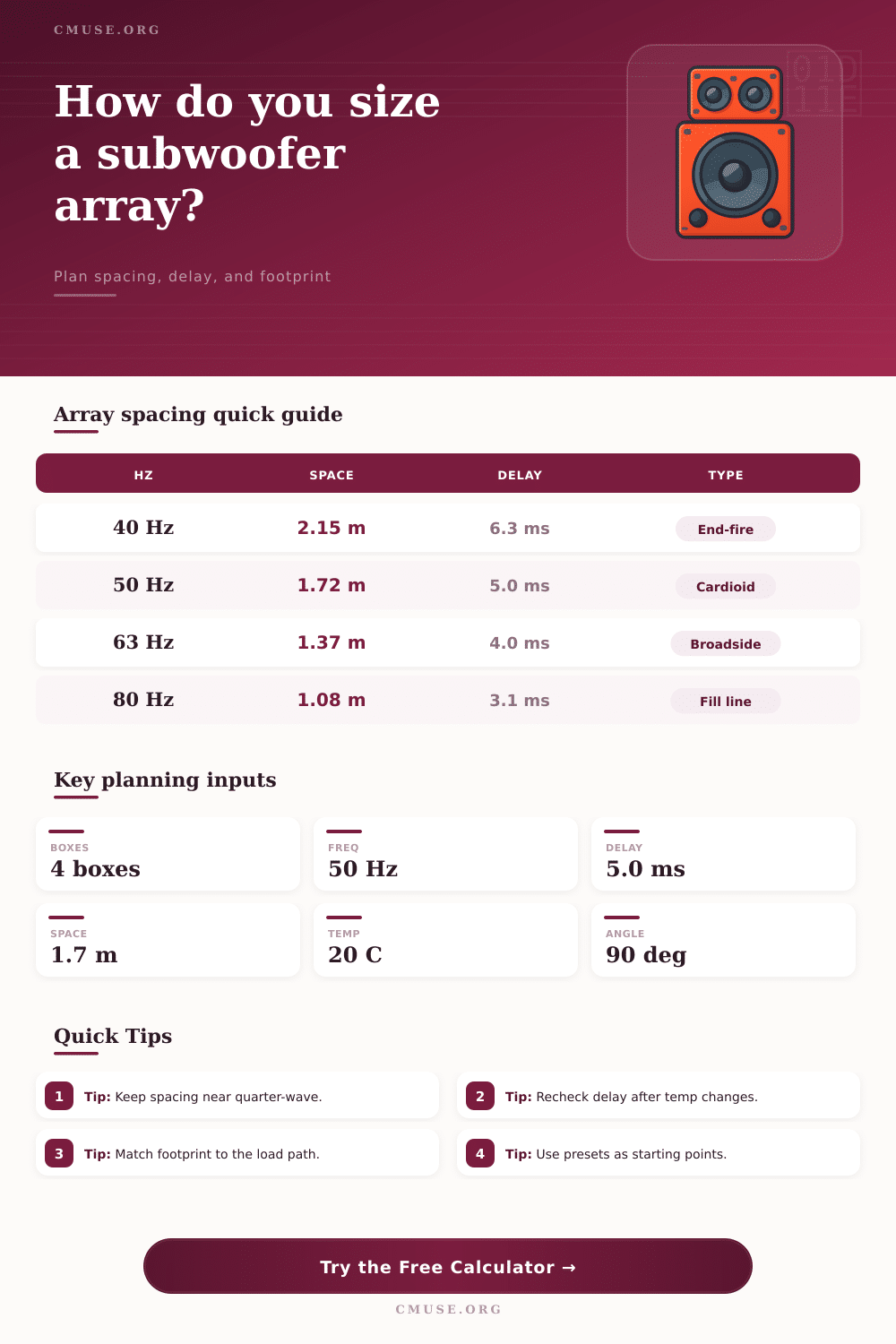
| 40 Hz | 2.15 m | 6.3 ms | Big rooms |
| 50 Hz | 1.72 m | 5.0 ms | Dance floor |
| 63 Hz | 1.37 m | 4.0 ms | Club bass |
| 80 Hz | 1.08 m | 3.1 ms | Fill line |
🏗 Common Footprint Examples
| Shape | Input set | Area | Use |
|---|---|---|---|
| Rectangle | 12 x 6 ft | 72 ft² | Simple line |
| Circle | 12 ft dia | 113 ft² | Cluster |
| Triangle | 12 x 8 ft | 48 ft² | Wedge |
| Custom | 90 ft² | 90 ft² | Manual |
📍 Coverage Width Guide
| Angle | 6 m | 10 m | 15 m |
|---|---|---|---|
| 60° | 6.9 m | 11.5 m | 17.3 m |
| 90° | 12.0 m | 20.0 m | 30.0 m |
| 120° | 20.8 m | 34.6 m | 52.0 m |
| 150° | 44.8 m | 74.6 m | 111.9 m |
💬 Practical Tips
A subwoofer array is a configuration of two or more subwoofer cabinets that are use to direct the low-frequency sound towards a specific area. If the location of the subwoofer cabinets are incorrectly positioned, the low-frequency sound will radiate out from the subwoofers into the entire venue. The reason that the sound does not appear to focus on the desired audiences is because of phase cancellation between the sound waves emanating from the subwoofer array.
Phase cancellation between the subwoofer cabinets can reduce the effectiveness of an array. The effectiveness of a subwoofer array depends upon the mathematics behind the wavelength of the sound created by the subwoofers. The wavelength of a sound wave is the distance that the sound wave travels during one cycle of sound.
How to set up a subwoofer array
The wavelength change based off the frequency of the sound. For instance, if the sound frequency is 50 Hz (a low frequency), the wavelength in standard air is 7 meter. If the subwoofer cabinets is placed closer than one-quarter of the wavelength of the sound that the subwoofers create, the subwoofer cabinets will sum coherent in the forward direction.
If the subwoofer cabinets are not placed correctly, the sound waves will cancel out each other. Because the wavelength of the sound depends upon the speed of sound in air, air temperature will impact the wavelength of the sound created by the subwoofers. Sound travels faster in warmer air, meaning that the wavelength will be longer in warmer air.
Thus, you will need to adjust the delays between each subwoofer cabinet according to the air temperature. Several different array styles can be used with subwoofer arrays. One of the most common array styles is the broadside array, where subwoofer cabinets are placed side by side with no delays between each cabinet.
This configuration is typically used for dance floors or areas where the sound need to be even across a large area. The second most common configuration is the end-fire array, where the subwoofer cabinets are arranged in a line with each subwoofer cabinet delayed by a specific amount of time. The third most common array is the cardioid array, in which the rear facing subwoofer cabinets is used with polarity inversion to prevent sound from traveling towards the stage.
Finally, a gradient array uses the same techniques as the other array styles but with stepped delays between each subwoofer cabinet. Each of these array styles require specific spacing between the subwoofer cabinets based upon fractions of the wavelength. For instance, each subwoofer cabinet can be placed at a distance of one-quarter of a wavelength or one-half of a wavelength from the next subwoofer cabinet for optimal results.
The physical footprint of a subwoofer array is the length and depth that the subwoofer array will take up on the stage where the sound is to be played. The total footprint of the array should be ensured to fit within the available space within the stage. For instance, if the available stage space is a rectangle that is 12 feet in length and 6 feet in width, the footprint of the subwoofer array cannot be greater than 12 feet in length and 6 feet in width.
Furthermore, the footprint should include some buffer space for the subwoofer array to accommodate for the subwoofer array cables and rigging equipment. If the number of subwoofer cabinets in the array does not match the available space for that number of cabinets, the subwoofer array may waste some of the ground space within the stage. Furthermore, if the subwoofer cabinets are too tightly packed together, the subwoofer cabinets may be damaged due to the lack of movement between each cabinet.
Coherence between the subwoofer cabinets can be used to measure the effectiveness of the array. High coherence between the subwoofer cabinets can be created by placing each subwoofer cabinet at the proper distance from each other (based upon wavelength) and by ensuring that the delays between each subwoofer cabinet are set up correctly. A coherence score of 90% or higher will cause the subwoofer array to behave as if it were a single subwoofer that is much more larger in size than each individual subwoofer cabinet.
A coherence score of 70% or lower, however, can result in lobbing and nulls in the sound created by the array. The size and type of the subwoofer cabinets will also impact the type of venue where the subwoofer array can be used. For instance, compact 18-inch subwoofer cabinets can be used for small clubs or venues that have a short throw distance to the audience.
Dual-18-inch subwoofer cabinets are better for larger festivals. Single 21-inch subwoofer cabinets will produce more punch in the sound but will take up more depth within the stage. A few mistakes can be made when setting up a subwoofer array, however.
One of the most common is to overlook the throw distance of the subwoofer array. Ignoring the throw distance can result in the sound only being provided to a narrow portion of the audience. Another mistake is to overlook the slope of the stage upon which the subwoofer array will be positioned.
The same arrangement of subwoofer array that may work for a flat stage may not work on a sloped stage. Finally, you should recheck the position of each subwoofer cabinet after the subwoofer array has been loaded onto the stage (the load-in process). It is possible that the subwoofer array may have been moved even one centimeter from its calculated position during the load-in process.
Any such movement will reduce the coherence between the subwoofer cabinets. Thus, a well-thought out and carefully constructed subwoofer array will utilize all of the factors mentioned in this article, and the result will be a focused beam of low-frequency sound from the subwoofer array.