Cardioid Subwoofer Array Calculator
Match spacing, delay, trim, and polarity for tighter forward throw and lower rear spill.
🎧 Quick Presets
🔧 Array Inputs
📊 Array Spec Grid
📑 Reference Tables
| Array mode | Delay target | Spacing target | Best use |
|---|---|---|---|
| Classic cardioid pair | Spacing / c | 0.25 λ | Strong rear null |
| End-fire pair | Spacing / c | 0.20-0.25 λ | Forward throw |
| Three-box gradient | Progressive steps | 0.22-0.28 λ | Smoother lobe |
| Arc cardioid line | Spacing / c | 0.20-0.26 λ | Wide audience line |
| Band | Wavelength | Quarter-wave | Use case |
|---|---|---|---|
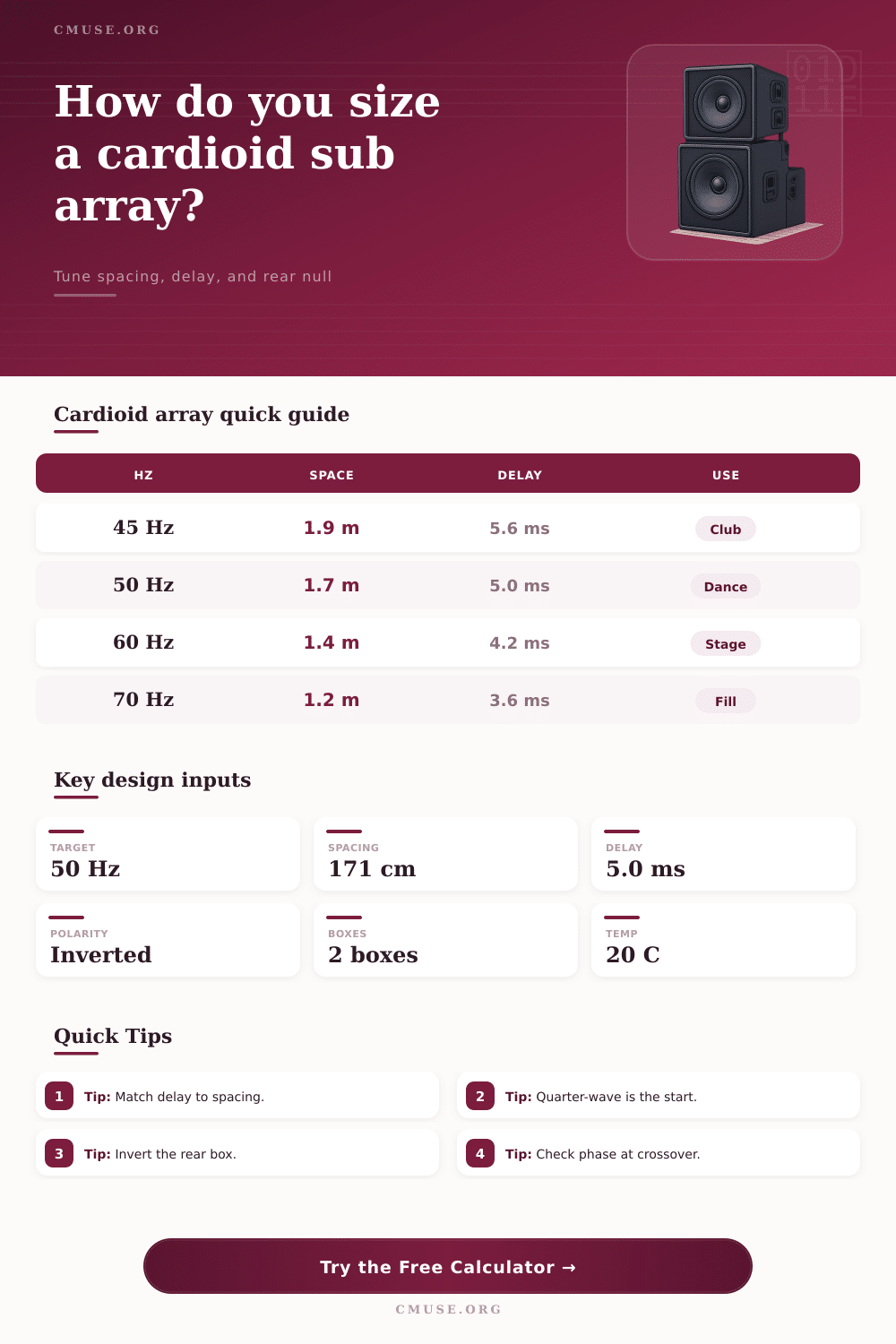
| 35-45 Hz | 7.6-9.8 m | 1.9-2.4 m | Festival low end |
| 45-55 Hz | 6.2-7.6 m | 1.6-1.9 m | Club stacks |
| 55-70 Hz | 4.9-6.2 m | 1.2-1.6 m | Stage subs |
| 70-90 Hz | 3.8-4.9 m | 0.95-1.2 m | Fill arrays |
| Spacing ratio | Delay at 50 Hz | Spacing at 50 Hz | Note |
|---|---|---|---|
| 0.20 λ | 4.0 ms | 1.37 m | End-fire bias |
| 0.25 λ | 5.0 ms | 1.71 m | Classic cardioid |
| 0.30 λ | 6.0 ms | 2.06 m | Looser throw |
| 0.33 λ | 6.6 ms | 2.28 m | Wide front line |
| Boxes | Footprint span | Delay span | Typical role |
|---|---|---|---|
| 2 | d | 1 step | Compact cardioid |
| 3 | 2d | 2 steps | Gradient start |
| 4 | 3d | 3 steps | Small arc line |
| 6 | 5d | 5 steps | Long end-fire line |
A cardioid subwoofer array is a method of directing the low-frequency sounds of a speaker in a specific direction, and it can reduce the amount of low-frequency sound that travels behind the speakers. In many musical environments, low-frequency sound radiate from a subwoofer in all directions. This can cause problem in that the sound can reflect off the walls of the venue, or it can interfere with other sound systems, such as stage monitors.
Using a cardioid subwoofer array can help to solve this problem by using the physics of sound to focus the sound of the subwoofers in one direction and cancel low-frequency sound that travels in an opposite direction. To create a cardioid subwoofer array, you must use more than one subwoofer and adjust the settings of those subwoofers. Specifically, you can use two subwoofers, but you must invert the rear subwoofer in polarity and delay it in time relative to the front subwoofer.
How to Make a Cardioid Subwoofer Array
By doing so, the low-frequency sound wave radiated from the two subwoofers will arrive at a specific point in time at a specific location in space. The sound waves from the rear subwoofer will arrive half a cycle later then the sound waves from the front subwoofer. As a result, they will interfere with each other in a way that cancel out the sound waves that travel from the rear subwoofer.
By adjusting the distance between the subwoofers to a quarter-wavelength of the low-frequency sounds that you want to cancel out, you can control the delay of the rear subwoofers sound waves relative to the front subwoofer. There are different types of subwoofer arrays that can be created for specific purpose. For example, you can create a classic cardioid array with two subwoofers to quieten a stage.
An end-fire array uses time delay to move the sound of the subwoofers further from the stage toward the audience, but they does not provide as much rejection of sound that radiates from the rear of the speakers. A gradient array uses three subwoofers to produce a more even sound in the audience. An arc array use four or more subwoofers to project sound in an arc for large crowds of listeners.
The type of array that is used will depend upon the size of the venue and the amount of rejection of sound that the array needs to create. A few environmental factors can affect the way that a cardioid subwoofer array work. For instance, temperature can change the speed of sound.
If the air in the environment is hotter then the desired operating temperature for the subwoofers, the speed of sound will be faster than calculated. This can cause the subwoofers to misfire. Another factor to consider is the depth of the cabinets of the subwoofers.
Because the sound originate from the subwoofers, the depth of the cabinets can change the way that the sound waves radiate. One more environmental factor that can affect a cardioid array is the ground plane created by the floor of the performance area. The sound waves can reflect off the floor, which will change the sound that emanate from the subwoofers.
There are a few mistakes that you can make in the creation of a cardioid subwoofer array. For instance, if you do not invert the polarity of the rear subwoofer, you will not be able to reject any sound that radiates from the rear of the subwoofer. If you set the time delay incorrect by even a single millisecond, the null point of the cardioid array will shift to a different frequency.
Finally, if you try to create a perfect null point at a specific frequency, such as 50 Hz, you will find lobe of sound at all other frequencies. Instead, focus on creating a null point at the frequency that you require the most rejection of sound for. To fine-tune a cardioid subwoofer array, use a transfer function or a mobile application to measure the sound that the subwoofers create.
Use those measurements to fine-tune the delay and the polarity of the subwoofers. Use the front-to-back sound level ratio to determine if the subwoofers are effective rejecting sound radiated from the rear of the subwoofers. When correctly tuned, a cardioid subwoofer array will direct the sound of the subwoofers toward the audience while significantly reducing the amount of low-frequency sound that emanate from the rear of the subwoofers.