Sound Absorption Coefficient Calculator
Measure alpha from incident and absorbed sound, estimate sabins, and see how thickness, air gaps, and coverage change room decay.
💡 Presets
⚙ Geometry and Measurement
💪 Material and Band
A = alpha x S
alphaeff = band alpha + thickness boost + gap boost
V = L x W x H
RT60 = 0.161 x V / Aroom
📊 Reference Tables
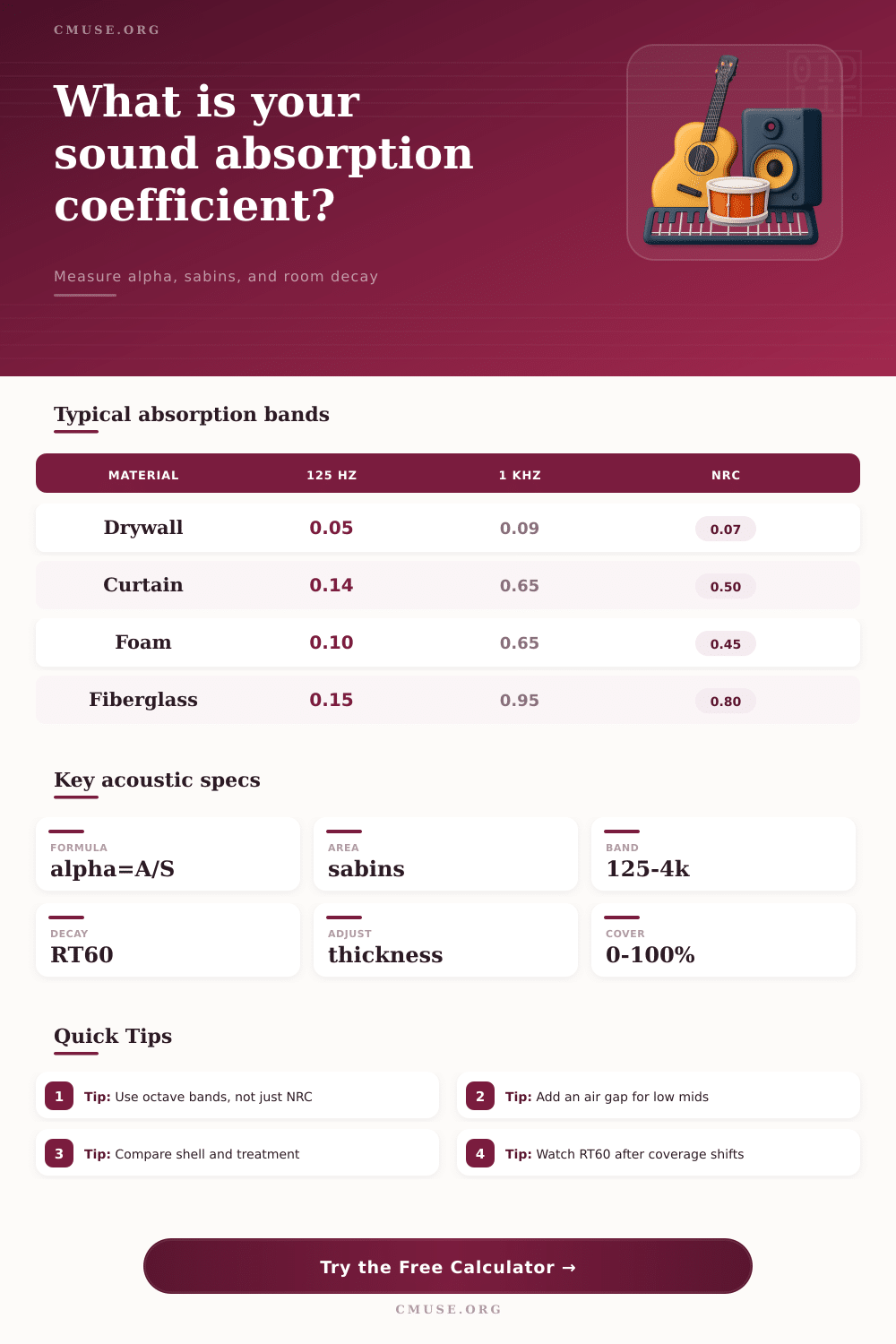
Common material bands
| Material | 125 Hz | 1 kHz | NRC |
|---|---|---|---|
| Drywall | 0.05 | 0.09 | 0.07 |
| Carpet | 0.08 | 0.45 | 0.30 |
| Curtain | 0.14 | 0.65 | 0.50 |
| Fiberglass | 0.15 | 0.95 | 0.80 |
Frequency band guide
| Band | Wavelength | Reads | Note |
|---|---|---|---|
| 125 Hz | 2.74 m | Low end | Room boom |
| 500 Hz | 0.69 m | Mid band | Box tone |
| 1 kHz | 0.34 m | Presence | Speech focus |
| 4 kHz | 0.09 m | Air band | Brightness |
Thickness and gap guide
| Build | Alpha lift | Low end | Use |
|---|---|---|---|
| 1 in | Small | Light | Reflection fix |
| 2 in + gap | Good | Better | Broadband wall |
| 4 in + gap | High | Strong | Control room |
| 6 in core | Very high | Deep | Bass control |
Room target guide
| Room use | RT60 | Mean alpha | Feel |
|---|---|---|---|
| Vocal booth | 0.20-0.35 s | 0.35+ | Dry |
| Mix room | 0.25-0.45 s | 0.25-0.40 | Tight |
| Rehearsal | 0.45-0.80 s | 0.18-0.30 | Open |
| Live room | 0.70-1.20 s | 0.12-0.25 | Warm |
📋 Comparison Grid
💡 Practical Notes
Sound absorption is a process in which a surface absorbs sound energy as opposed to reflecting the sound energy back into a listening room. The absorption coefficient (also referred to as alpha) is the measurement of the sound that a surface absorbs. If a surface have an absorption coefficient that is near zero, it will reflect most of the sound that interacts with that surface.
If a surface has an absorption coefficient that is near one, it will absorb most of the sound that interacts with that surface. If sound absorption isnt managed in a treatment plan for a room, the room may become too boomy or too loud due to excessive chatter within the room. The absorption coefficient is not a single number.
How Rooms Absorb Sound
The absorption coefficient change based off upon the frequency of the sound waves that a surface reflects, and the total area of the surfaces within that particular room. For instance, painted drywall has a low absorption coefficient at low frequencies, but has a slightly higher absorption coefficient at the frequencies used for human speech. Carpet and curtain will increase the absorption of mid-range frequencies within a room, but will not increase the absorption of low frequencies within a room.
To find the absorption coefficient of a room, the user must compare the power of the incident sound waves to the power of the sound waves that are absorb by the room. Different frequency bands requires different types of sound absorption treatments within a room. For instance, sound waves at 125 Hz have very long wavelengths and create a booming sensation within a room.
Sound waves at 1 kHz have shorter wavelengths and the 1 kHz frequency range is important for hearing the clarity of human voices. The Noise Reduction Coefficient value the absorption coefficient of a room between 250 Hz and 2000 Hz. This coefficient may reveal weakness in the absorption of a room that are not immediately apparent.
For instance, fiberglass may have a high absorption coefficient across all frequencies, but foam may have a high absorption coefficient at high frequencies, but a low absorption coefficient at frequencies below 500 Hz. Porous materials will trap vibrations most effective if the material has a thickness that is approximately one-quarter of the wavelength of the sound waves that are to be absorbed. The thickness of sound absorption materials, as well as the use of air gaps behind the absorption materials, can increase the effectiveness of sound absorption within a room.
A one-inch layer of sound absorption material will absorb some of the reflected sound waves, but will not effectively absorb low frequencies. A one-inch layer of sound absorption material, however, will not effectively absorb low frequencies if a two-inch air gap are incorporated behind the material. The total amount of sound absorption that is created within a room is based upon the percentage of the total area of the room that is covered in absorbent materials.
If thirty-five percent of a room is covered in absorbent materials, the reverberation time of the room may shift from one second to half a second. The reverberation time of a room (also referred to as the RT60 value) is a measurement of the length of time that it takes for sound to decay in a room. The reverberation time can be calculated by dividing the volume of the room by the total area that absorbs sound.
There are presets that can assist in the sound absorption decisions that must be made for a room. These presets include dimensions of the room, the types of materials that are within the room, and the ratios of the absorbed power of each frequency band within the room. Each of these presets can be altered to reflect the design of the room that is to be treated.
Shapes of the absorbers can be altered to model ceiling clouds or corner traps. These models can demonstrate the effect that the depth of the sound absorbing material has on the absorption coefficient, as well as the effect that an air gap has on the absorption of low-mid frequencies. Each model can display the impact that the Sabine model has on sound absorption, as well as the Eyring model.
The Sabine model is used to calculate the absorption coefficient of a room if the reflections of sound waves is equally distributed throughout the room. The Eyring model is considered to be more accurate if the absorption coefficients of the room is very high. There are some mistakes that many people make when treating sound absorption within a room.
One mistake is to focus too much on absorbing high frequencies, but not to incorporate bass traps to absorb the low frequencies within a room. If the hard surfaces within a room are ignored, such as glass windows, the glass windows will reflect light and increase the brightness of the sound within the room. Sound absorbing materials may not efficient absorb sound waves if they are not mounted correctly within the room.
When testing sound absorption, pink noise should be utilized rather than musical tones. Pink noise will reveal any weakness in sound absorption that may otherwise be overlooked when utilizing music. Absorption only removes sound from a room, but diffusion scatters sound within the room.
Diffusion is often incorporated into a room alongside sound absorbing materials for treatment of that room.