Counterpoint Calculator
Check species, note density, consonance, and cadence planning for cleaner two-voice or multi-voice studies.
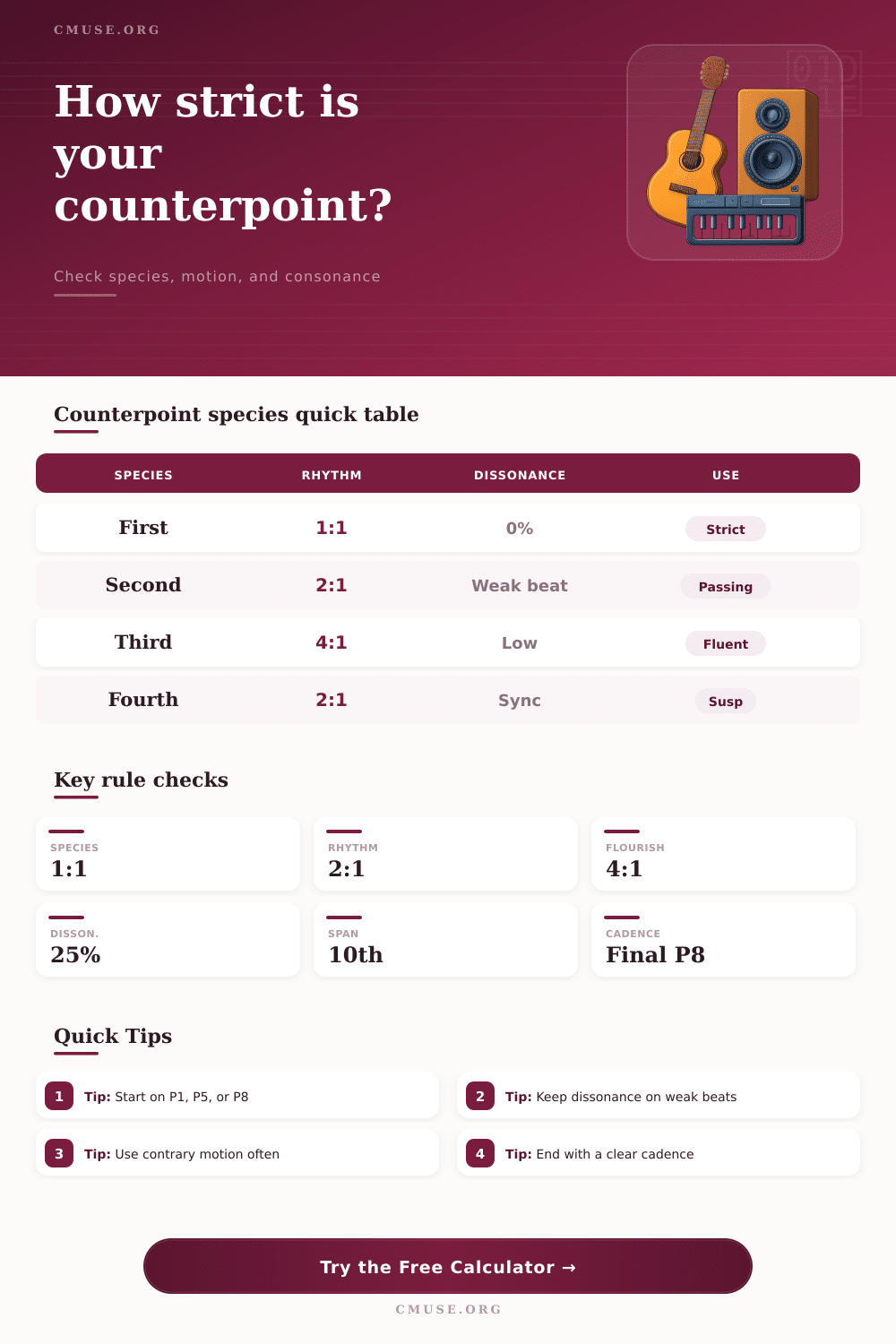
First species
Strict consonance only
Second species
Passing motion on weak beats
Third species
Fluent stepwise motion
Fourth species
Prepared suspensions
| Species | Rhythm | Dissonance | Focus |
|---|---|---|---|
| First | 1:1 | 0% | Strict |
| Second | 2:1 | Weak beat | Passing |
| Third | 4:1 | Low | Fluent |
| Fourth | 2:1 | Prep. | Suspension |
| Fifth | Mixed | Flexible | Free flow |
| Interval | Class | Use | Risk |
|---|---|---|---|
| P1 / P8 | Perfect | Start / end | Stable |
| P5 / P4 | Perfect | Outer voices | Strong |
| M3 / m3 | Imperfect | Inner motion | Gentle |
| M6 / m6 | Imperfect | Cadence color | Warm |
| 2nd / 7th | Dissonant | Passing only | Watch |
| Motion | Meaning | Risk | Best use |
|---|---|---|---|
| Parallel | Same dir | High | Avoid |
| Similar | Same dir | Med | Hidden ok |
| Contrary | Opposite dir | Low | Preferred |
| Oblique | One stays | Low | Cadence |
| Cadence | Ending | Use | Feel |
|---|---|---|---|
| Authentic | P8 / P1 | Firm close | Final |
| Plagal | P1 / P8 | Soft close | Gentle |
| Modal | P1 / P8 | Chant style | Open |
| Free | Varies | Exercises | Loose |
Counterpoint are a system of musical composition that utilize certain rules to determine how the various line of music interact with each other. Counterpoint is utilized to create two or more melodies that sound harmonious when played at the same time. The system of counterpoint require the use of interval between the notes within each line of music.
These intervals that are create between the notes must be managed so that the resulting lines of music obey the rules of consonance and dissonance within the music. A man named Fux organized the system of species counterpoint in an manual that was entitled *Gradus ad Parnassum*. Species counterpoint includes five levels of complexity.
How Species Counterpoint Works
The first species of counterpoint is the most basic level of counterpoint within this system. At the first level of species counterpoint, the two lines of music must have a relationship of note for each note within the other line. Within first species counterpoint, only consonant intervals may be utilized; dissonant intervals is not permitted within counterpoint lines.
Second species counterpoint require that the two lines of music have a relationship of two notes within the counterpoint line for each note within the cantus firmus line. Within second species counterpoint, dissonant intervals are permitted within the weak beat of the measures, but those dissonances must be used as passing tone. Third species counterpoint require that the two lines of music have a relationship of four notes within the counterpoint line for each note within the cantus firmus line.
Third species use many stepwise interval within the counterpoint line. Fourth species counterpoint focuses upon the use of suspensions within the line. Suspensions occur when a note within a line of music is held from one beat to the next to create a dissonant interval that resolve to a consonant interval.
Fifth species counterpoint combine many of the techniques from the first four species of counterpoint into a single style of counterpoint. In creating a counterpoint line, there are several factor that should be considered. For example, if the cantus firmus line consist of eight bars of music, the composer must calculate the number of notes within the counterpoint line.
For instance, if first species counterpoint is utilized, there will be eight notes within the counterpoint line. However, if third species counterpoint is utilized, there will be thirty-two notes within the counterpoint line. In addition to calculating the number of notes within each line of music, the composer should manage the voice span and the amount of dissonance within the counterpoint line.
The voice span is the distance between the highest and lowest note within the counterpoint lines. The composer can regulate the amount of dissonance within the counterpoint line to create a line that sound either more complex than the music that precedes it (by utilizing a high percentage of dissonance) or that sound more stable than the music that follows it (by utilizing a low percentage of dissonance). Another factor to consider within the composition of counterpoint lines is the motion of each line.
Counterpoint lines utilize both contrary motion and oblique motion. Contrary motion occur when the two lines of music move in opposite directions from one note to the next. Oblique motion occur when one line of music remains on the same note while the other line move to different notes.
Within counterpoint lines, the composer should avoid motion that is parallel to the other line of music (known as parallel motion). Examples of parallel motion include the movement of both lines to fifths and octaves. If these intervals are use within counterpoint lines, those lines will lose their independence to each other.
Cadences are used to end each phrase within the music or each exercise in counterpoint. Authentic cadences convey a sense of finality to each phrase, while plagal cadences convey a weaker finality to each phrase. Cadences should land on the appropriate bar of each phrase; if they land too early, the phrase will appear to be incomplete, and if they land too late, the phrase may appear to be rush.
Some of the mistakes that many student make in the study of counterpoint include attempting to learn the more complex techniques of counterpoint before learning the basic techniques of counterpoint. For instance, you should of mastered first species counterpoint before learning second and third species counterpoint. Furthermore, the composer should learn the skeleton of the music (the structure of the consonant intervals within the line) before adding more notes to the line or introducing dissonance.
By mastering each of the techniques of species counterpoint in order, composer will be able to create lines of music that are both independent and harmonious.