Schroeder Frequency Calculator
Estimate the modal-to-diffuse crossover from room volume, RT60, and air conditions for studio and control-room planning.
🎧 Room Presets
⚙ Room Inputs
Room volume: V = floor area x ceiling height.
Air speed: c = 331.3 + 0.606T + 0.0124RH.
Mode estimate: N = 4 pi V fs^3 / (3 c^3).
📊 Modal / Spec Comparison
📑 Reference Tables
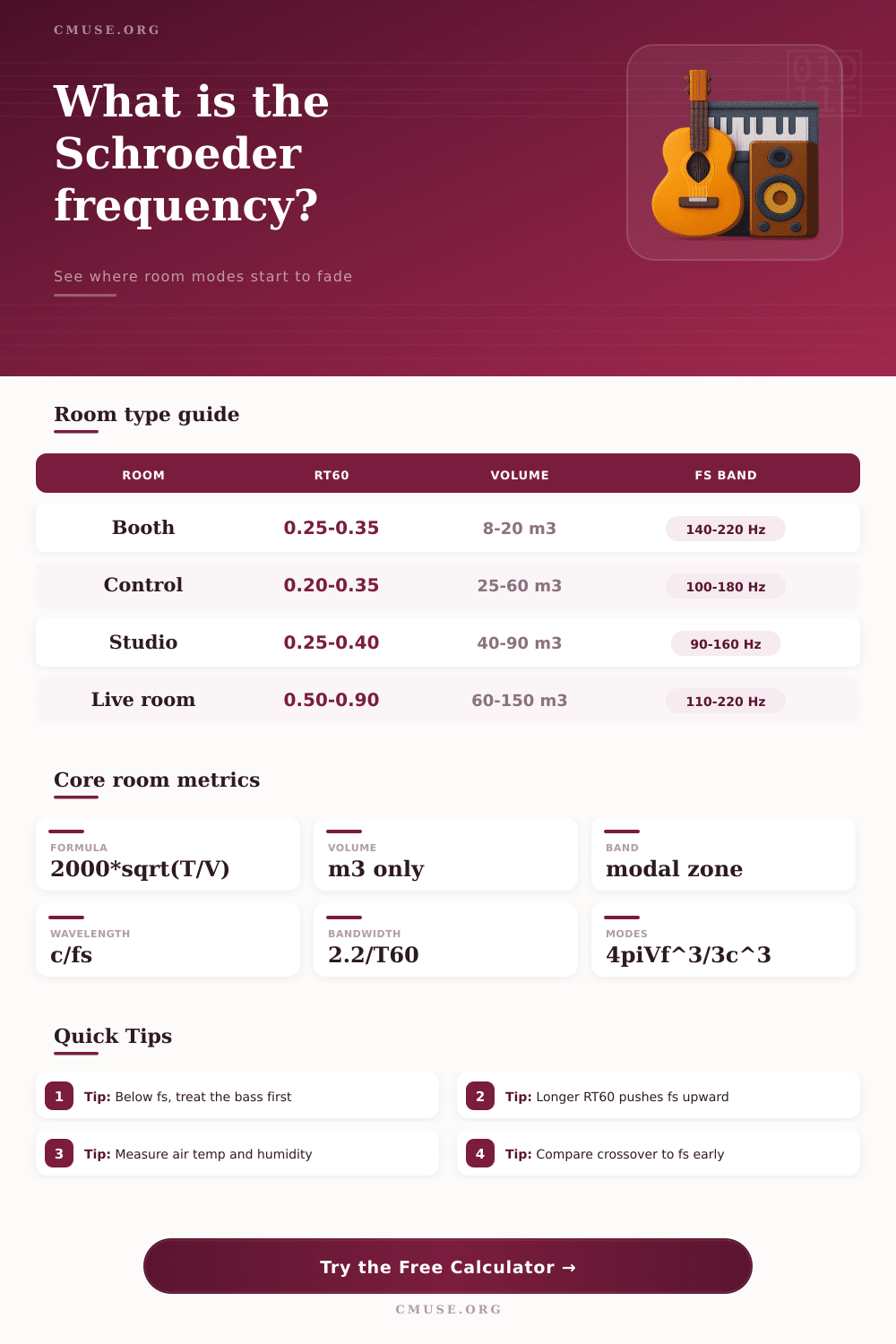
| Room type | Typical RT60 | Typical volume | Fs band |
|---|---|---|---|
| Vocal booth | 0.20-0.35 s | 8-20 m3 | 140-220 Hz |
| Control room | 0.20-0.35 s | 25-60 m3 | 100-180 Hz |
| Composer suite | 0.25-0.40 s | 30-70 m3 | 95-170 Hz |
| Project studio | 0.25-0.40 s | 40-90 m3 | 90-160 Hz |
| Live room | 0.50-0.90 s | 60-150 m3 | 110-220 Hz |
| Fs band | Meaning | Listen for | Action |
|---|---|---|---|
| < 40 Hz | Deep modal | Sub shifts | Measure and trap |
| 40-60 Hz | Very modal | Big nulls | Place carefully |
| 60-100 Hz | Modal heavy | Low-end smear | Blend treatment |
| 100-200 Hz | Transition | Less ringing | Balance speaker / room |
| > 200 Hz | Diffuse field | Even decay | Refine clarity |
| Span | First axial mode | Example | Use |
|---|---|---|---|
| 2.4 m | c / (2L) | 2.4 m wall | 71.5 Hz |
| 3.0 m | c / (2L) | 3.0 m wall | 57.2 Hz |
| 4.0 m | c / (2L) | 4.0 m wall | 42.9 Hz |
| 5.0 m | c / (2L) | 5.0 m wall | 34.3 Hz |
| 6.0 m | c / (2L) | 6.0 m wall | 28.6 Hz |
| Crossover | Relation | Typical use | Note |
|---|---|---|---|
| 60 Hz | Usually below fs | Sub focus | Room is still modal |
| 80 Hz | Often near fs | Main + sub blend | Check phase carefully |
| 100 Hz | Can sit above fs | Wide-band support | Low end needs control |
| 125 Hz | Well above fs | Large-room crossover | Room sounds more diffuse |
| 160 Hz | Far above fs | Utility systems | Less modal risk |
💡 Practical Tips
The Schroeder frequency is the specific frequency that defines how a room will behave acousticly. Depending on the frequency of the sound that enter the room, the room can behave in different ways. If the frequency of the sound that enters a room is below the Schroeder frequency of the room, the sound waves will bounce off the walls of the room.
These bounces of the sound waves creates standing waves within the room that can lead to problems with the sound emanating from the room. However, if the frequency of the sound that enters a room is above the Schroeder frequency of the room, the sound waves will scatter within the room in many different directions, instead of bouncing off the wall. This scattering of the sound waves creates a smooth acoustic field within the room.
How the Schroeder Frequency Affects Room Sound
The Schroeder frequency can be determined based off the volume of the room in which listener will be present, as well as the RT60 measurement of that room. The RT60 measurement of a room is a measurement of how long the reverb will remain within that room. The RT60 is critical to calculating the Schroeder frequency.
Rooms with large volumes will have Schroeder frequencies that are high, while rooms with small volume will have Schroeder frequencies that are low. Additionally, rooms with high RT60 measurements will have Schroeder frequencies that are high, while rooms with low RT60 measurements will have Schroeder frequencies that are low. For instance, a vocal booth can have a Schroeder frequency of 200 Hz, while a large live room may have a Schroeder frequency of 100 Hz.
To calculate the Schroeder frequency of a room, one can utilize the following formula: take the value of 2000 and multiply it by the square root of the rooms RT60 measurement; then, divide the result by the volume of the room in cubic meter. One can calculate the volume of the room by multiplying the area of the floor of the room by the height of the room. As such, the higher the height of the room, the more greater the volume of that room, and the higher its Schroeder frequency.
While the speed of sound and its relationship to temperature, humidity, and wavelength can impact Schroeder frequency, such impact are small. The shape of the room can impact the way that the mode within that room behave. Rooms that are rectangular in shape have sets of parallel walls.
These modes tend to cluster within rooms with such easily-parallel walls. While many audio recording studios have rectangular treatment rooms, the mode within those rooms can be problematic due to the presence of these planes of parallel wall. Other shape, such as triangular or circular rooms tend to distribute the modes more evenly throughout the space.
By calculating the dimensions of the area of the room with the desired Schroeder frequency, it is possible to calculate such a frequency based upon the dimensions of that shape. By comparing the Schroeder frequency of the room to the crossover point of the subwoofer that will fill the room, it is possible to treat the modes created within that room. Should the crossover point of the subwoofer be below the Schroeder frequency of the room, the room is still within its modal state at that crossover point, and those modes should be treated.
However, if the subwoofer crossover point is above the Schroeder frequency of that room, the room is within its diffuse state, and the focus should be placed upon the treatment of the phase and placement of the subwoofers, rather than the acoustic treatment of the room. For instance, if the Schroeder frequency of a room is 100 Hz, but the crossover frequency of a subwoofer is 80 Hz, the mode created by that room should be treated. The RT60 of the room is one of the primary driver of the Schroeder frequency of the space.
A room that has a long measurement for its RT60 will have a higher Schroeder frequency than a room that has a short RT60 measurement. For instance, a room with a long RT60 measurement of 0.7 seconds will have a higher Schroeder frequency than a room that has a short RT60 of 0.3 second. Thus, in a room with a long RT60, bass trap should be placed at low and wide areas within the room.
In a space with a short RT60 and low Schroeder frequency, the acoustic clarity of the room will be increased. Because the RT60 of the room alters the Schroeder frequency, a decision must be made in advance of the target RT60 for the room. The density of the mode created within a room below its Schroeder frequency can also be important to consider.
Modes tend to become more dense within areas with higher frequency sound than in areas with low frequencies. Thus, if a room contain few modes below its Schroeder frequency, the transition into a diffuse field will be abrupt. Additionally, it is important to measure the height of the room to the point of actual reflection of sound within the room.
If the height of the room is ignored, one can incorrectly calculate the volume of the room. Thus, incorrect calculation of the volume can lead to incorrect calculations of the Schroeder frequency. Based upon the Schroeder frequency calculation for a specific area, a sound engineer or room acoustician can treat the room in specific ways.
For instance, within the range of frequency below 60 Hz, deep bass traps will be required to treat the deep modes created within the room. Within the range between 100 Hz and 200 Hz, one can create a balance between bass absorbers and diffusers. Within the range of frequencies above 200 Hz, the sound systems that is playing within the room has likely surpassed the Schroeder frequency, and focus upon high frequencies may be preferred.
By calculating the Schroeder frequency of a space, sound engineers and others can gain a thorough understanding of the way in which that room will handle sound. By gaining such an understanding, those who treat that room will be able to treat it in an effective manner.