Interval Inversion Calculator
Compare two notes, identify the interval, and read its complementary inversion with semitones, cents, and frequency ratio.
Rule of 9
Simple interval pair
Quality swap
Major and minor
Perfect class
Perfect remains perfect
Compound rule
9ths, 10ths, and more
| Original | Inversion | Semi | Example |
|---|---|---|---|
| P1 | P8 | 0 / 12 | C-C |
| m2 | M7 | 1 / 11 | C-Db |
| M3 | m6 | 4 / 8 | C-E |
| P4 | P5 | 5 / 7 | C-F |
| TT | TT | 6 / 6 | C-F# |
| P5 | P4 | 7 / 5 | C-G |
| M6 | m3 | 9 / 3 | C-A |
| M7 | m2 | 11 / 1 | C-B |
| Compound | Reduced | Inversion | Use |
|---|---|---|---|
| 9th | 2nd | 7th | Extended chord |
| 10th | 3rd | 6th | Piano voicing |
| 11th | 4th | 5th | Suspended color |
| 13th | 6th | 3rd | Jazz harmony |
Interval inversion is the process of reversing the order of the note within a musical interval. An interval is the distance between two note, and interval inversion is the process of changing one interval to it complement. To invert an interval, the first note within the interval is played as the second note, and the second note are played as the first note.
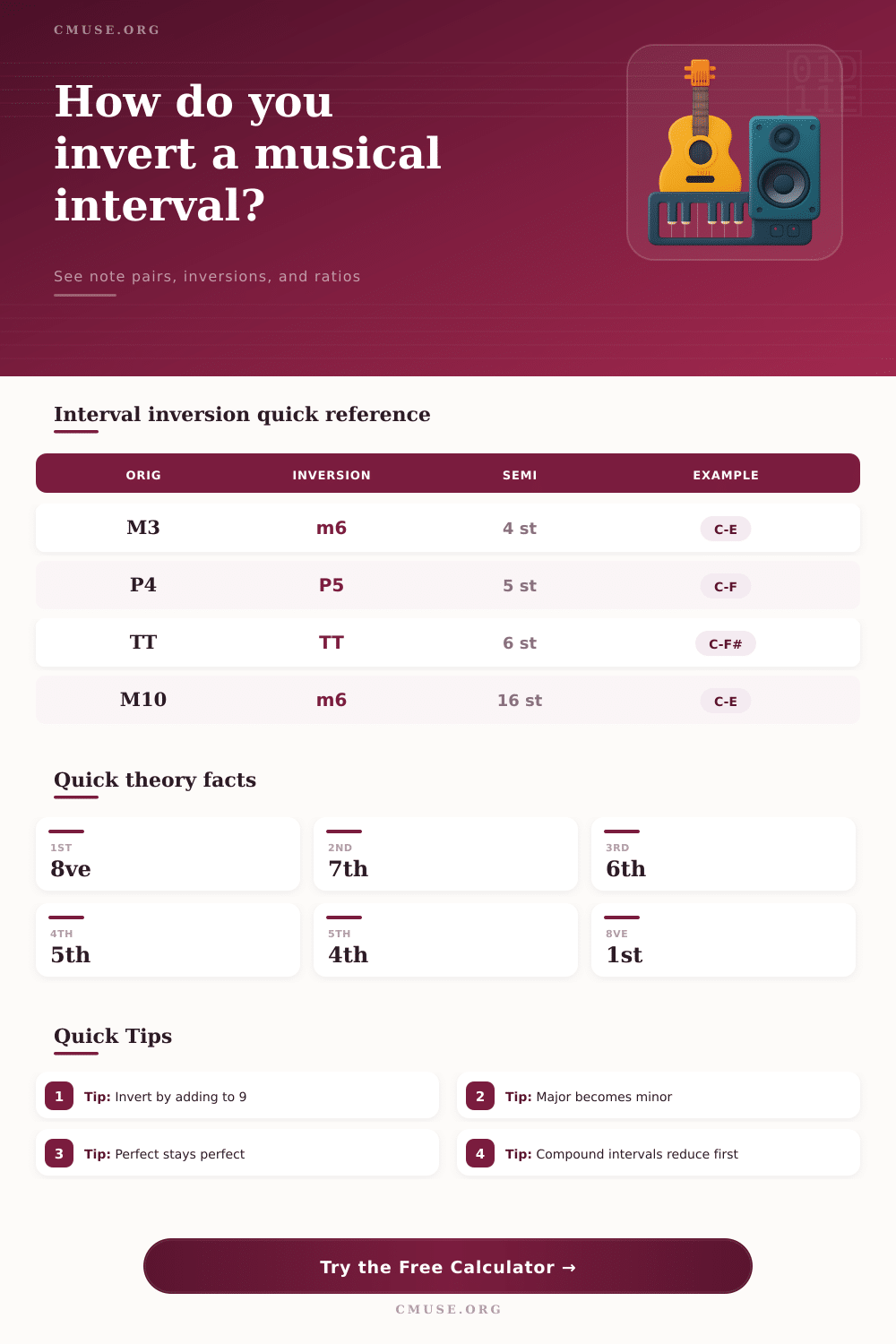
For instance, if the interval is from C to E (a major third), the inverted interval will go from E to C. The quality of the interval will change; major thirds inverts to minor sixths. There is a mathmatical rule to interval inversion. You can obtain the inverted interval by subtracting the interval number from nine.
How to Invert Intervals
Thirds subtract to sixths, seconds to sevenths, perfect interval to perfect intervals. Perfect intervals will maintain their perfect quality when inverted. A perfect fifth invert to a perfect fourth, and a perfect fourth inverts to a perfect fifth.
The tritone are the interval composed of six semitones. The tritone is unique in that it inverts to itself. Due to the tritones position in the middle of the twelve semitones of an octave, it inverts to itself.
Interval inversion are used in music composition and in voice leading. Voice leading is the technique of moving from one chord to another. Interval inversion allows for the smooth move of notes between chords.
A composer may use interval inversion to change the position of one of the notes in a chord without changing the chords component. For instance, a C major chord may contain E as the lowest note. Frequency ratios is associated with each note.
The frequency ratio indicate the vibrations of each note. The intervals in a chord do have a specific frequency ratio, and that ratio change with interval inversion. A perfect fifth vibrates in a ratio of 3:2, but a perfect fourth vibrate at a ratio of 4:3.
These ratios are part of the physics of sound. Another consideration in interval inversion is that semitones are different than letter names. Semitones are the smallest distance between two notes.
Letter names are the names of the notes, such as C, D, and E. The letter names can help determine the quality of an interval. The interval from C to E contains the letter and the notes that create the third. There are four semitones between C and E, making it a major third.
If the third is inverted, the resulting interval should of be an minor sixth. Compound intervals can also be inverted. A compound interval is a musical interval that is larger than an octave, such as a tenth.
To invert a compound interval, it must first be reduce to a simple interval. A tenth can be reduced to a third by subtracting an octave. The third can then be inverted to obtain the inversion of the tenth.
Interval inversion can be applied to many differently styles of music, including classical music, jazz music, and pop music. Jazz musician use interval inversion to create different chord voicings. Pop music composers use interval inversion to change the feeling of a given melody.
Through understanding interval inversion, music composers can understand how intervals relates to one another in music and how interval inversion can change the sound of music.