RT60 Calculator
Estimate room RT60, total absorption, and treatment coverage for speech rooms, studios, rehearsal spaces, and live rooms.
🎧 Room Presets
🔧 Geometry and Use
💪 Surface Mix
🔧 Treatment Plan
📊 Acoustic Spec Grid
📑 Reference Tables
| Room use | RT60 target | Feel | Best for |
|---|---|---|---|
| Podcast booth | 0.25-0.35 s | Tight | Speech |
| Control room | 0.25-0.40 s | Focused | Mixing |
| Rehearsal room | 0.50-0.80 s | Natural | Band work |
| Live room | 0.70-1.20 s | Open | Tracking |
| Finish | NRC-ish | Midband alpha | Use |
|---|---|---|---|
| Painted drywall | 0.05 | 0.05 | Reflective shell |
| Carpet on underlay | 0.30 | 0.30 | Speech floors |
| Heavy curtain | 0.55 | 0.55 | Soft wall |
| Acoustic tile | 0.60 | 0.60 | Ceiling control |
| Depth | Alpha lift | Low-end shift | Best use |
|---|---|---|---|
| 1 in | Light | Small | Flutter fix |
| 2 in | Moderate | Medium | Voices |
| 4 in | High | Strong | Control rooms |
| 6 in | Very high | Deep | Corner traps |
| RT60 band | Room feel | Speech | Music |
|---|---|---|---|
| < 0.30 s | Very dry | Clear | Close mic |
| 0.30-0.45 s | Tight | Good | Mix rooms |
| 0.45-0.75 s | Controlled | Okay | Rehearsal |
| 0.75+ s | Live | Soft | Room sound |
RT60 is a measurement of reverberation time. The value of RT60 is the amount of time it take for sound to decay by 60 decibels after a sound source stop making noise. If the value of RT60 is too long, the clarity of the sound will decreases.
Furthermore, if the value of RT60 is too short, the room will feel unnaturally dead. The ideal value for RT60 should be balance based off the use of the room; rooms used for podcasting will have different values of RT60 than those used for musical performances. The shape of a room will affect how sound travel within that room.
What RT60 Is and How to Control Room Sound
The shape of a room will determine how the sound energy that is released from a sound source within that room build up within that environment. Rectangular rooms will reflect sound in different ways than circular or triangular rooms. Additionally, the height of the ceiling within a room will also affect it’s RT60 value.
Rooms with taller ceilings will have more air within that room, and a larger volume of air will increase the value of the RT60 measurement of that room. The materials that people utilize within a room will affect the amount of sound that that space absorbs. For instance, painted drywall will absorb less sound than heavy curtains or acoustic tiles.
Other element that absorb sound within a room include the people and furnitures within that space. Finally, the windows within a room will also act as absorbent surfaces for sound wave, which will help to shorten the RT60 value of that space. There is a variety of acoustic calculation tools that can help room designers or architects to model the way that sound will behave within a specific room.
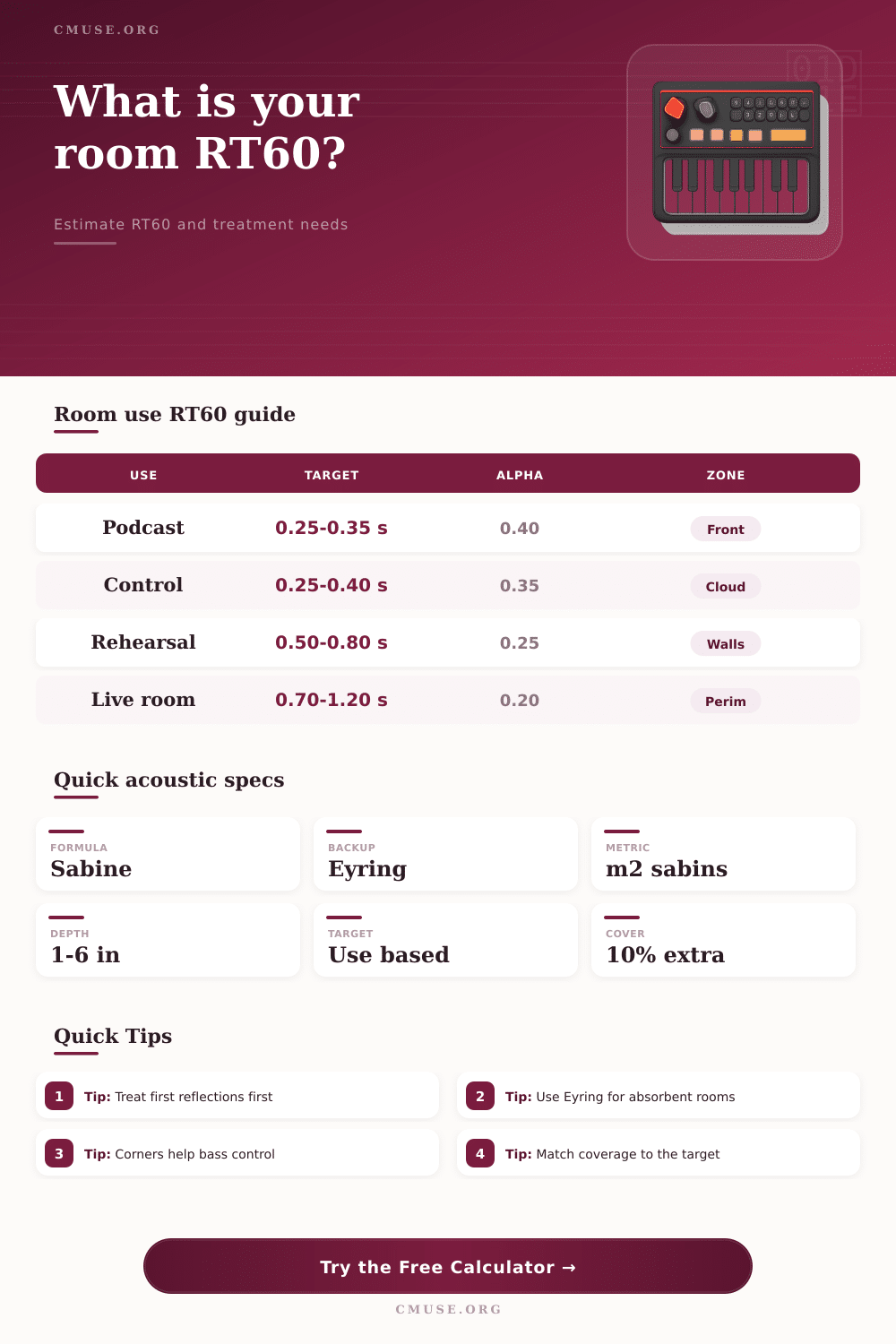
These acoustic calculation tools often use the Sabine formula or the Eyring formula. The Sabine formula is used to calculate the reverberation time within highly reflective room, while the Eyring formula is used to calculate the reverberation time within highly absorbent rooms. To use these calculation tools, you can input the dimensions of the intended room into the software, as well as the materials that will be used to line the wall and ceiling of that space.
As a result of entering these variables into the acoustic calculation tool, that software will provide a prediction of the RT60 value of that room. The treatment choice within a room will allow for the change of the rooms RT60 value. For instance, you can place acoustic panels on the front wall of a room to help to stop the reflections of sound that directly enters that wall, or you can place panels in the corners of the room to help to treat any bass that reflects off of those corners.
Additionally, the thickness of the panels will determine the frequencies of sound that that treatment absorbs; thin panels will absorb high frequencies of sound, while thicker panels will absorb low frequencies of sound. Finally, it is not necessary to cover 100% of the surface of a room with acoustic treatment; excessive treatment can result in a room that feels too dead. Instead, calculating the percentage of each surface that should be treated will allow the room to be adequately treated without becoming too absorbent for sound.
The purpose of a given room will help to determine the desired target value of the RT60 of that space. For instance, a podcasting booth may require an RT60 value of between 0.25 and 0.35 seconds, a control room will have an RT60 value of approximately 0.40 seconds, a rehearsal room may have an RT60 value between 0.50 and 0.80 seconds, and live music room may have an RT60 value between 0.70 and 1.20 seconds. Each of these RT60 values are targeted for those specific type of rooms and tasks because each task requires a specific acoustic environment to appropriately perform the necessary tasks.
It is also important to ensure that each of the different frequencies of sound within a room is treated appropriately. Thin materials can absorb high frequencies of sound, but low frequencies will require the use of thicker absorbent materials, such as bass trap that are placed within the corners of a treatment. Furthermore, it is important to treat the first reflections of sound that hit the side walls and the ceiling of a room.
Finally, it is also important to ensure that the mean absorption coefficient of a treatment is accounted for; this coefficient is a measure of the average absorption of sound that each surface of a space will absorb. Finally, another factor to consider is the environmental factor that may affect the sound that travels within a room; air temperature and humidity can impact the way in which sound travel within that space. Thus, after treating a room to contain the desired RT60 value, it may be necessary to measure the room again to ensure that the treatments were sucessful.