Horn Flare Calculator
Size exponential horn flare from throat, mouth, length, temperature, and target cutoff.
🎧 Quick Presets
🔧 Horn Inputs
Calculation breakdown
📊 Horn Reference Tables
| Cutoff | m | Min mouth | Use |
|---|---|---|---|
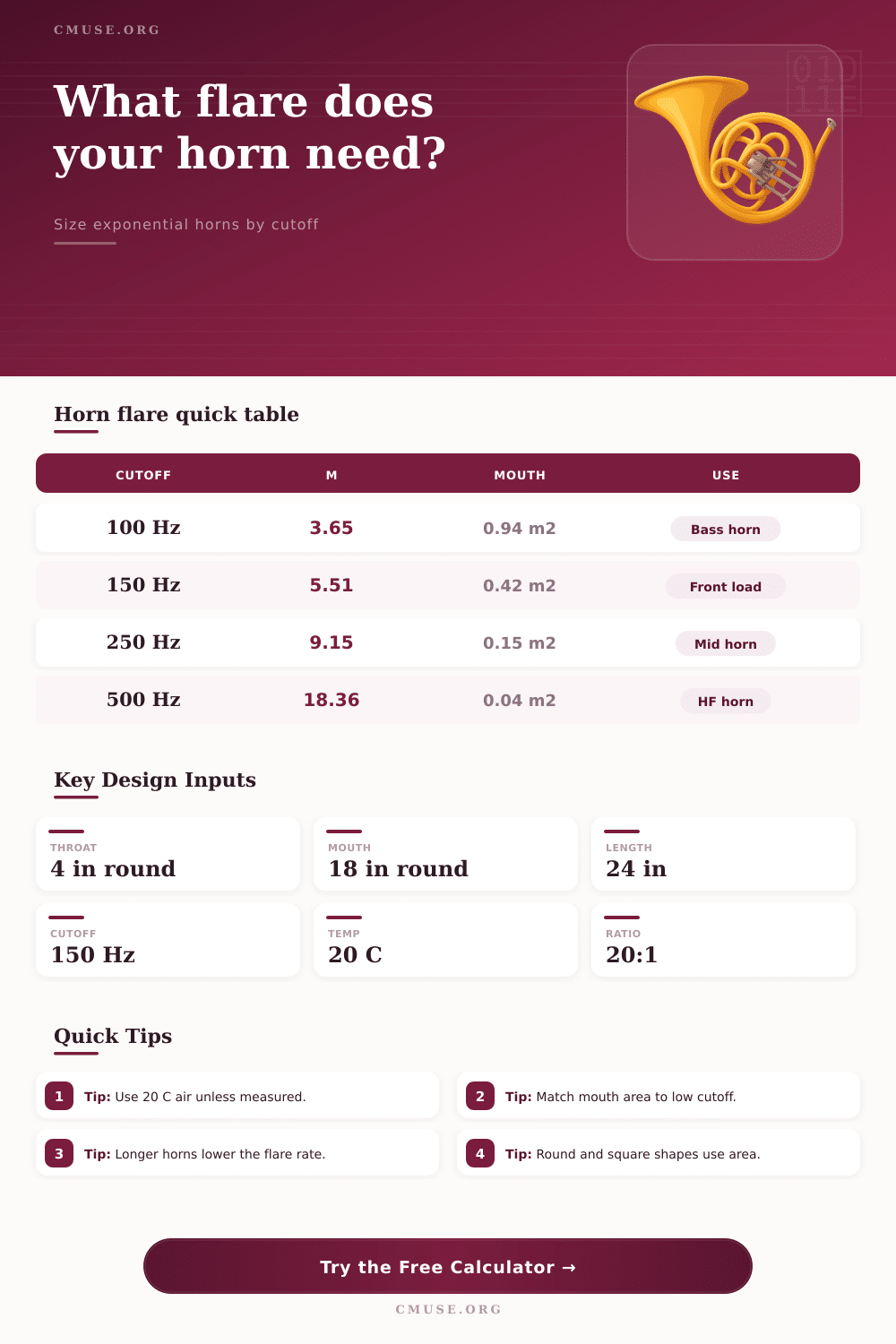
| 60 Hz | 2.20 | 2.60 m² | Giant bass |
| 100 Hz | 3.66 | 0.94 m² | Bass horn |
| 150 Hz | 5.49 | 0.42 m² | Front load |
| 250 Hz | 9.16 | 0.15 m² | Mid horn |
| Temp | c | 100 Hz wave | Note |
|---|---|---|---|
| 0 °C | 331.3 m/s | 3.31 m | Cold room |
| 10 °C | 337.4 m/s | 3.37 m | Cool room |
| 20 °C | 343.3 m/s | 3.43 m | Room temp |
| 30 °C | 349.4 m/s | 3.49 m | Warm room |
| Horn family | Cutoff band | Length feel | Comment |
|---|---|---|---|
| Bass horn | 60-120 Hz | Very long | Big mouth area |
| Front loaded | 120-250 Hz | Long | Good loading |
| Compression horn | 250-1000 Hz | Medium | Higher flare |
| Waveguide | 1 kHz+ | Short | Directivity control |
📦 Horn Design Grid
💬 Tips
Designing an exponential horn require an understanding of the mathematical relationship between the throat size, the mouth dimension, and the path length. An exponential horn gradually expand in area to load the driver and create improved sound output. The area of an exponential horn is calculate using the formula $S(x) = S_0 e^{mx}$, where the constant $m$ control the rate of expansion of the horn between the throat and the mouth.
This constant $m$ is mathematicaly linked to the horn’s cutoff frequency. If the value of the flare constant $m$ are set incorrectly, the horn will be reactive to the audio signal, which cause the horn to waste energy. The horn’s cutoff frequency, $fc$, represent the frequency below which the horn will not function as intended.
How to Design an Exponential Horn
Sound wave cannot propagate through the horn at frequencies lower than the cutoff frequency. At frequencies lower than the cutoff frequency, the horn acts as a stopped pipe that reflect the sound waves back to the driver. At frequencies more higher than the cutoff frequency, the horn increase the sensitivity of the driver.
The size of the horn’s throat determine the area from which the horn begin to expand. The throat size must match the specification of the driver. Drivers that require high level of pressure have a small throat size.
Drivers with low-cut frequency have larger throat sizes. The horns mouth must have a minimum area. If the mouth area is too small, sound output will be weak and there will be ripple at the horn’s cutoff frequency.
The temperature of the environment in which the horn will be used is another factor that need to be considered in horn design. The speed of sound in air is affect by air temperature. Changes to the temperature of the air change the speed of sound; changes in the speed of sound change the wavelength of the sound.
The temperature of the horn’s environment will impact the performance of the horn; thus, the temperature have to be accounted for in horn design. The length of the horn along its axis impact the expansion of the horn’s path. A shorter length require a higher value of the flare constant $m$ to achieve the same area expansion of the horn.
Depending on the specifications of the speaker cabinet in which the horn will be used, the area expansion might not have to be as great as the calculated factor suggest. Some horn design example can be applied to the mathematical principles described. For instance, a front loaded bass horn can be designed for 150 Hz with a 1.5-inch round throat and a 12-inch square mouth area.
The mouth area must be large enough for the horn to radiate sound effective. If the horn’s mouth area is too small for the horn’s diameter, the horn will become reactive. If you use a compression driver to create the horn, care must be taken to ensure that it does not operate below its frequency capability.
Using a compression driver with bass horns create challenges because bass horns need a very large mouth area to move the air required to create low frequency. The horn design tool include presets that can help to speed up the horn design process. A 60 Hz preset will calculate a horn with a very large mouth area and path length.
A 1 kHz waveguide preset will calculate a horn with a small throat and mouth area. The horn design tool can calculate the length of the horn that is required to achieve a target cutoff frequency. It can also calculate the growth factor of the horn.
If the calculated frequency is 20% higher than the targeted frequency, the designer can increase the path length of the horn or the horn’s mouth area can be expanded. Although the horn design formula can calculate the performance of a horn, there are other factor to consider in horn design. For instance, if the horn is in close proximity to a wall, that wall has the potential to double the mouth area of the horn.
Folding horn paths can save space on the speaker cabinet. However, folding the horn path introduce bends into the horn that may alter the sound of the horn. The material of the horn and the driver throat adapter impact the performance of the horn.
Different material have different impacts on the performance of the horn. The areas of the horn have to be equated correctly when the horn has different shape of its mouth opening. If the horn’s mouth area is not accurately equate to the area of the throat, that will lead to a loss of efficiency of the horn.
Finally, equating the horn’s cutoff frequency to the targeted frequency; calculating the minimum size of the horn’s mouth; and setting the length of the horn to the size constraints of the speaker cabinet can best improve the efficiency of the horn.