dBV to dBu Calculator
Translate consumer and pro audio line levels through real Vrms, then compare the result against common studio references and load estimates.
How it works: dBV and dBu describe the same voltage in different reference systems. This calculator converts the selected input level, shows the shared Vrms value, and highlights the fixed offset between the standards.
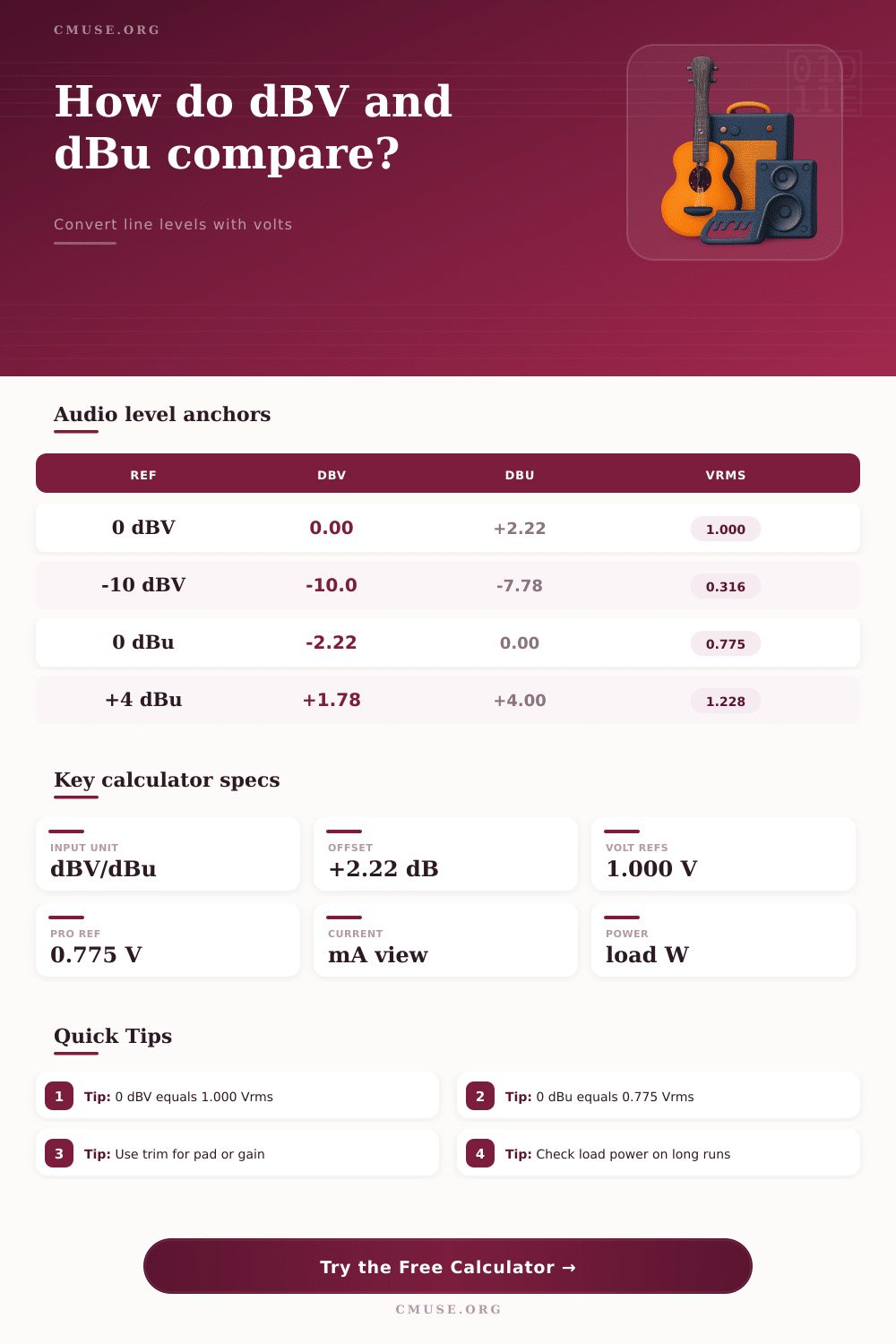
Reference anchors: 0 dBV = 1.000 Vrms and 0 dBu = 0.775 Vrms. Because the voltage bases differ, 0 dBV reads about +2.22 dBu.
| Reference | Vrms | dBV | dBu |
|---|---|---|---|
| Consumer zero | 1.000 V | 0.00 | +2.22 |
| Semi-pro line | 0.316 V | -10.0 | -7.78 |
| Pro nominal | 0.775 V | -2.22 | 0.00 |
| Broadcast line | 1.228 V | +1.78 | +4.00 |
| Device | Typical out | Equivalent | Use case |
|---|---|---|---|
| CD player | -10 dBV | 0.316 V | Semi-pro send |
| Audio interface | 0 dBV | 1.000 V | USB line out |
| Mixer main | +4 dBu | 1.228 V | Pro line out |
| Broadcast desk | +4 dBu | 1.228 V | Long cable drive |
| Vrms | dBV | dBu | Comment |
|---|---|---|---|
| 0.250 V | -12.04 | -9.82 | Quiet synth |
| 0.775 V | -2.22 | 0.00 | 0 dBu ref |
| 1.000 V | 0.00 | +2.22 | 0 dBV ref |
| 1.228 V | +1.78 | +4.00 | Pro line |
| Scenario | Input | Converted | Target cue |
|---|---|---|---|
| Consumer send | -10 dBV | -7.78 dBu | Unity-ish |
| Pro mixer | +4 dBu | +1.78 dBV | Normal line |
| Hot stage | +8 dBu | +5.78 dBV | Wide headroom |
| Quiet synth | -18 dBV | -15.78 dBu | Needs gain |
Understanding the difference between dBV and dBu is necessary because dBV and dBu are two different way of measuring voltage in audio equipment. Many people believes that dBV and dBu is the same, but they are actualy different in that they use different baseline voltages when measuring. If you dont understand how to properly measure dBV and dBu signals, you could find yourself with clipping or weak signal when you attempt to connect your consumer audio gear with your professional audio gear.
dBV use a baseline of 1 volt as its zero point.
Therefore, 0 dBV is equal to 1 volt. DBu, on the other hand, uses a baseline of 0.775 volts. Thus, 0 dBu is equal to 0.775 volts.
What is the Difference Between dBV and dBu
Because the baseline for dBV is more high than that of dBu, dBV and dBu are actually different scale. The two scales differ by 2.22 dB, meaning that the numerical value of a signal measured in dBV will be different then the same signal measured in dBu. If you connect audio equipment with a voltage standard that isnt matched to the equipment to which you are sending the signal, you will encounter various problem.
For example, if you try to send a signal that is -10 dBV into professional audio equipment, you will find that the signal is underpowered for that equipment. To compensate for this underpowered signal, you must increase the gain in the professional audio equipment, which possibly leads to noise being heard. Similarly, if you attempt to play a +4 dBu signal from professional audio equipment into consumer audio equipment, the signal will be too hot for the consumer audio equipment, clipping the signal.
The signal clips because the voltage of the +4 dBu signal is too high for the consumer audio equipment to handle. Impedance is another factor in audio signal transfer. Impedance is a measurement of the resistance of a circuit to the current flowing through it.
Many audio source have a low impedance output, but many audio equipment input have high impedance requirements. Impedance and voltage are two factor that must be considered when connecting audio equipment; if the two impedances are not compatible with one another, the audio source will have to work harder to drive the signal to the audio equipment. The signal may change or the audio hardware may overheat as a result.
Trim pad can be used to even out voltage differences between audio equipment. Trim pads allow the signal to be adjusted to reach unity. In addition to voltage and impedance, current draw is another consideration when connecting audio equipment.
Current draw is the amount of current an electrical device draws from a power source. If the audio equipment has a low impedance load, the current draw will be high. High current draw can place stress on the operational amplifier that are used in audio interfaces.
High current draw also means that the audio equipment may overheat. If the load has high impedance, the current draw will be lower. Lower current draw means that less stress will be placed on the operational amplifier, and less stress on the audio equipments will cause it to overheat.
Some of the mistake that people make with audio signals and equipment is to treat dBV and dBu as measurements of loudness. In fact, dBV and dBu are measurements of voltage. The voltage of a signal does not change, regardless of how the signal is processed with equalization or how the signal interacts with the acoustics of the room in which it is playing.
Another mistake is to forget to check the impedance of the audio equipment after setting the voltage to the proper level. Impedance must also be checked to ensure that the signal is properly functioning through the signal chain. In order to properly transfer audio signals between audio equipment, you must pay attention to the voltage level of the signal.
If you manage the voltage level of the signal correct, you will not have clipping or weak signals issue between your audio equipment. Thus, if you understand how dBV and dBu relate to voltage, you can successfully connect audio equipment of different type.