Chord Voicing Calculator
Compare close, open, drop 2, shell, and quartal stacks with note names, span, density, and register center for clear arranging decisions.
🎵 Presets
⚙ Voicing Inputs
Pick the chord shell, then shape the stack. The calculator keeps the voicing math tied to actual pitch classes, octave placement, and tension choices.
Full Breakdown
📖 Reference Tables
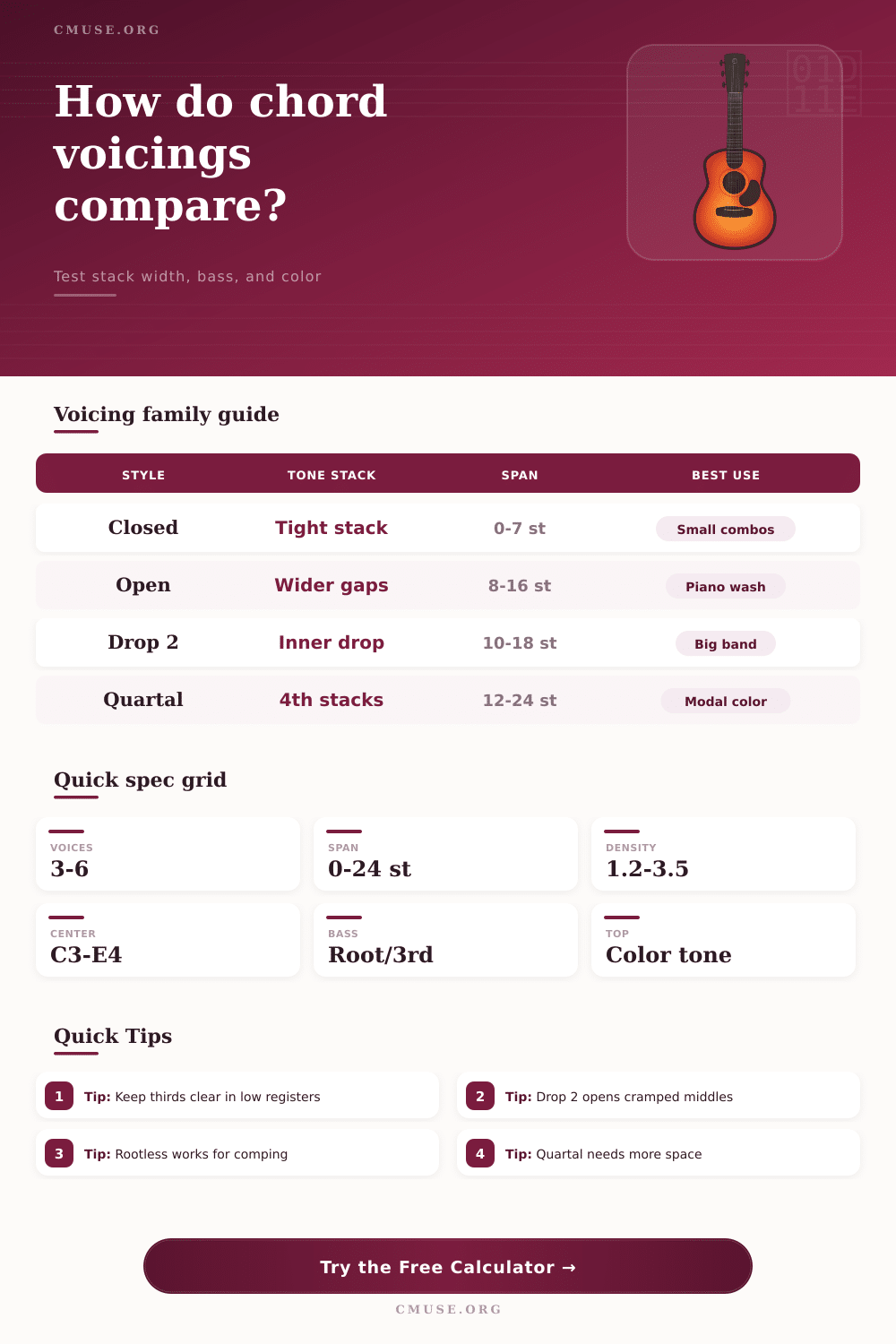
These reference tables keep the calculator grounded in practical voicing behavior, so the output is useful for arranging, comping, and orchestration.
| Family | How it moves | Span | Best use |
|---|---|---|---|
| Closed | Compact stack | 0-7 st | Short lines |
| Open | Lift upper tones | 8-16 st | Piano wash |
| Drop 2 | Drop inner voice | 10-18 st | Big band |
| Quartal | Stack 4ths | 12-24 st | Modal color |
| Quality | Formula | Guide tones | Common color |
|---|---|---|---|
| Major | 1-3-5 | 3 and 5 | add9 |
| Minor | 1-b3-5 | b3 and 5 | 11 |
| Dominant 7 | 1-3-5-b7 | 3 and b7 | 9 or #9 |
| Half-diminished | 1-b3-b5-b7 | b3 and b7 | 11 |
| Extension | Added tones | Color | Watch out |
|---|---|---|---|
| add9 | 9 | Airy | Low mud |
| 6/9 | 6 + 9 | Soft major | Root blur |
| 11 / #11 | 11 or #11 | Modern | 3rd clash |
| 13 / b13 | 13 or b13 | Bright | Thin stack |
| Range | Bass zone | Motion | Use case |
|---|---|---|---|
| Low | C2-E2 | Strong root | Pedal bass |
| Mid | C3-E3 | Balanced | Comping |
| High | C4-E4 | Bright top | Strings |
| Wide | 16 st + | Open air | Pad layers |
📊 Voicing Comparison Grid
💡 Tip Boxes
🎬 Why It Helps
This chord voicing calculator helps you audition closed, open, drop 2, shell, and quartal stacks with real note names, spans, and register centers.
Use it to test color, density, and clarity fast.
Chord voicing is the method of arranging the specific notes within a chord to create different musical sounds. Chord voicing are important in that the voicing of a chord will determine the density of the notes included within that chord and the amount of space that exists between each of those notes. If a chord is voiced in a way that creates too many notes in close proximity to one another, the chord may sound muddily.
Conversely, if the chord is voiced in a way that creates to much space between each of the notes of the chord, the chord may lose some of it’s clarity and bite. Chord voicing is also important in that it allows musicians to support a band or a soloist while still allowing space for the other musicians in that band to shine. There are different families of chord voicings that can be used in music.
How Chord Voicing Works
Some of these include closed position voicings, in which the notes of the chord are close to one another and horn sections in a band often utilize them, open voicings, in which each of the upper notes of the chord are move up by one octave and allows for the bass player in a band to have more space, drop two voicings, in which the second note of a chord is moved down by one octave and often used in big bands, shell voicings, in which only the essential notes of a chord (such as the third and seventh) are voiced and often used when a band includes a bass player who will play the root note of the chord, and quartal voicings, in which the notes of the chord are stacked in fourths and are often used to create an ambient sound within a song. Each of these voicing families use the same chord tones but create a different feeling in the music that utilize those chords. A person can use inversions to change the sound of a chord.
Root position voicings of a chord will have the root note of that chord voiced at the bottom of the chord and are often used to convey a grounded sound to listeners. Second inversion voicings of a chord will have the fifth note of that chord voiced at the bottom of the chord and allow for the other notes of the chord to move more easy. Rootless voicings are voicings of a chord that does not include the root note of the chord and are often used when a band has a bass player that will play the root note.
The fifth note of a chord can also be omitted in voicings. Omitting the fifth note of a chord can allow for that chord to have less density in the chord. Another factor that relate to chord voicing is the span and the density of the chord.
The span of the chord is the distance between the lowest note and the highest note included in the chord. The density of a chord is the number of notes that are included in a specific area of the chord, such as a specific octave. Chords with a large span and high density are often used with smaller musical groups.
For instance, a Cmaj9 chord that is voiced in a closed position will have a small span and high density and will be used in small musical groups. In contrast, an open Cmaj9 chord will have a more larger span, lower density, and provide a lighter sound to the music that is created by that chord. The distance between the third and seventh note of a chord (known as the guide tones) should of always be obvious when voicing a chord.
Another factor of chord voicing is the register in which a chord is played. Chords that are played in the lower registers of an instrument will contain more overtones than chords played in the higher registers. To avoid a muddy chord sound in the lower registers, chords should use thirds when voiced.
Conversely, chords played in the upper registers will create a brighter sound and may be used to create a sparkling effect in a band’s music. Finally, the center of the register in which a chord is voiced will determine whether that chord is voiced in the midrange or high-end frequencies of the instruments in a band. A musician can prepare for playing chords with different voicing by practicing each of the voicing presets described above.
For example, a musician can practice using a Dm11 rootless shell voicing for comping in jazz band performances or a G13 drop two voicing to create drive in rock music performances. Additionally, musicians can use quartal voicings with a wide spread between the chord tones to create the sensation of depth in a bands music without creating any clashes between the chords in that music. Through playing each of these voicings, a musician can gain an understanding of how each voicing family and span creates a different personality to a chord.