7th Chord Inversion Calculator
Map root position and every inversion of maj7, dom7, minor 7, half-diminished, and diminished chords. See the bass note, slash symbol, and stacked notes instantly.
This calculator is built for theory checks, jazz voicings, and quick slash-chord naming. Choose a root, chord quality, inversion, octave, and spelling preference, then read the full stack from bass to top.
🎵Preset Inversion Paths
Preset buttons preload a common chord shape and then recalculate the inversion and slash notation immediately.
📝Calculator Inputs
Results
Breakdown
📊Inversion Reference
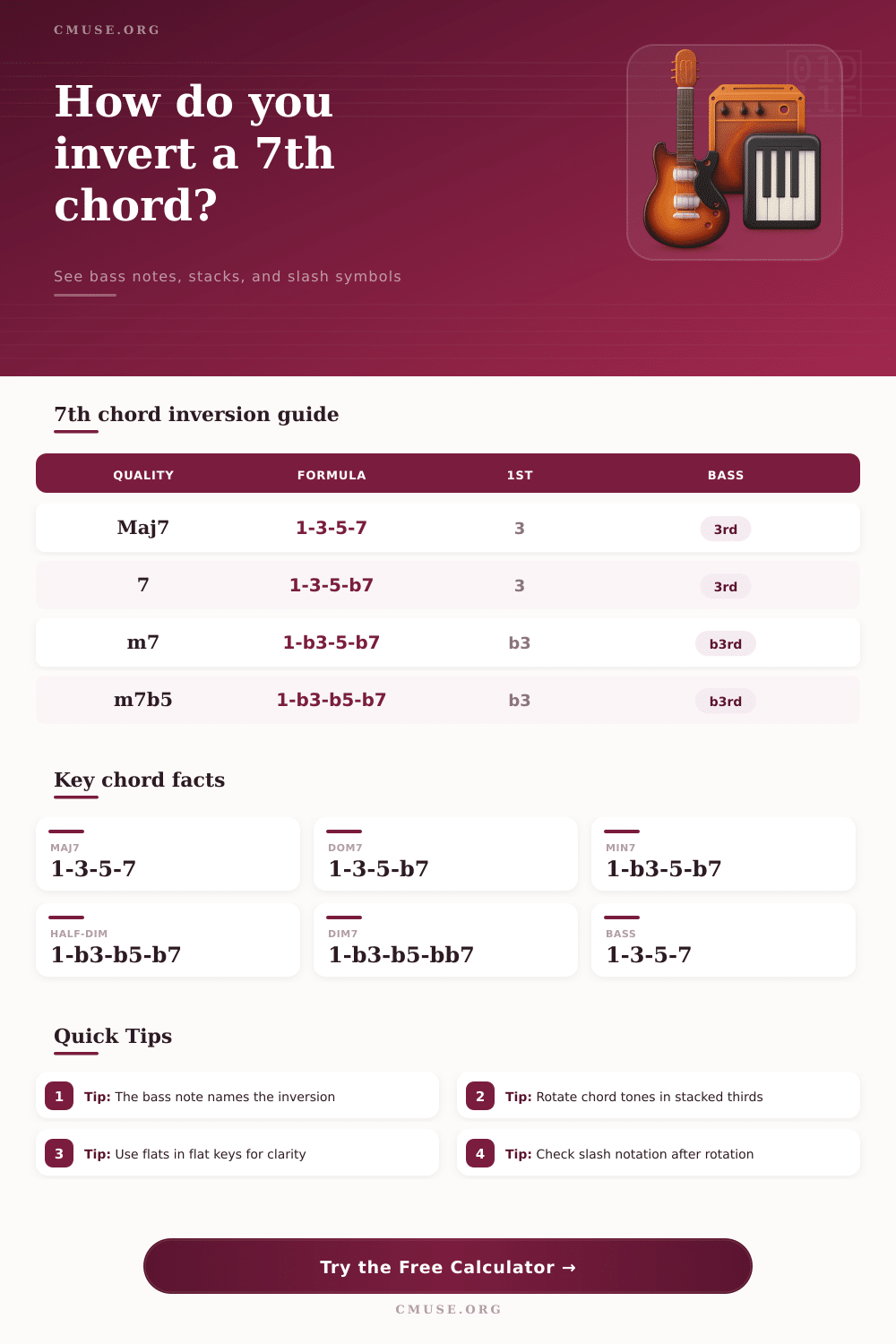
Common seventh chord formulas
| Quality | Formula | Sound | Use |
|---|---|---|---|
| Major 7 | 1-3-5-7 | Warm, glossy | Lead tone |
| Dominant 7 | 1-3-5-b7 | Tense, open | V chord |
| Minor 7 | 1-b3-5-b7 | Soft, modal | ii or vi |
| Half-dim 7 | 1-b3-b5-b7 | Lean, dark | ii in minor |
Inversion naming quick map
| Position | Bass | Slash form | Note order |
|---|---|---|---|
| Root | 1 | Cmaj7 | 1-3-5-7 |
| 1st | 3rd | Cmaj7/E | 3-5-7-1 |
| 2nd | 5th | Cmaj7/G | 5-7-1-3 |
| 3rd | 7th | Cmaj7/B | 7-1-3-5 |
📖Chord Comparison Table
| Preset | Setting | Slash chord | Stack |
|---|---|---|---|
| Cmaj7 root | C / maj7 / root | Cmaj7 | C-E-G-B |
| G7 1st | G / dom7 / 1st | G7/B | B-D-F-G |
| Dm7 2nd | D / min7 / 2nd | Dm7/A | A-C-D-F |
| Bdim7 3rd | B / dim7 / 3rd | Bdim7/A | A-B-D-F |
🎯Voicing Snapshot
This calculator turns seventh-chord theory into a practical inversion map. Use it to confirm note order, bass note, and slash notation while you build voicings or analyze harmony.
A 7th chord consist of four note: the root, the third, the fifth, and the seventh. There is several types of 7th chords, each containing a different set of note within the chord. An major 7th chord contains the notes 1, 3, 5, and 7.
A dominant 7th chord contain the notes 1, 3, 5, and an flat 7. A minor 7th chord contains the notes 1, a flat 3, 5, and a flat 7. A half diminished 7th chord contains the notes 1, a flat 3, a flat 5, and a flat 7.
7th Chords and Their Inversions
A diminished 7th chord contain the notes 1, a flat 3, a flat 5, and a double flat 7. An inversion is used to rearrange the notes of a 7th chord such that one of the chord note other than the root are at the bottom of the chord. The bottom note of a chord is refer to as the bass note.
A 7th chord’s inversion is name according to the bass note of that chord. A 7th chord in root position have the root as the bass note of the chord. A first inversion of a 7th chord have the third of the chord as the bass note.
A second inversion of a 7th chord has the fifth of the chord as the bass note. A third inversion of a 7th chord has the seventh of the chord as the bass note. A slash note after a chord indicate the bass note of that chord.
For instance, a Cmaj7/E is a Cmaj7 chord in first inversion because E is the third of the chord and the bass note of that chord. Using inversions allow for smooth movement within a progression of chords. If all of the chords in a progression use the root position of each chord, the bass line will likely jump from one note to another.
However, if inversions are used, then the bass line can feature stepwise motion. Stepwise motion for a bass line mean that each note of the bass line move to the next note of the scale. Using stepwise motion for a bass line create smooth movement within the chord progression.
Additionally, inversions can be used to change the color of a chord. An inversion of a chord will create the same chord, but it may sound different when incorporate into a song. The rotations of the notes of a 7th chord can be calculate using mathematical patterns.
To create a first inversion of a 7th chord, the root of that chord is move up one octave to the next root note, and the third of that chord is played in the bass note. This create a pattern of 3, 5, 7, 1. To create a second inversion of a 7th chord, the root and the third of that chord is moved up one octave, and the fifth of that chord is played in the bass note.
This create a pattern of 5, 7, 1, 3. To create a third inversion of a 7th chord, the root, the third, and the fifth of the chord are move up one octave to the next set of that note, and the seventh of that chord is played in the bass note. This create a pattern of 7, 1, 3, 5.
Many musicians use tools to calculate inversions. One such tool will display the notes of a chord from the bass note to the highest note of that chord. Another feature of these tools display the degree rotation of the chord.
Degree rotation display the sequence of the notes of the chord. Additionally, these tools can calculate the span of the chord. The span of a chord is the number of semitones between the lowest note and the highest note in the chord.
The span of a chord is important to understand as it can tell a musician the span of that chord based off the musician’s hand size. Finally, an inversion of a chord is not a different chord from the original. A G7/B is the same than a G7 chord and will function the same within a musical composition.
A G7/B chord is just an inversion of a G7 chord. Inversions is used to create more sophisticated music. Additionally, using inversions of chords allow a musician more control over their bass line.
Using inversions of chords is the primary method for changing the texture of a musical progression.