Scale Degree Calculator
Map any tonic, mode, and note into exact scale degree spelling, solfege, and equal-tempered frequency.
The forward solve spells the selected degree from the tonic. The reverse check compares another note against the active scale pattern.
| Degree | Note | Function | Frequency |
|---|
| Degree | Name | Solfege | Tendency |
|---|---|---|---|
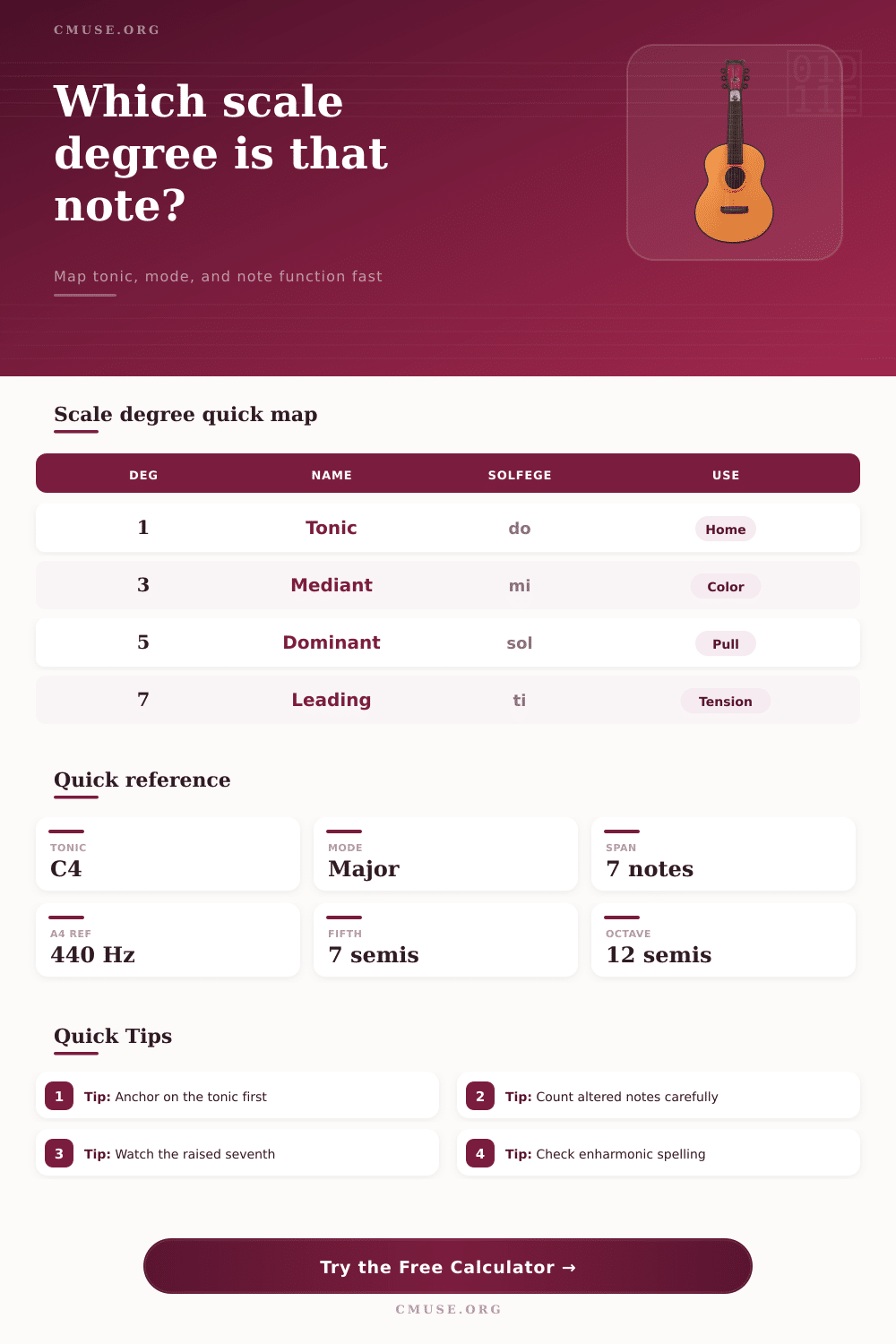
| 1 | Tonic | do | Home base |
| 2 | Supertonic | re | Leans to 1 or 5 |
| 3 | Mediant | mi | Defines color |
| 4 | Subdominant | fa | Opens motion |
| 5 | Dominant | sol | Pulls to tonic |
| 6 | Submediant | la | Softens cadence |
| 7 | Leading tone | ti | Wants to rise |
| Mode | Semitone Pattern | Altered Degrees | Color |
|---|---|---|---|
| Major | 2212221 | 7 natural | Bright and stable |
| Natural minor | 2122122 | b3 b6 b7 | Dark and flexible |
| Harmonic minor | 2122131 | 7 raised | Strong pull |
| Melodic minor | 2122221 | 6 and 7 raised | Smooth lift |
| Dorian | 2122212 | b3 b7 | Cool minor |
| Phrygian | 1222122 | b2 b3 b6 b7 | Dark and tense |
| Lydian | 2221221 | #4 | Airy and open |
| Mixolydian | 2212212 | b7 | Bluesy and loose |
| Locrian | 1222122 | b2 b3 b5 b6 b7 | Unstable color |
| Key of Degree | Common Chord | Pull Point | Practical Use |
|---|---|---|---|
| 1 | Tonic triad | Rest | Ending and home base |
| 2 | Predominant | To 5 | Preparation and motion |
| 3 | Mediant triad | To 1 or 5 | Color and branch point |
| 4 | Subdominant | To 5 | Lift into dominant space |
| 5 | Dominant triad | To 1 | Cadence and pressure |
| 6 | Submediant | To 4 or 2 | Soft pivot and contrast |
| 7 | Leading tone | Upward | Sharp resolution cue |
Scale degree refer to the specific names of the note within a musical scale. Scale degree allow a person to understand the gravitational pull of a song. If a person understands scale degrees, that person can understand how the song tend to resolve to its tonic.
However, if a person do not understand scale degrees, they will struggle with understanding how the harmony in a song work. Scale degrees will allow a person to understand the relationship between scale note, and it will help a person to understand the movement of melodies and chords within a song. The tonic is the first degree of a scale.
What Are Scale Degrees
It is also referred to as the home base of an individual scale. All scale orbit around the tonic. For example, if a person choose the note C4 as the tonic for a major scale, it will create the following pattern of semitone within that scale: whole step and half step.
These determine the identity of each of the remaining scale degree within that scale. The dominant for a scale is the fifth scale degree. The dominant create a magnetic pull on the rest of the scale towards the tonic.
The dominant is seven semitones away from the tonic. If a person use a harmonic minor scale, the seventh scale degree is raised. Raising the seventh scale degree create more tension within the scale, as it creates a sense of desire to resolve that scale note upward to the tonic scale degree.
Modes are different type of scales with altered scale degrees. Modes change the sound of the scale by altering specific note. The Dorian mode for instance keep the same major second scale degree but changes the third and seventh scale degree to flats.
The Phrygian mode change the second scale degree to a flat scale degree. A flat scale degree to the second scale degree create tension within that mode. The Lydian mode change the fourth scale degree to an added scale degree.
This scale degree create an “open” sounding mode. Modes change scale degree in specific ways that allow people to recognize which mode is being played within a song. Solfege is used to name each of the scale degree within a song.
Solfege allow a person to train their musical ear to recognize the different scale degree. For example, the note “do” always represent the tonic for a scale. This note can be used as the home note for a scale.
The note “mi” represent the third scale degree. The third scale degree within a scale will determine whether the scale sound major or minor. The note “ti” represent the seventh scale degree for a scale.
This scale degree will create a desire for that scale to resolve to its tonic. Using solfege allow a person to sing the scale. When a person sing the scale, they gain a better understanding of each of the scale degree.
Errors in music usualy result from a person misidentifying the scale degree of a note. A person can make an error in identifying a note if they make a mistake in the name of the note, or if they ignore the octave of that note. For example, if a person mistake Db for C#, they have committed an error in enharmonic spelling.
A person might also make an error if they ignore the octave of the note they are playing. If they do, they will play the wrong note. The standard reference note for music is A4 at 440 Hz.
Any change in the reference pitch of a song will change the frequency of each of the note in that song. Therefore, changing the reference pitch will change how each note sound. Chords can be constructed using the scale degree of a song.
Chords that follow the same pattern as the scale degree will sound best within a song. For instance, a tonic triad will be constructed using the first scale degree. This chord will sound stable since the tonic scale degree is the most stable scale degree.
A dominant seventh chord will use the seventh scale degree for its construction. This chord will create in listener a feeling of needing to resolve to the tonic scale degree. The scale degree can be used to construct chord progressions.
For instance, a ii-V-I progression will use the second, fifth, and first scale degree to create the movement and resolution that is characteristic of these chord. The scale degree for a song can be used to determine whether a persons note for a song is correct or incorrect. For instance, if a person place a note into a scale, the scale will reveal whether the note is within that scale or outside of it.
If a note is outside of the scale by one semitone, it might be a blue note or a borrowed note. If a persons note has an exact match to a scale degree, it will be confirmed that the note have a specific function within thats song’s scale. This method of determining whether a persons note is correct or incorrect will help that person develop musical intuition.
Intuition in music allow a person to rely less on sheet music in their music performance. If a person understand the scale degree of music, they will be able to understand the architecture of a song. A person who understand scale degree can compose or transcribe song, as well as understand how to jam along to the song with accuracy.