Microtonal Fret Calculator
Map nut-to-fret distances for EDO, quarter-tone, and custom cents systems using live scale length, compensation, and a full fret chart.
🎸 Presets
⚙ Calculator Inputs
📊 System Reference Grid
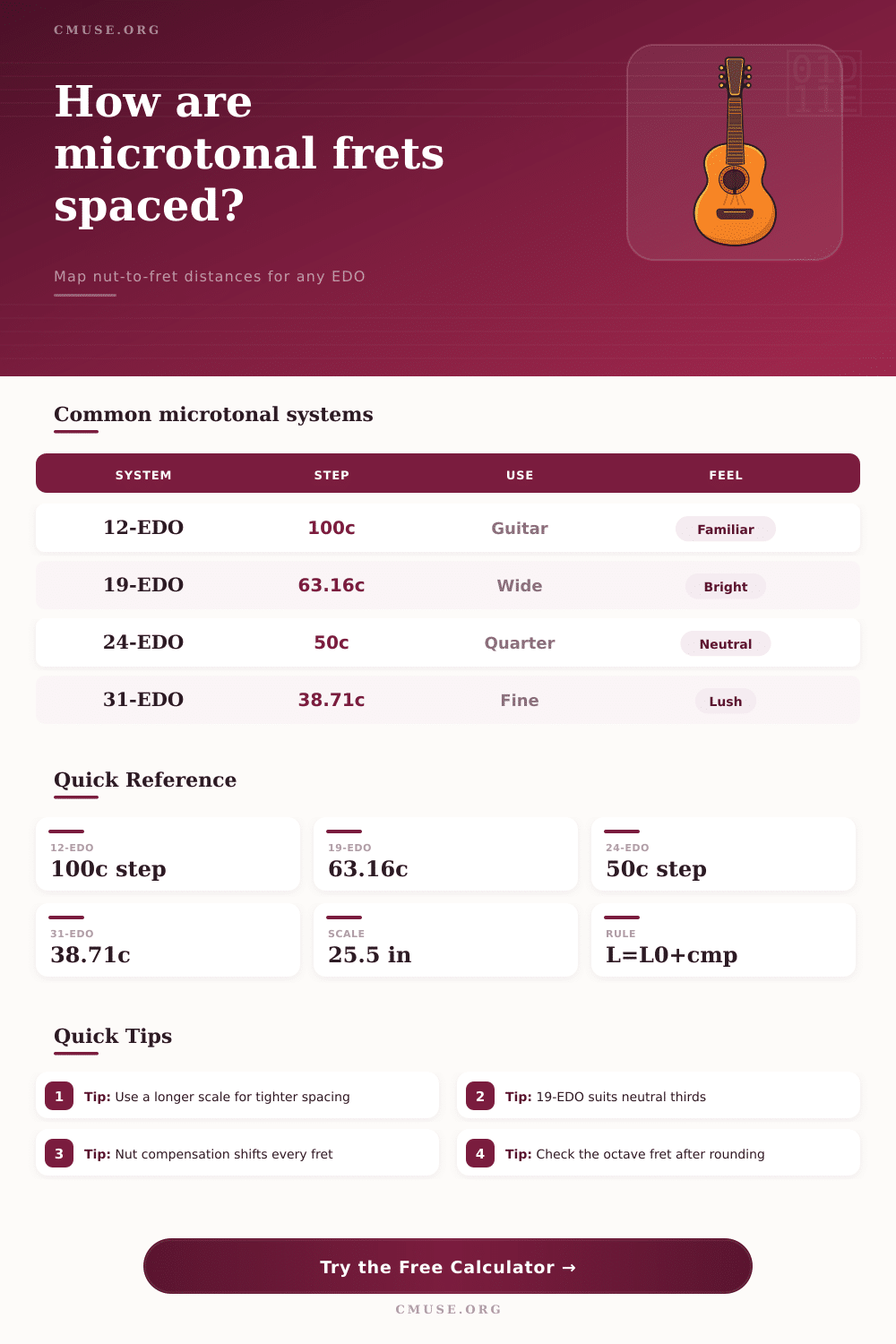
📐 Common Microtonal Systems
| System | Step | Typical Use | Character |
|---|---|---|---|
| 12-EDO | 100.00 cents | Standard guitar | Familiar |
| 17-EDO | 70.59 cents | Compact experiments | Reedy |
| 19-EDO | 63.16 cents | Neutral color | Bright |
| 24-EDO | 50.00 cents | Quarter-tone work | Neutral |
| 31-EDO | 38.71 cents | Fine harmonic blends | Lush |
| 34-EDO | 35.29 cents | Septimal shades | Edge |
| 41-EDO | 29.27 cents | Dense mapping | Precise |
| 53-EDO | 22.64 cents | High-resolution layouts | Pure |
📏 Fret Position Chart
| Fret | Position | Step | Cents | Ratio |
|---|
When building a guitar with microtonal frets, there will be more than twelve division of a musical octave. These divisions is referred to as Equal Divisions of the Octave, or EDO. Microtonal fret placements allow the guitar to play the notes that lie between the standard twelve notes of a scale.
However, because there are more divisions of an octave, the gaps between the frets will be more smaller. Thus, the scale length of the guitar will have to be considered when building a guitar with microtonal frets. Guitars with a 25.5-inch scale length is standard for guitars with twelve-tone scales.
Building a Guitar with More Than 12 Notes
For guitars with 41-EDO, however, a guitarist will require a 27-inch scale length for the frets to be playable. The longer the scale length of the guitar, the more further apart the frets will be, and the easier they will be for the guitarist to press on the instrument. The geometric ratio of the notes that will be played on the guitar will determine the positions of the frets.
Twelve frets on a standard guitar will double the vibration of the string to produce the octave note. For guitars with microtonal systems like 19-EDO and 31-EDO, though, the frets will be closer together along the neck toward the bridge. Thus, the builder will have to make compensation for the nut and the saddle of the guitar.
If compensation is not made for the nut and the saddle, the measurements for the frets will be incorrectly. Frequency input can be used to calculate the correct measurements for the frets. Frequency input allow the technician to input the frequency of a note, such as 110 Hz for a standard A note.
The software will calculate the frequency of each fret for the guitar. The step mode will have to be chosen for calculating the position of the frets. If the system chooses equal divisions, the system will use the geometry of EDO divisions.
For instance, 19-EDO will make 1200 cents of an octave divided by 19, or approximately 63 cents per division. If the technician chooses the custom cents steps, the technician can choose the size of the divisions of the octave that they want to use. For instance, if 50-cent divisions are chosen, the guitar will be able to play quarter-tone.
The formula to calculate the position of each fret is based on an exponential scale. The position of each fret will have the same formula regardless of the chosen step mode. Furthermore, the decimal precision can be increased to ensure the accuracy of the calculations.
There are many different divisions of the octave that can be used to build a guitar with microtonal frets. Twelve-EDO is the standard system. For example, 24-EDO uses 50-cent divisions and allows guitars with quarter-tones to be played.
19-EDO use intervals that are close to the pure ratios of the intervals, and many musicians choose to use 19-EDO because the intervals sound pleasing to the ear. 31-EDO divisions are even finer than 19-EDO but require longer scale lengths for the frets to be playable. However, too fine of divisions for the length of the scale will make the frets too close together for the guitarist to play efficient.
When actually building the guitar, factors such as the type of wood, the gauge of the guitar strings, and the radius of the neck will need to be considered. The type of wood will affect the vibrations of the strings. The gauge of the guitar strings will affect the tension of the strings.
The radius of the neck will impact the interaction of the guitarist fingers with the microtonal frets. Furthermore, using the presets of a guitar fret calculator will help to prototype the guitar. The presets will allow the guitarist to program systems like 31-EDO on a 26-inch scale length to test the parameter of the design before beginning construction of the guitar.
The octave fret can be used to determine if the divisions of the octave are correct. If the octave fret lands on the correct frequency that is half the open string, the guitarist has correctly calculate the measurements of the frets. Otherwise, there will be an error in the measurements of the fret positions.
Some of the most common errors in building a guitar with microtonal frets is ignoring the physical limitations of a guitarist hands. For example, putting 72-EDO on a guitar with a short scale length will produce frets that are too small for a guitarist to play efficient. Thus, the guitarist should of start with more conservative systems with fewer divisions of the octave to learn the layout of the frets.
Furthermore, the guitarist can listen to each note on a single string to ensure that the tuning of the guitar is correct. By measuring the length of the frets twice and calculating the position of each fret twice, a guitarist can avoid any error in the production of the frets that will ruin the intonation of the guitar. By adding microtonal frets to a guitar, guitarists will be able to play the notes that lie between the standard twelve notes of a musical scale.
Thus, the frets will allow guitarists to explore the continuum of pitch for there instruments.