Q to Octave Calculator
Convert Q factor to octave width, edge frequencies, and filter span for EQ, band-pass, and notch work.
🎵 Presets
⚙ Calculator Inputs
📊 Reference Tables
| Q Factor | Bandwidth | Ratio | Typical Use |
|---|---|---|---|
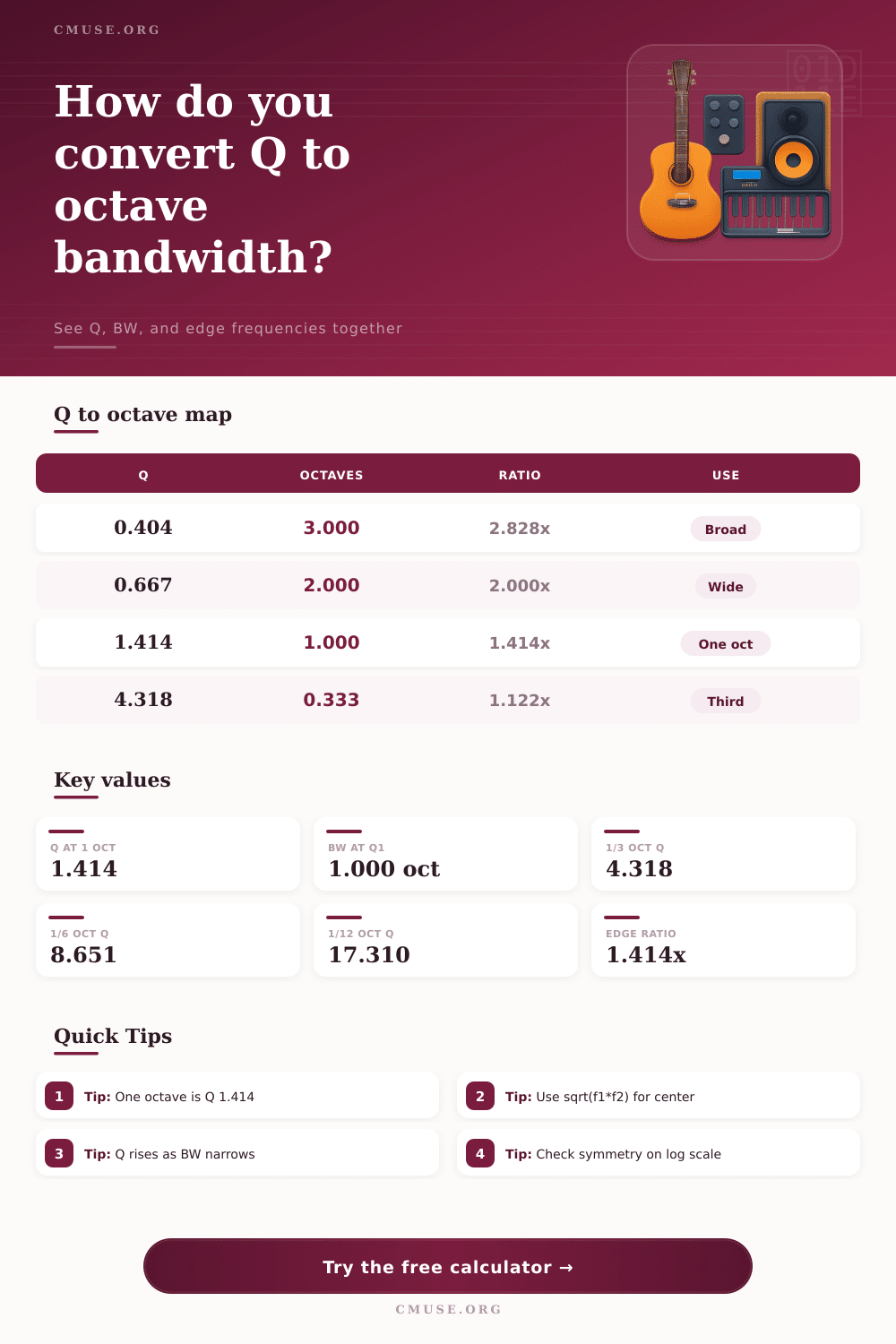
| 0.404 | 3.000 oct | 2.828x | Broad master |
| 0.667 | 2.000 oct | 2.000x | Wide tone |
| 0.920 | 1.500 oct | 1.682x | Warm bell |
| 1.414 | 1.000 oct | 1.414x | One octave |
| 2.145 | 0.667 oct | 1.260x | Two-thirds |
| 2.871 | 0.500 oct | 1.189x | Half octave |
| 4.318 | 0.333 oct | 1.122x | Third octave |
| 8.651 | 0.167 oct | 1.059x | Sixth octave |
| 17.310 | 0.083 oct | 1.029x | Twelfth oct |
| Bandwidth | Q Factor | Ratio | Reference |
|---|---|---|---|
| 3.000 oct | 0.404 | 2.828x | Very broad |
| 2.000 oct | 0.667 | 2.000x | Wide move |
| 1.500 oct | 0.920 | 1.682x | Musical lift |
| 1.000 oct | 1.414 | 1.414x | Exact octave |
| 0.500 oct | 2.871 | 1.189x | Half octave |
| 0.333 oct | 4.318 | 1.122x | Third oct |
| 0.167 oct | 8.651 | 1.059x | Sixth oct |
| 0.083 oct | 17.310 | 1.029x | Twelfth oct |
| Width | Lower Edge | Upper Edge | Span |
|---|---|---|---|
| 1/12 oct | 971.53 Hz | 1029.30 Hz | 57.77 Hz |
| 1/6 oct | 943.87 Hz | 1059.46 Hz | 115.59 Hz |
| 1/3 oct | 890.90 Hz | 1122.46 Hz | 231.56 Hz |
| 1/2 oct | 840.90 Hz | 1189.21 Hz | 348.31 Hz |
| 1 oct | 707.11 Hz | 1414.21 Hz | 707.11 Hz |
| 2 oct | 500.00 Hz | 2000.00 Hz | 1500.00 Hz |
| Band Use | Q Range | BW Range | What It Does |
|---|---|---|---|
| Broad tone | 0.4-1.0 | 1.5-3.0 | Smooth shaping across a wide arc |
| Musical bell | 1.0-3.0 | 0.5-1.5 | Balances focus and width |
| Control cut | 3.0-10.0 | 0.1-0.6 | Targets resonant peaks |
| Surgical notch | 10.0-24.0 | 0.05-0.2 | Isolates narrow ringing |
📐 Comparison Spec Grid
💡 Tips
📝 Calculation Notes
The Q to octave calculator turns filter sharpness into octave width, then shows the matching edge frequencies. Use it to match EQ bands, analyzer probes, and notch settings with confidence.
The Q factor is a measurement of the resonance of a filter. The Q factor describe how sharply the filter will peak or dip at the center frequency. High Q factors will create a narrow and sharp filter, while low Q factors will create a wide and smooth filter.
People use high Q factors when they is performing surgical tasks on there songs, while people use low Q factors for creating broad changes to a sound. The Q factor is also related to the bandwidth of the sound, and the Q factor can be used to calculate the bandwidth of filters in octaves. The bandwidth of a filter is the width of the frequency range of the filter.
Q Factor and Filter Bandwidth in Octaves
The frequency range is often measured in octaves. An octave is a unit of measurement of sound where the upper frequency value is that of the lower frequency value times two. Because the human ear perceive sound on a logarithmic scale, the relationship between the Q factor and the bandwidth measured in octaves is also on a logarithmic curve.
To account for this logarithmic relationship between the Q factor and bandwidth in octaves, a specific formula are used to calculate the bandwidth of a filter in octaves given the Q factor of that filter. The formula that involves the Q factor of that filter is used to calculate the bandwidth of a filter in octaves. For instance, in order to create a filter whose bandwidth is equal to one octave, the Q factor need to be set to 1.414.
Any other value for the Q factor will result in a bandwidth that is not equal to one octave in width. If the Q factor is 0.7, the bandwidth will be approximately two octaves. A Q factor of 2.9 will result in a bandwidth of approximately one-half of an octave.
Depending on the task that is being performed on the song, different Q factor settings can be used. For instance, when mixing a song with a bassline, a producer can use a low Q factor to create a broad sound. In contrast, a high Q factor can be used when performing tasks on a guitar solo to ensure that only a specific frequency range are affected.
High Q factors are also used for surgical equalization tasks to remove specific type of noise from a sound. The edges of a filter are the frequencies at which the boost (or cut) of the filter ends. The center frequency is the middle frequency of the filter, with the lower and upper cut-off frequencies being positioned logarithmic in relation to the center frequency.
Given that the center frequency and bandwidth of the filter are known, it is possible to calculate the frequencies at which the filter’s lower and upper edges occurs. Additionally, given that the frequencies of the edges of the filter are known, it is also possible to calculate both the Q factor and the bandwidth of that filter. It is a common mistake to assume that the Q factor of a filter set to 1.0 will result in a bandwidth of one octave.
In reality, a Q factor of 1.0 will result in a bandwidth of approximately 1.4 octave. Consequently, care must be taken when adjusting the Q factor to achieve a particular bandwidth of a filter in octaves. For example, to create a bandwidth of three octaves, a Q factor of less than 0.5 should of been used.
For narrow filters with bandwidths of one-third of an octave, a Q factor of 4.3 should be used. Finally, despite the type of filter being used in a sound mixing program, the Q factor will always remain a constant means of measuring the resonance of that filter. For example, bell filters use the Q factor to boost or cut a specific frequency.
Band-pass filters use the Q factor to allow only specific ranges of frequencies to pass through the filter. Since the Q factor and bandwidth in octaves are mathematically link, it is possible to use the Q factor to make decisions about the mix of a song. Using the concept of octaves is helpful in creating a better mix because octaves relate to the way that notes are organize in music.
Using octaves in the mixing process allows engineers to think in terms of musical notes when making there decisions about the filter settings for the sound in question.