dB/Octave Calculator
Measure level change across any octave span, then compare high-pass and low-pass rolloff in one view.
🎵 Real Presets
📊 Octave Inputs
Formula: gain change equals slope multiplied by the attenuated octaves. The pass side stays flat, while the cut side follows the selected dB/oct value.
📈 Slope Spec Cards
📑 Common Slope Reference
| Slope | 1 Oct | 2 Oct | Typical Use |
|---|---|---|---|
| 6 dB/oct | 6 dB | 12 dB | Soft tilt |
| 12 dB/oct | 12 dB | 24 dB | Common HP/LP |
| 18 dB/oct | 18 dB | 36 dB | Tighter cleanup |
| 24 dB/oct | 24 dB | 48 dB | Steep split |
📋 Octave Span Checkpoints
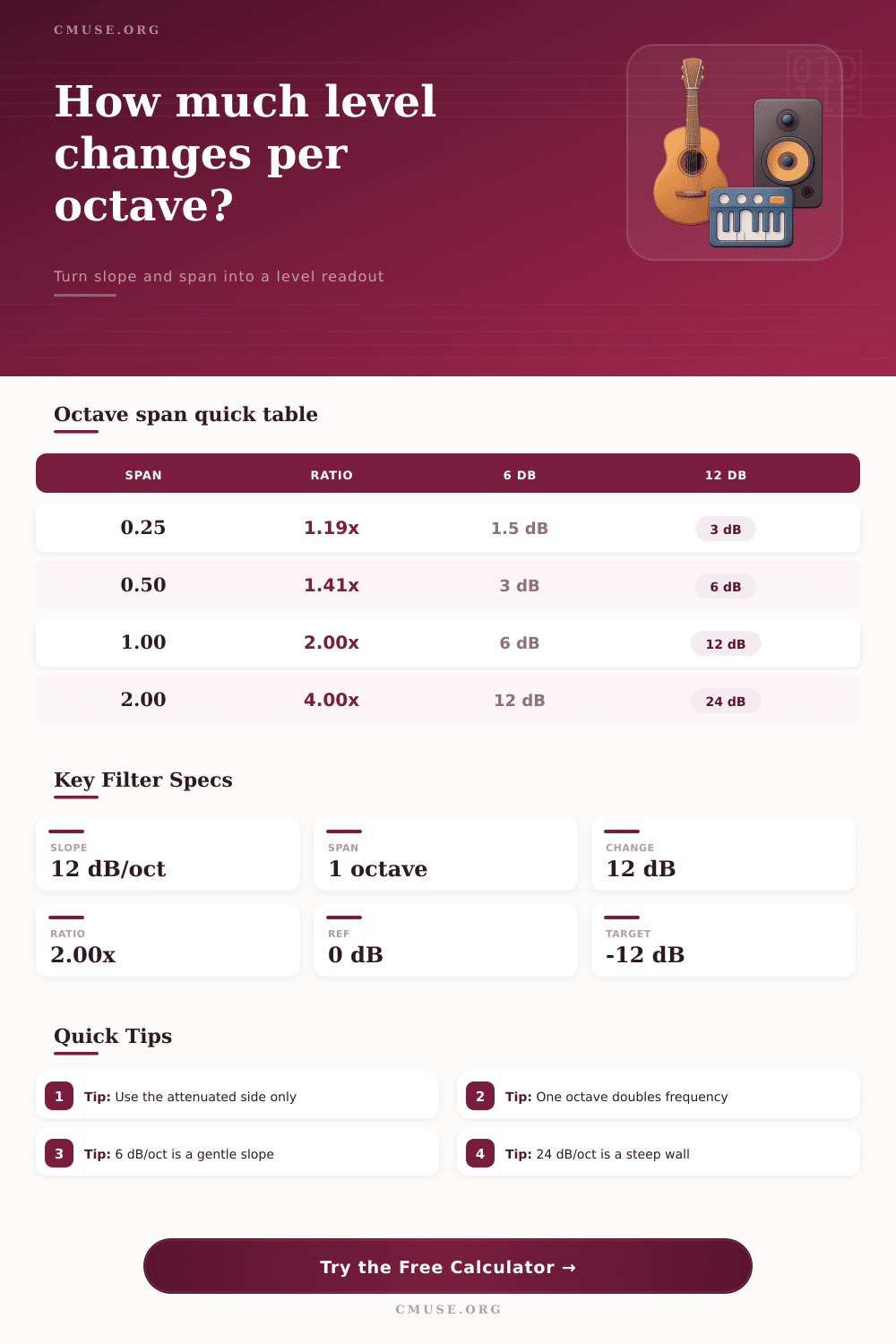
| Span | Ratio | 6 dB/oct | 12 dB/oct |
|---|---|---|---|
| 0.25 | 1.19x | 1.5 dB | 3 dB |
| 0.50 | 1.41x | 3 dB | 6 dB |
| 1.00 | 2.00x | 6 dB | 12 dB |
| 2.00 | 4.00x | 12 dB | 24 dB |
🔍 Filter Direction Guide
| Mode | Pass Side | Cut Side | Use Case |
|---|---|---|---|
| High-pass | Above ref | Below ref | Rumble control |
| Low-pass | Below ref | Above ref | Hiss control |
| Flat check | Same freq | Zero dB | Reference QA |
| Span test | Any pair | Override span | Exact compare |
🎧 Audio Use Cases
| Scenario | Span | Slope | What It Does |
|---|---|---|---|
| Vocal cleanup | 1 oct | 12 dB/oct | Trim plosives |
| Bass DI trim | 1 oct | 18 dB/oct | Tighten subs |
| Speaker crossover | 2 oct | 24 dB/oct | Sharper split |
| Synth tilt | 0.5 oct | 6 dB/oct | Gentle rolloff |
Tip Box 1
- Keep the reference on the pass side.
- One octave is a 2:1 frequency jump.
Tip Box 2
- If the target stays flat, the slope is not active.
- Double the slope to double the drop per octave.
A high-pass filter allow you to remove the low frequencies from your audio signal. A high-pass filter allows high frequencies to pass through the signal without changing there volume. The slope of a high-pass filter describes the volume decreases for a given decrease in frequency.
The slope are represented in units of decibels per octave. Within an octave, the frequency within the signal is doubled or halve. For instance, a frequency of 100 Hz will be doubled to 200 Hz within one octave.
How High-Pass Filters Work
Similarly, a frequency of 200 Hz will be halved to 100 Hz within one octave. The slope of a high-pass filter tell you the decibel reduction in volume for a distance of one octave. For instance, a 6 dB/octave slope mean that the volume will decrease by 6 decibels for every octave that the frequency move away from the cutoff frequency of the high-pass filter.
A 12 dB/octave filter will reduce the volume by 12 decibels for every octave that the frequency move away from the cutoff frequency. Filters will not reduce the volume of the audio signal at a constant rate. Instead, the slope of the filter will reduce the volume.
A 6 dB/octave filter will have a gentler slope. A 12 dB/octave filter will have a moderate slope. A 24 dB/octave filter will have a steep slope.
Steep slopes are often used to create a sharp boundary between the frequencies that pass through the filter and those that is removed. For instance, speaker crossovers often use steep slopes to ensure that each speaker maintain its specific range of frequencies. High-pass filters allow high frequencies to remain at a flat volume while low frequencies is reduced.
Low-pass filters perform the opposite function of high-pass filters. It allow low frequencies to remain at a flat volume and reduces the high frequencies. A reference frequency for the audio signal must be select for the filter to work.
The reference frequency is where the volume of the audio signal will begin to change. The relationship between the slope of the filter and the span of frequencies will determine the total change in volume of the audio signal. To calculate the total change in volume, multiply the slope of the filter by the number of octaves between the reference frequency and the target frequency.
For example, if you use a 24 dB/octave high-pass filter at 80 Hz, the volume will reduce by 24 decibels at 40 Hz because 40 Hz is one octave away from 80 Hz. If the target frequency is two octaves away from the reference frequency, the volume will reduce by twice the slope. So with the same 24 dB/octave high-pass filter at 80 Hz, the volume will reduce by 48 decibel at a frequency two octaves away from 80 Hz.
The order of a filter are related to the slope. The order will determine the steepness of the slope. For instance, a first-order filter will have a slope of 6 dB/octave while a second-order filter will have a slope of 12 dB/octave.
A fourth-order filter will have a slope of 24 dB/octave. Steeper slopes offer more precisely control over the frequencies that pass through the filter. However, steeper slopes also introduce phase rotation.
Phase rotation can alter the behavior of the sound. For instance, phase rotation can make the attack of a drum or string instrument less clearly. Thus, engineers must find a balance between the slope of the filter and the need to maintain the clarity of the audio signal.
Finally, there is some mistakes that engineers may make when using high-pass filters and low-pass filters. One mistake is assuming that the frequencies within an audio signal are linearly change when they are actually changing in a logarithmic fashion. Another mistake is ignoring the effect that the slope of the filter will have on the audio signal.
Using an extremely steep slope may remove some of the useful frequencies from the audio signal. An engineer should remember that the volume within the passband will remain at the reference volume while all frequencies beyond that passband will reduce in volume according to the slope of the filter. Finally, engineers should use there ears to listen to the audio signal to ensure that it sound appropriate with the settings for the high-pass and low-pass filters.