Octave Band to dBA Calculator
Convert octave-band SPL values from 31.5 Hz to 8 kHz into A-weighted dBA, raw broadband Z totals, and band-by-band energy shares.
🎵 Spectrum Presets
⚙ Octave-Band Inputs
LA = 10 log10(Σ 10^((Li + Ai)/10))
Sharei = 100 x 10^((Li + Ai)/10) / Σ 10^((Li + Ai)/10)
Offset = LZ - LA
Full breakdown
| Band | Input Li | A corr Ai | Weighted Li + Ai | Energy share |
|---|
📋 Meter and Analyzer Comparison
📑 Reference Tables
| Nominal band | Exact mid-band | Lower limit | Upper limit | Bandwidth |
|---|---|---|---|---|
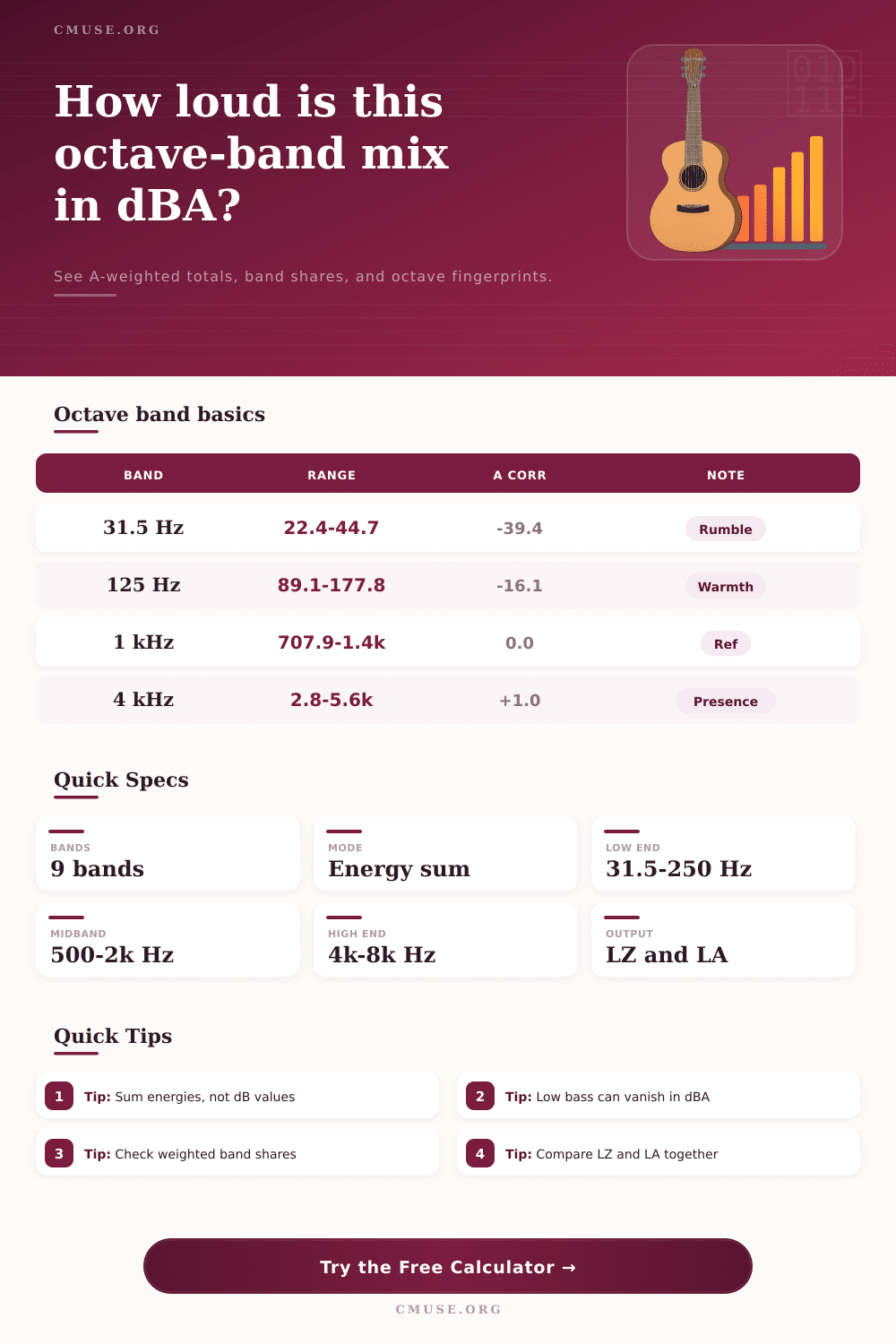
| 31.5 Hz | 31.6 Hz | 22.4 Hz | 44.7 Hz | 22.3 Hz |
| 63 Hz | 63.1 Hz | 44.7 Hz | 89.1 Hz | 44.5 Hz |
| 125 Hz | 125.9 Hz | 89.1 Hz | 177.8 Hz | 88.7 Hz |
| 250 Hz | 251.2 Hz | 177.8 Hz | 354.8 Hz | 177.0 Hz |
| 500 Hz | 501.2 Hz | 354.8 Hz | 707.9 Hz | 353.1 Hz |
| 1 kHz | 1000.0 Hz | 707.9 Hz | 1412.5 Hz | 704.6 Hz |
| 2 kHz | 1995.3 Hz | 1412.5 Hz | 2818.4 Hz | 1405.8 Hz |
| 4 kHz | 3981.1 Hz | 2818.4 Hz | 5623.4 Hz | 2805.0 Hz |
| 8 kHz | 7943.3 Hz | 5623.4 Hz | 11220.2 Hz | 5596.8 Hz |
| Band | A corr | Effect on dBA | Why it matters |
|---|---|---|---|
| 31.5 Hz | -39.4 dB | Strong cut | Sub-bass has little weight in dBA. |
| 63 Hz | -26.2 dB | Strong cut | Rumble and HVAC hum lose influence. |
| 125 Hz | -16.1 dB | Moderate cut | Warmth still matters, but less. |
| 250 Hz | -8.6 dB | Moderate cut | Lower mids still affect the total. |
| 500 Hz | -3.2 dB | Small cut | Midrange begins to stay near flat. |
| 1 kHz | 0.0 dB | Reference | A-weighting is anchored here. |
| 2 kHz | +1.2 dB | Small boost | Speech presence gets extra weight. |
| 4 kHz | +1.0 dB | Small boost | Attack and clarity stay prominent. |
| 8 kHz | -1.1 dB | Small cut | Top-end sheen eases off again. |
| Source type | Typical shape | dBA behavior | What to check |
|---|---|---|---|
| HVAC bed | 31.5-250 Hz | Offset grows fast | Compare low-band share |
| Speech at 1 m | 500 Hz-4 kHz | Tracks hearing well | Look at 2 kHz and 4 kHz |
| Pink noise | Flat per octave | Fairly balanced | Check tilt across bands |
| PA or guitar cab | 125 Hz-8 kHz | Can rise in dBA | Watch presence-band peaks |
| Band zone | Likely symptom | Common source | Listening cue |
|---|---|---|---|
| 31.5-63 Hz | Rumble | Traffic, fans, subs | Pressure and shake |
| 125-250 Hz | Boxiness | Rooms, walls, furniture | Thick chest tone |
| 500-1000 Hz | Body | Speech, instruments | Fullness vs nasal tone |
| 2-4 kHz | Presence | Consonants, attacks | Edge and clarity |
| 8 kHz | Air or hiss | Noise floor, sibilance | Sheen or top-end hiss |
Sound pressure level measurement use octave band, which are logarithmic segment of sound that range from 31.5 Hz to 8 kHz. Each band represent a portion of the sound energy radiating from the sound source. However, the sound pressure level of each octave band cannot simple be averaged to find the total sound pressure level of the source.
Since sound is a form of energy, the decibel level of each octave band must first be converted to a linear scale. The linear sound energy of each octave band can then be summed, and that total can be converted back to a decibel level to find the total sound pressure level of the sound source. If this energy summation are not performed, the total broadband sound pressure level will be incorrect.
Difference Between dBA and Z-Weighted Sound Levels
A-weighting is a method for measuring sound that take into account the way the human ear perceives sound. Since the human ear is less sensitive to low and high frequency, A-weighting applies corrections to each octave band to even out the relative perception of each frequency by the human ear. A Z-weighting measurement measures the sound pressure level of a sound source without weighting.
However, a dBA measurement applies the A-weighting to the sound pressure level of the source to find the perceived loud of the sound. For instance, a sound source that emit low frequencies will have a high sound pressure level within the low-frequency octave band. However, the A-weighting will reduce the level contribution of those band.
On the other hand, a sound source that emits frequencies within the mid-range will have less sound pressure within those bands then the low or high frequency band, but the A-weighting will increase the contribution of those band to the dBA measurement. Therefore, the dBA measurement will be lower than the Z-weighting measurement for a sound with many low frequencies. There are a variety of sound source, each with different relationship between the Z-weighting and dBA measurement.
For instance, HVAC system emit alot of low frequency, resulting in high energy within the low-frequency band. A-weighting reduce the contribution of those band to the dBA measurement. Another example is pink noise, which have equal energy within each octave band.
Therefore, the dBA measurement will be similar to the total broadband sound pressure level. A third example is speech, which occurs within a range of 500 Hz to 4 kHz. Therefore, the dBA and broadband sound pressure level will be similar.
Band share provide more information about the sound source. Band shares display the percentage of the total dBA level of a sound that each octave band contribute. Since A-weighting reduces the contribution of low-frequency band, they will have small band share.
Instead, each of the bands within the range of 500 Hz to 4 kHz will have high band share and account for 70% or more of the total dBA level. The dominant weighted band within the sound source can help to identify which frequency contribute to the total dBA level of that sound. Some common mistake when measuring sound occur.
One mistake is to calculate the total sound pressure level of a sound without energy summation. Another error is to assume that each octave band have the same energy if they have the same decibel measurements because the width of each octave band double at each step of the scale. Thirdly, individuals may not consider the position of the microphone relative to the sound source.
The position of the microphone will impact the sound pressure level that the microphone measure. Another reason to find the difference between the Z-weighted sound level and the dBA sound level is that this difference can help to diagnose the type of sound that a sound source is being create by. If the Z-weighted sound level is much higher than the dBA sound level, the sound have a bass tilt to it, meaning that the sound contains a lot of low frequency relative to the other frequency band.
Furthermore, if dBA measurement are used to determine noise ordinance for a location, the dBA measurement will indicate the level of noise that the individual in that location perceive. However, if broadband measurement are used, the total low-frequency vibration at the location can be monitored. Thus, understanding the difference between Z-weighted measurement and dBA measurement allow individuals to gain an understanding of the loudness of sound as it is perceived by the human ear.