Baffle Step Compensation Calculator
Estimate the baffle-step midpoint, shelf depth, and passive network parts from real cabinet geometry and driver data.
📋 Presets
⚙ Calculator
Breakdown
📊 Reference Tables
| Baffle width | Metric | BSC Hz | Depth |
|---|---|---|---|
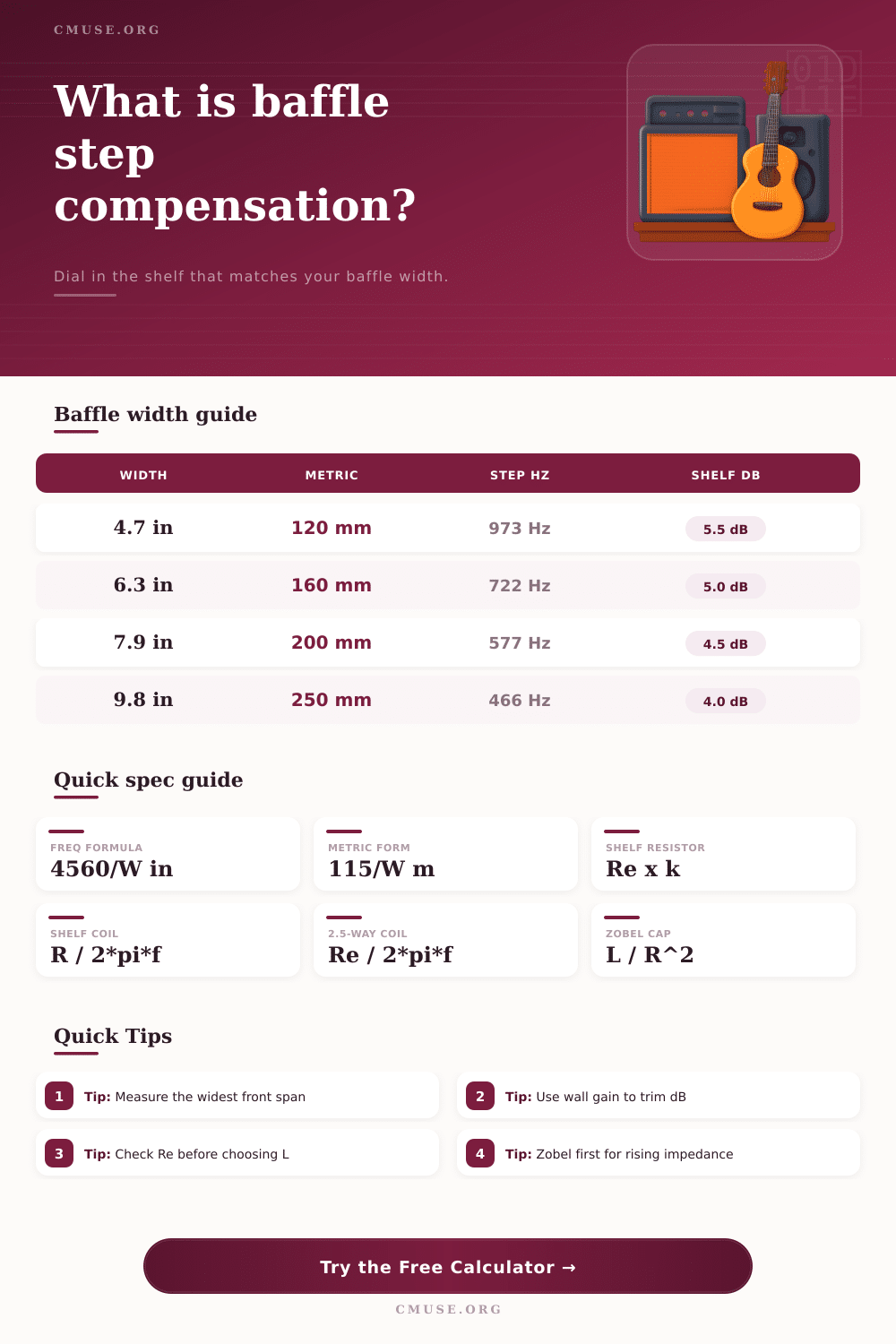
| 4.7 in | 120 mm | 973 | 5.5 dB |
| 6.3 in | 160 mm | 722 | 5.0 dB |
| 7.9 in | 200 mm | 577 | 4.5 dB |
| 9.8 in | 250 mm | 466 | 4.0 dB |
| Boundary | Hint dB | Use case | Notes |
|---|---|---|---|
| Free | 6.0 | Stand-alone | Most open-air loss |
| Near wall | 4.5 | Rear gain | Useful on stands |
| On wall | 3.5 | Wall boost | Less shelf needed |
| Soffit | 1.0 | Infinite baffle | Nearly full support |
| Topology | Primary part | Formula cue | Best for |
|---|---|---|---|
| Shelf | R + L | Re and fBSC | 2-way passive |
| 2.5-way | L only | Re / 2πf | Lower woofer |
| Zobel | R + C | 1.25 x Re | Impedance rise |
| Active EQ | DSP | Set shelf gain | Flexible tuning |
| Driver data | Good check | Why it matters | Signal |
|---|---|---|---|
| Re | Nominal ohms | Sets network scale | Ohm load |
| Lvc | mH value | Feeds Zobel cap | Rising top end |
| Width | Front span | Sets fBSC | Cabinet face |
| Offset | Top distance | Checks symmetry | Driver placement |
📝 Spec Grid
💡 Tips
Use this calculator to size baffle-step compensation from baffle width, driver resistance, and desired shelf depth, then compare passive shelf and 2.5-way choices.
Baffle step compensation are used to correct the behavior of bookshelf speakers. When bookshelf speakers play music, the sound waves emanate from the woofer of the speaker and move in various different directions depending on the frequency of the music being played. At low frequencies, the sound waves from the woofer move in all direction, radiating both in front of and behind the speaker.
However, at higher frequencies, the sound waves begin to hug the edge of the speaker cabinet. This phenomenon is referred to as diffraction and cause the sound waves to appear to emanate only from the front of the speaker. As a result, the sound output level of the speakers decrease by 6 dB.
How to Fix the Sound Drop in Bookshelf Speakers
This 6 dB drop occur between 300 Hz and 1000 Hz and makes the speakers sound thin and brightly when this drop occurs. To calculate the transition frequency of the speakers, take the value of 4560 and divide that by the width of the speakers baffle in inches. For instance, if the speaker has a narrow baffle with a width of 120 mm, the resulting transition frequency will be 970 Hz.
For a speaker with a baffle that is 250 mm wide, the transition frequency will be 460 Hz. Speakers with narrow baffles will require more compensation than those with wider baffles. The specifications of the woofer will play an important role in the design of the speaker’s passive crossover.
One of the most important values to use in the passive crossover network is the DC resistance of the woofer, Re. Since the Re for a woofer will not always be the same for each woofer, different components will be needed for a woofer with a resistance of 6 ohms compared to a woofer that has an Re of 8 ohms. The inductance of the voice coil in the woofer will play an important role in the impedance of the woofer.
The impedance will rise with frequency, which a Zobel network can compensate for. Such a network will assist the speaker’s passive crossover in performing correct. The placement of the speakers in the room will also play a role in the amount of baffle step compensation that is needed.
For example, if the bookshelf speakers are free-standing and located in the middle of the room, they will experience the full 6 dB drop in output. However, if the speakers are placed near a room wall, the gain of the sound waves reflected from that wall will reduce the 6 dB drop to 4.5 dB. If the speakers are mounted to a wall, such as in a soffit, the drop may only be 1 dB.
Thus, the geometry of the listening room will dictate the compensation requirement of the speakers. One way of providing the compensation is through the use of a passive network that includes a resistor and an inductor. Placing a resistor across the woofer and an inductor in series with the woofer will provide compensation.
The inductor can be tuned to the frequency at which the 6 dB drop occurs. To calculate the value of the resistor, multiply the Re value of the woofer by a ratio based on the decibel target. The inductor value can be calculated by dividing the calculated value of the resistor by 2 pi times the target frequency.
For 2.5-way speakers, the lower woofer will not include a resistor but will include an inductor whose size will be based on the Re value of the woofer and the target frequency. Many people will make a mistake when measuring the width of the speaker’s baffle. The trim ring or the side panels of the speaker cabinet should not be measured.
Instead, measure the width of the baffle between the widest points of the speaker’s front panels at the centerline of the speaker’s driver. Rounded edges or cutouts should be accounted for when measuring the baffle width. For circular or triangular speakers, the baffle geometry will be different, but the majority of bookshelf speakers use a rectangular baffle.
Using a Zobel network can allow for further polishing of the speaker’s frequency response. The inductance of the woofer will rise above 1 kHz. To compensate for this rising inductance, you can introduce a capacitor whose value is calculated as the inductance of the woofer divided by the squared resistance of the woofer.
Using a Zobel network is not always necessary for bookshelf speakers. However, by incorporating such a network into the speaker design, the rising impedance of the speaker will not affect the amplifiers that drive the speaker or the crossover filters of the speaker system. Another mistake to avoid is overcompensating for the baffle step.
For many speakers, the goal is to have a frequency response that is as flat as possible, but it is also important to account for the fact that humans ears are accustomed to a certain range of sound characteristics in the midrange frequencies. Most humans prefer the midrange to sound slightly forward, not flat. Finally, ensure that the components used in the passive networks are of high quality.
Air-core inductors are recommended to avoid saturation of the iron core. Additionally, non-inductive resistors are used to minimize the amount of noise that is created within the speaker system.