Speaker Sensitivity and Amplifier Power Calculator
Estimate watts, voltage, current, and SPL margin from real speaker sensitivity data.
🎧 Real World Presets
💻 Calculator Inputs
Calculation breakdown
📊 Reference Tables
| Sensitivity | W to 100 dB @ 1 m | W to 100 dB @ 3 m | Use |
|---|---|---|---|
| 82 dB | 63 W | 560 W | Small HT |
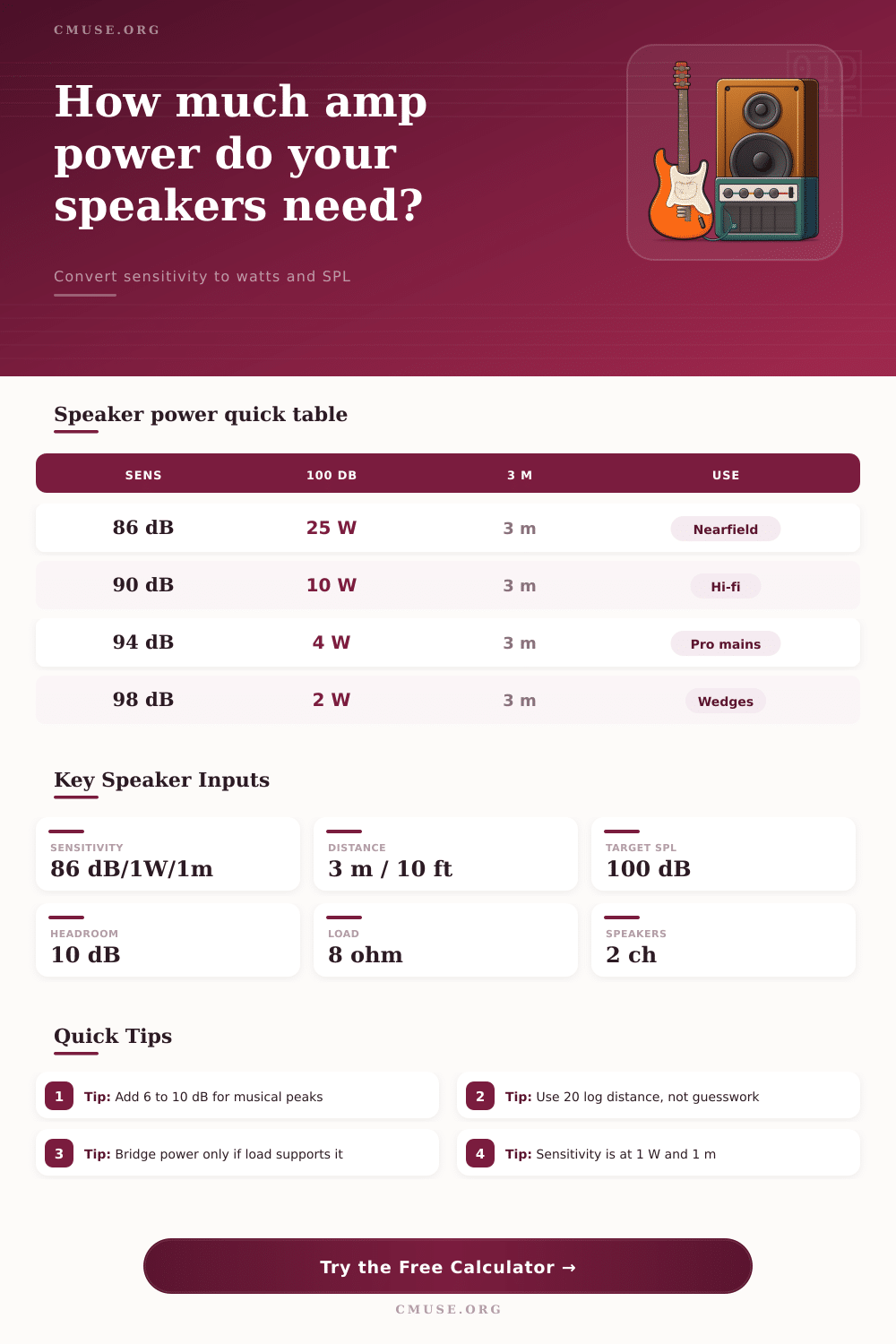
| 86 dB | 25 W | 225 W | Nearfield |
| 90 dB | 10 W | 90 W | Hi-fi |
| 94 dB | 4 W | 36 W | Pro mains |
| Distance | Loss | Power x | Comment |
|---|---|---|---|
| 1 m | 0 dB | 1.0x | Reference |
| 2 m | 6.0 dB | 4.0x | Double dist |
| 3 m | 9.5 dB | 9.0x | Living room |
| 4 m | 12.0 dB | 16.0x | Small stage |
| Load | V RMS @100W | I RMS @100W | Note |
|---|---|---|---|
| 4 ohm | 20.0 V | 5.0 A | Harder load |
| 6 ohm | 24.5 V | 4.1 A | Common |
| 8 ohm | 28.3 V | 3.5 A | Typical |
| 16 ohm | 40.0 V | 2.5 A | Easy drive |
| Use | SPL | Count | Range |
|---|---|---|---|
| Nearfield | 78 dB | 1-2 | Desk |
| Living rm | 82 dB | 2 | Seat |
| Rehearsal | 98 dB | 2-4 | Band |
| Front PA | 103 dB | 2-8 | Crowd |
📦 Speaker Spec Grid
💬 Tips
When you purchase new speaker, there are often specifications on the speaker packaging. These specification will include information about the sensitivity of the speakers and their impedance. The sensitivity of the speakers is a measurement of how loud the speakers will become when they receives one watt of power at a distance of one meter.
The impedance of the speakers is a measurement of the electrical resistance of the speakers, and it is often measured in unit of ohms. These two factor must be considered when you are purchasing an amplifier, as they must match with the speakers to avoid distortion from the speakers or an inability of the speakers to reach the desired volume. The sensitivity of the speakers will impact how much power you must supply to the speakers to create the desired volume.
How to Choose the Right Amplifier for Your Speakers
With high sensitivity speaker, it will require less power to create loud sounds from the speakers. For low sensitivity speakers, it will require more power to create loud sounds from the speakers. Your distance from the speakers will also impact the volume of sound that you hear from the speakers.
If you are twice as far from the speakers, you will hear the speakers at a volume six decibels more lower than if you were standing closer to the speakers. Because of this, you should consider your distance from the speakers and the sensitivity of the speakers when you are purchasing an amplifier for your speakers. Impedance is also one of the factors that will impact how the amplifier perform with the speakers.
Most speakers will have an impedance of eight ohms, though some speaker will have an impedance of four ohms. Speakers with four ohms of impedance will require more current from the amplifier than speakers with eight ohms of impedance. Additionally, the boundaries of the room in which the speakers are used can also impact the volume of sound that is heard.
Walls can reflect the sound back to the listeners, adding two to six decibels of volume to the speakers. When you are purchasing an amplifier for your speakers, you should consider the continuous power rating of the speakers over the peak power ratings of the speakers. The peak power ratings of the speakers indicate the maximum amount of power that the speakers can handle.
The continuous power ratings of the speakers indicate the amount of power that the amplifier should be able to provide to the speakers. If the amplifier cannot provide enough power for loud sections of music, it will clip the audio signal. Audio clipping will cause the speakers to become distorted.
Depending on the environment in which you will be using your speakers, the speakers may require different power levels to perform effective. For instance, nearfield studio monitors are used for listening to music at close distances to the speakers. Because of this, they do not require as much power as speakers that are used in a living room.
Living room speakers are often used at a distance from the listeners, so they requires more power. Additionally, professional stage speakers have high requirement for the power they recieve from amplifiers because they must be loud enough to compete with the other sound that may be happening on stage. Furthermore, professional stage speakers often do not benefit from the reflections of sound off the walls in the room.
Another factor to consider when purchasing speakers and amplifiers is the dynamic range of the music that will be played with those speaker. Dynamic range refers to the difference in volume between the quietest and loudest sound in a song. For example, speech has a relatively low dynamic range, while rock music has a high dynamic range.
Therefore, music with a high dynamic range will require more headroom from the amplifier to handle loud sections of the song without clipping the audio signal. To recap, you can calculate the relationship between the various factor related to speakers and amplifiers. If you understand the sensitivity of the speakers, you will understand how much power will be needed to create the desired volume from the speakers.
If you understand the impedance of the speakers, you will understand how much current the amplifier will need to supply to the speakers. Additionally, if you understand the distance that the listeners will be from the speakers and the boundaries of the rooms, you will understand how much the environment may impact the volume of the speakers. By considering and calculating each of these factor, you will be able to select the correct amplifier for your speakers.