Dotted Quarter to Quarter Note Calculator
Convert dotted-quarter note counts into quarter-note values, tempo equivalents, and bar lengths for compound-meter charts.
🎵 Quick Presets
The BPM field follows the selected beat unit, so a dotted-quarter tempo converts cleanly into quarter-note timing and back again.
⏱ Note Inputs
📊 Core Ratios
📖 Note Value Reference
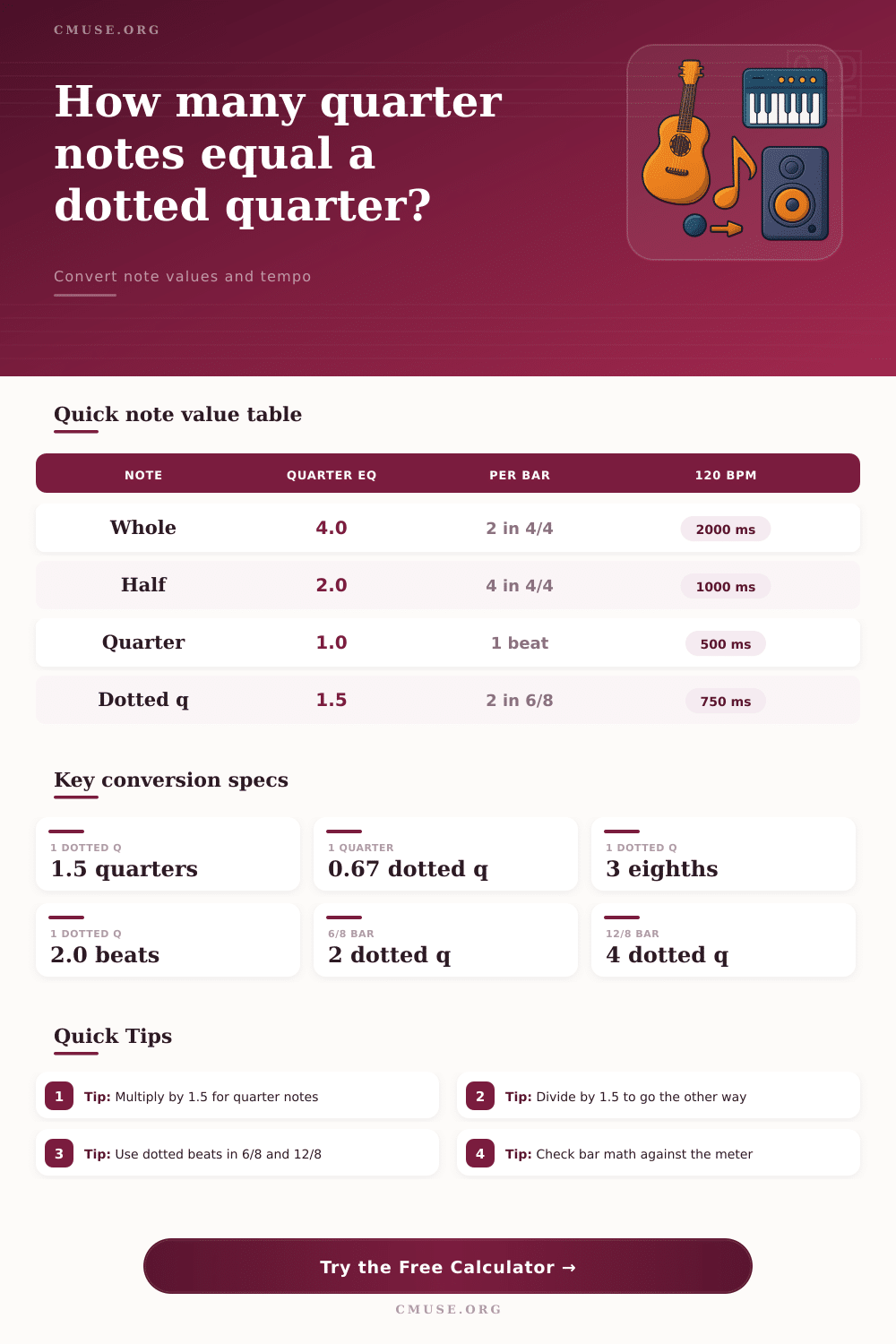
| Note | Quarter Eq | Dotted Eq | 120 BPM |
|---|---|---|---|
| Whole | 4.0 | 2.67 | 2000 ms |
| Half | 2.0 | 1.33 | 1000 ms |
| Quarter | 1.0 | 0.67 | 500 ms |
| Dotted q | 1.5 | 1.00 | 750 ms |
🎶 Tempo Basis Map
| Quarter BPM | Dotted BPM | Quarter ms | Dotted ms |
|---|---|---|---|
| 60 | 40 | 1000 | 1500 |
| 90 | 60 | 667 | 1000 |
| 120 | 80 | 500 | 750 |
| 150 | 100 | 400 | 600 |
📈 Compound Meter Map
| Meter | Dotted Beats | Quarter Beats | Feel |
|---|---|---|---|
| 4/4 | 2.67 | 4.0 | Straight |
| 6/8 | 2.0 | 3.0 | Compound |
| 9/8 | 3.0 | 4.5 | Compound |
| 12/8 | 4.0 | 6.0 | Compound |
⏰ Phrase Examples
| Scenario | Dotted q | Quarter q | 120 BPM |
|---|---|---|---|
| 1 bar 6/8 | 2.0 | 3.0 | 1.50 s |
| 2 bars 6/8 | 4.0 | 6.0 | 3.00 s |
| 4 bars 12/8 | 16.0 | 24.0 | 12.00 s |
| Half-bar tag | 1.0 | 1.5 | 750 ms |
A dotted quarter note last for a specific amount of time. A dotted quarter note is equal to one-and-a-half quarter note. Since a dotted quarter note is equivalent to one-and-a-half quarter notes, a musician can think of a dotted quarter note as consist of three eighth notes.
A dotted quarter note is often used as the main beat for musical piece that use meters like 6/8 or 12/8. These meter is considered compound meters, meaning that the beats is divided into groups of three eighth notes. A dotted quarter note is used in these type of meters because it fits the structure of dividing the beat into three eighth notes.
How to Convert Dotted Quarter Notes to Quarter Notes
However, many musicians struggle with transitioning from compound meters to simple meters, like 4/4 time. If a musician intends to play musical notes with the beat of a dotted quarter note, but is guided by a metronome or musical software that indicates quarter note beat, the musician may create errors in playing the music. One of the main reason that tempo conversions are necessary between dotted quarter notes and quarter notes is because the tempo will change depending on the type of beat that is being counted.
For example, a tempo of 84 dotted quarter notes per minute is equivalent to a tempo of 126 quarter notes per minute. In this example, 84 dotted quarter notes per minute multiplied by 1.5 equal 126 quarter notes per minute. Such a calculation is necessary for musicians to understand how to properly play music with a metronome that use quarter notes instead of dotted quarter note pulses.
If the musician does not perform the calculation prior to setting the metronome to tick in relation to the music that they will play, errors will occur in the tempo of the music. Errors in music often occur because a musician ignores the denominator of the time signature. Time signature like 6/8 have an 8 in the denominator, indicating that eighth notes are the main division of the beats in that time signature.
For instance, 6/8 has six eighth notes per bar. Those eighth notes are divided into two group of three eighth notes each. Since dotted quarter notes is composed of three eighth notes each, two dotted quarter notes will play in a bar of 6/8 time.
If the musician ignores this and treats 6/8 time like a simple time signature, the musician will most likely make errors in playing the music. Another reason for errors in music is if the musician dont ensure that the basis of the tempo match the time signature of the music. Mathematical formulas can be used to ensure accuracy in converting dotted quarter notes to quarter notes, as well as quarter notes to dotted quarter notes.
To convert from dotted quarter notes to quarter notes, you can multiply the number of dotted quarter notes by 1.5 to find the number of quarter notes that is equivalent to the dotted quarter notes. For instance, four dotted quarter notes multiplied by 1.5 yields a result of six quarter notes. To convert quarter notes to dotted quarter notes, the number of quarter notes can be divide by 1.5 to find the number of dotted quarter notes.
Such calculations could of been used to ensure that all musicians in a band, for instance, are playing in sync with one another. Another of the main use for these formulas is in professional music scenarios. For instance, a musician may be performing with a dotted quarter note tempo, but the recording engineer may need to write the musicians tempo in quarter notes for the songs technical documentation.
Additionally, time may need to be calculated for music to play for films, for instance. By being able to convert the number of beats to quarter notes, and quarter notes to seconds, the musician can calculate the length of the music in seconds. These methods for converting dotted quarter notes to quarter notes, and vice versa, therefore ensure that all platforms and musicians involved in the music will have the same time signature and beat, allowing for synchronization in the performance of the music.