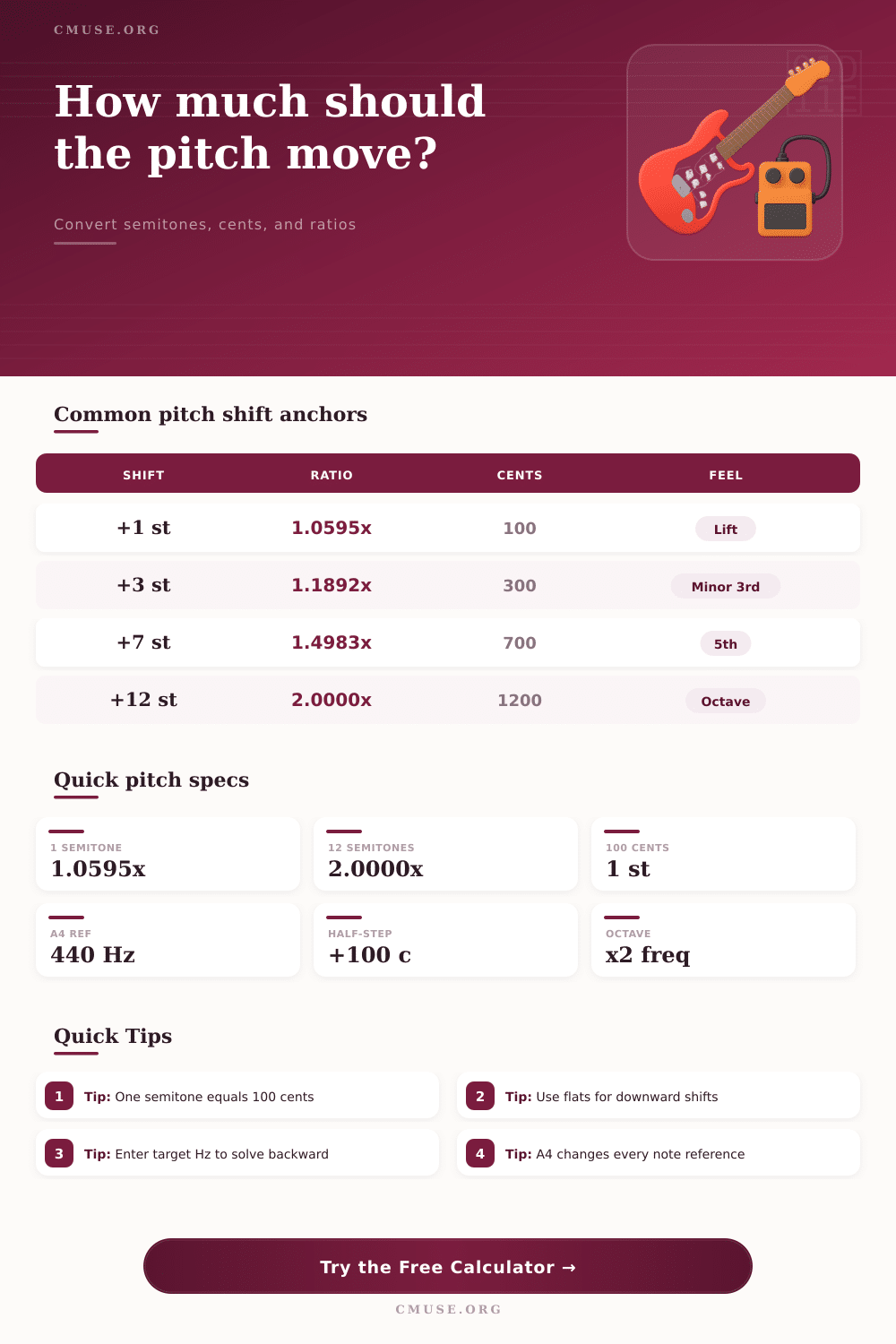
Pitch Shift Calculator for Semitones
Convert source pitch into frequency ratios, semitone moves, cents, and note names, or solve backward from a target Hz value.
🎼 Pitch Shift Presets
⚙ Shift Inputs
📊 Pitch Shift Quick Specs
📖 Reference Tables
| Shift | Ratio | Cents | Feel |
|---|---|---|---|
| +1 st | 1.0595x | 100 | Lift |
| +3 st | 1.1892x | 300 | Minor 3rd |
| +7 st | 1.4983x | 700 | Fifth |
| +12 st | 2.0000x | 1200 | Octave |
| -12 st | 0.5000x | -1200 | Drop |
| Note | Hz | MIDI | Use |
|---|---|---|---|
| A4 | 440.00 | 69 | Ref |
| C4 | 261.63 | 60 | Mid |
| E4 | 329.63 | 64 | Lead |
| A3 | 220.00 | 57 | Warm |
| A5 | 880.00 | 81 | Bright |
| Use | Shift | Ratio | Note |
|---|---|---|---|
| Vocal lift | +2 | 1.1225x | Natural |
| Guitar drop | -2 | 0.8909x | Open |
| Chipmunk | +12 | 2.0000x | Fast |
| Deep voice | -12 | 0.5000x | Low |
💡 Practical Notes
Pitch shifting is an process of changing the frequency of a sound without change the tempo of the sound. Pitch shifting allow a person to change the pitch of a vocal track. Pitch shifting allows a person to change the pitch of an instrument.
Because pitch shifting change the frequency of a sound, pitch shifting can make a vocal sound more higher or pitch shifting can make an instrument sound lower. Pitch shifting can be used to correct a vocal that are flat. Pitch shifting can be used to make a guitar sound deep.
What Is Pitch Shifting
The pitch of a sound exist on a logarithmic scale. For example, moving a note one semitone up in pitch increase the frequency of the note by 6 percent. A semitone are a unit of measure for pitch.
A person can also change the pitch in units of cent. There are 100 cent in a semitone. This unit of measurement allow for more precise pitch changes.
Sometimes pitch shifting require more precise adjustment to the pitch of a note than using semitones alone. Imprecise pitch adjustments can make a vocal or instrument sound roboticly. Many music producers uses pitch shifting for specific musical purpose.
For example, pitch shifting can be used to increase the pitch of a vocal track to add energy to a song. Producers may use pitch shifting to change the tuning of a guitar. Bass player may use pitch shifting to decrease the pitch of the guitar string by an octave to make the bass sound lower.
Pitch shifting can also be used to create the chipmunk effect in vocal. The chipmunk effect is created when you increase the pitch of the vocal track by 12 semitone. Increasing the pitch of a note by 12 semitone double the frequency of that note.
The reference pitch are one of the most important aspect of pitch shifting because the reference pitch will ultimately determine the frequency of the notes that is used in the pitch shifting. While A4 at 440 Hz is the most common standard for the reference pitch, some orchestra use a reference pitch of 442 Hz, and some historical ensemble used a reference pitch of 415 Hz. The reference pitch will ultimately impact the target note for the pitch shifting.
Additionally, using the target frequency will allow you to find the correct semitone and cent value for that sound, associating it with a particular pitch. In order to achieve the correct pitch with pitch shifting, it is important to consider both the semitones and the cents of the sound. While shifting the sounds to include the correct number of semitones, you must ensure that the cents of the sound are adjust to ensure that the resulting pitch is accurate.
Additionally, ratio are utilized within pitch shifting to determine the relationship between the two sound. For instance, a ratio of 2:1 represent an octave, while a ratio of 1.5:1 represent a perfect fifth. Changing the pitch of a sound too much can impact the formant of the voice, which may make it sound unnatural when heard by a listener.
Another way to ensure that the pitch shifting sound good is to use your ear to judge the results of the pitch shifting. Even with the use of mathematical ratio to determine the shift in pitch, the resulting sound should be pleasing to the ear. One way to practice properly shift pitches is to use transposition exercise, which will enable you to become accustomed to hearing the different pitch within a melody.
Finally, it is important to remember the relationship between pitch shifting and playback speed. Slowing down the playback speed of a recording will lower the pitch of the sound file.