Cents to Hz Calculator for Pitch Shifts
Convert pitch offsets into exact frequencies, compare tuning standards, and read the nearest note for fast music math checks.
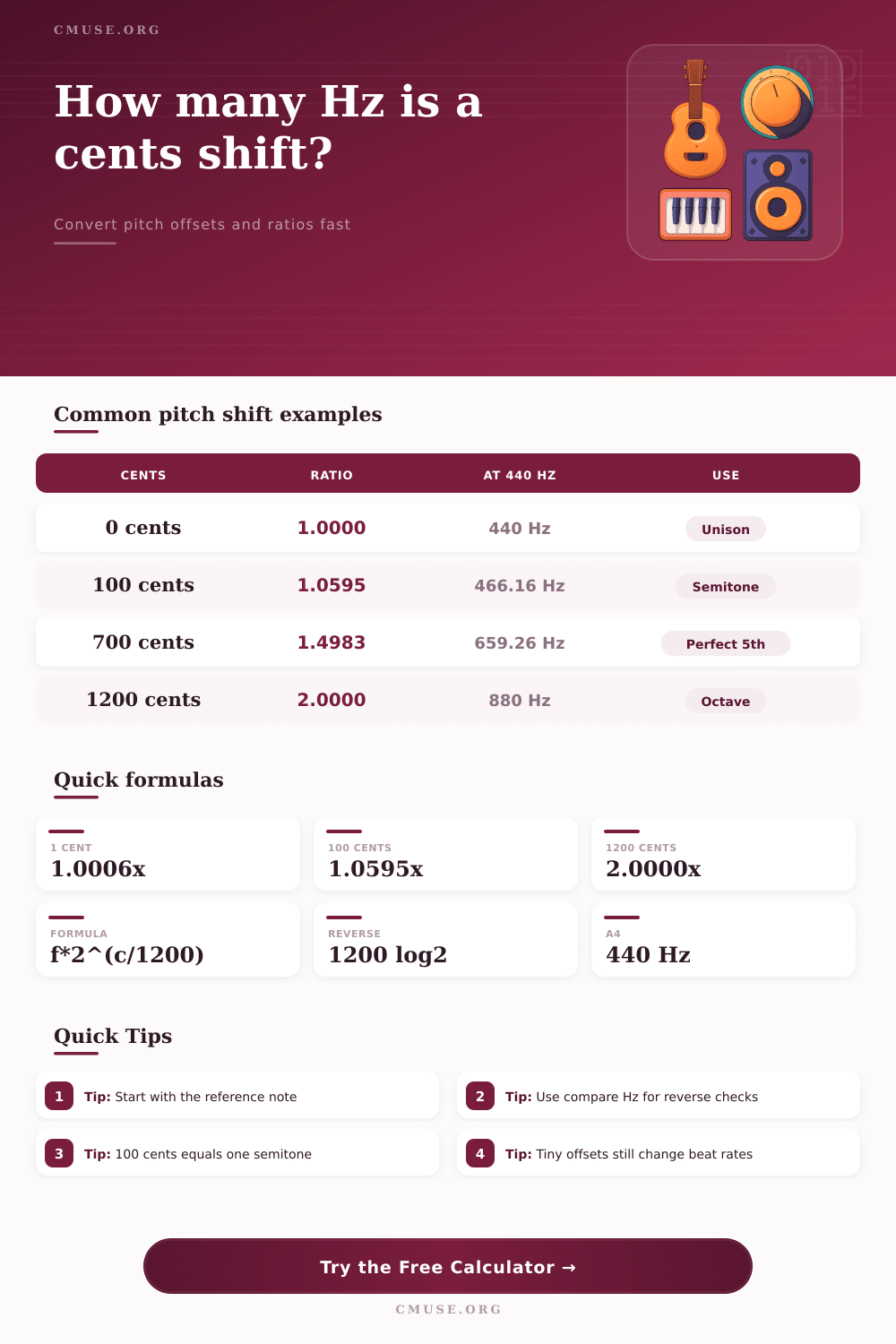
| Interval | Cents | Ratio | Example |
|---|---|---|---|
| Unison | 0 | 1.0000 | A4 to A4 |
| Minor second | 100 | 1.0595 | A4 to A#4 |
| Major second | 200 | 1.1225 | A4 to B4 |
| Minor third | 300 | 1.1892 | A4 to C5 |
| Perfect fourth | 500 | 1.3348 | A4 to D5 |
| Perfect fifth | 700 | 1.4983 | A4 to E5 |
| Major sixth | 900 | 1.6818 | A4 to F#5 |
| Octave | 1200 | 2.0000 | A4 to A5 |
| Standard | A4 | Common use | Note |
|---|---|---|---|
| Baroque | 415 Hz | Period ensembles | Dark and low |
| Concert | 440 Hz | General reference | Most common |
| Orchestral | 442 Hz | Modern symphony | Brighter blend |
| Brilliant | 444 Hz | Sharp pop tuning | More forward |
| Scenario | Ref | Shift | Target |
|---|---|---|---|
| Concert A4 | 440 Hz | 0 | 440 Hz |
| Flat choir check | 440 Hz | -8 | 437.97 Hz |
| Piano stretch | 440 Hz | +3 | 440.76 Hz |
| One semitone up | 440 Hz | 100 | 466.16 Hz |
| Perfect fifth | 440 Hz | 700 | 659.26 Hz |
| Octave up | 220 Hz | 1200 | 440 Hz |
| Cents | Ratio | 440 Hz base | Use |
|---|---|---|---|
| 1 | 1.0006 | 440.25 Hz | Micro trim |
| 5 | 1.0029 | 441.24 Hz | Fine nudge |
| 10 | 1.0058 | 442.54 Hz | Soft pull |
| 25 | 1.0146 | 446.42 Hz | Small bend |
| 50 | 1.0293 | 452.90 Hz | Half step feel |
| 75 | 1.0440 | 459.36 Hz | Wide glide |
| 100 | 1.0595 | 466.16 Hz | Semitone |
| 1200 | 2.0000 | 880 Hz | Octave |
Musical tuning involve adjusting the pitch of instruments to make the notes sound harmoniously together. Many musicians uses cents to measure the distance between pitches. One cent is an unit of measurement used to describe the intervals between pitches.
There is 1,200 cents within one octave. One cent equals a.06% change in frequency, which can be measured in Hertz. The reference pitch A is 440 Hz, but 440.25 Hz represent the pitch an octave above the reference note.
Cents and Pitch: How Musicians Tune
The cent scale are logarithmic, matching the human ear perception of pitch. Steps in cents are considered to be equal steps in pitch for the human ear, while steps in Hertz is not equal to each other in higher pitches. A semitone contains 100 cent.
A perfect fifth contain 700 cents. Many orchestra tend to tune to a frequency higher then the reference frequency of 440 Hz. Higher frequencies creates a brighter sound.
Baroque musicians often tune to a frequency lower than 440 Hz. Lower frequencies are said to create a warmer sound. Cents is used in several task in music.
One such task is stretch tuning for piano. Piano notes are not perfectly in tune due to the inharmonicity of the piano wires. Inharmonicity make the piano sound out of tune.
To combat this, the note are adjusted in cents. Each note can be adjusted up to 3 or 4 cents to create a clear sound from the piano. Another task is correct choirs.
Singers often get tired while singing long songs. Their pitches may drift flatly. In this case, singers can be adjusted -8 cents to return there pitches to the correct notes.
A reference pitch in Hertz is needed to perform these tasks as the reference note is use in all calculations. Mathematical formulas are used to reverse engineer pitches. For instance, a pitch measured at 437.97 Hz is -8 cents flat relative to a reference pitch of 440 Hz.
Another formula output the ratio of the vibrations of the target pitch to the reference note. A semitone ratio is 1.0595. Another use of mathematical formula is to approximate where a given pitch sit in relation to the musical staff.
The mathematical formula can tell you the cents of deviation between a given pitch and the nearest note on the staff. The standard pitch for music has change throughout history. In the 1600s, organ pipes were tuned to 400 Hz.
Today’s pitch standards is much higher. Some musicians believe 432 Hz are better for singers. However, there is no scientific evidence to support this belief.
Moddern pop music is often sharp tuned. Jazz players use just intonations. Just intonation use pure intervals.
Equal temperament is a system that use compromises between intervals so that musicians can play in different key. Some musicians use scales with intervals smaller then 100 cents. These scales are call microtonal scales.
Common mistakes when tuning include forgetting that cents represent a logarithmic scale. A 5 cent shift in frequency have a different impact on low frequencies than it does on high frequencies. For instance, a 5 cent shift at 130 Hz only change the frequency by.4 Hz.
At 1300 Hz, the same 5 cent shift affect the frequency by 4 Hz. The higher the frequency, the more larger the change in that frequency. Another common mistake is that error in cents become more noticeable in harmonies shared by many singers.
The singers will create overtones that beat together if their pitches are not correctly tuned in cent. Always compare the measured pitches to the reference frequency to ensure that the pitch is in tune. There are several real-world limits to the tuning of musical instruments.
For instance, the acoustics of the performance room will affect how the musicians perceive the pitches of other musicians. Musicians may become fatigued which affect their pitch perception. After being tuned to a specific pitch, some instrument will change.
For instance, the wooden string of a violin may go sharp due to the heat in the performance space. Woodwind instruments may also change after the musicians has sung for a long time due to the presence of the musicians saliva on those instruments. Although there are mathematical tools to aid the musicians in tuning musical instruments to specific frequencies, the musicians should of always use their ear to ensure the pitches blend well.
If two musicians are playing the same note, even the tiniest offset in cents will change the beat rate of there pitches. The same is true for any duet. Whether you are creating a baroque performance or a moddern pop song, the ability to convert cents to Hertz will allow you to bridge the gap between your musical ear and mathematical equations.