🎵 Secondary Dominant Chord Calculator
Find the secondary dominant (V/x) for any chord in any key — includes chord tones, tensions & resolution
→ Dm
→ Em
→ F
→ G
→ Am
→ B°
→ C
V/V
| Notation | Chord Name | Chord Tones | Borrowed Note | Resolves To |
|---|---|---|---|---|
| V/ii | A7 | A – C# – E – G | C# | Dm (ii) |
| V/iii | B7 | B – D# – F# – A | D# | Em (iii) |
| V/IV | C7 | C – E – G – Bb | Bb | F (IV) |
| V/V | D7 | D – F# – A – C | F# | G (V) |
| V/vi | E7 | E – G# – B – D | G# | Am (vi) |
| V/vii° | F#7 | F# – A# – C# – E | A# | B° (vii) |
| Key | V of Key | V/V (Sec. Dom) | Chord Tones |
|---|---|---|---|
| C Major | G | D7 | D F# A C |
| G Major | D | A7 | A C# E G |
| D Major | A | E7 | E G# B D |
| A Major | E | B7 | B D# F# A |
| E Major | B | F#7 | F# A# C# E |
| F Major | C | G7 | G B D F |
| Bb Major | F | C7 | C E G Bb |
| Eb Major | Bb | F7 | F A C Eb |
| Ab Major | Eb | Bb7 | Bb D F Ab |
| Db Major | Ab | Eb7 | Eb G Bb Db |
| F# Major | C# | G#7 | G# B# D# F# |
| B Major | F# | C#7 | C# E# G# B |
Root-3-5-b7
Root-3-5-b7-9
Root-3-5-b7-b9
Root-3-#5-b7
| Notation | Chord | Chord Tones | Resolves To |
|---|---|---|---|
| V/iv | C#7 / Db7 | C# E# G# B | Dm (iv) |
| V/v | E7 | E G# B D | Em (v) |
| V/VI | C7 | C E G Bb | F (VI) |
| V/VII | D7 | D F# A C | G (VII) |
| V/III | B7 | B D# F# A | C (III) |
| Chord Tone | Interval | Semitones from Root | Function |
|---|---|---|---|
| Root | P1 | 0 | Foundation |
| Major 3rd | M3 | 4 | Leading tone to target root |
| Perfect 5th | P5 | 7 | Stability |
| Minor 7th | m7 | 10 | Pulls down to target 3rd |
| Major 9th | M9 | 14 | Color tone (V9) |
| Minor 9th | m9 | 13 | Strong pull (V7b9) |
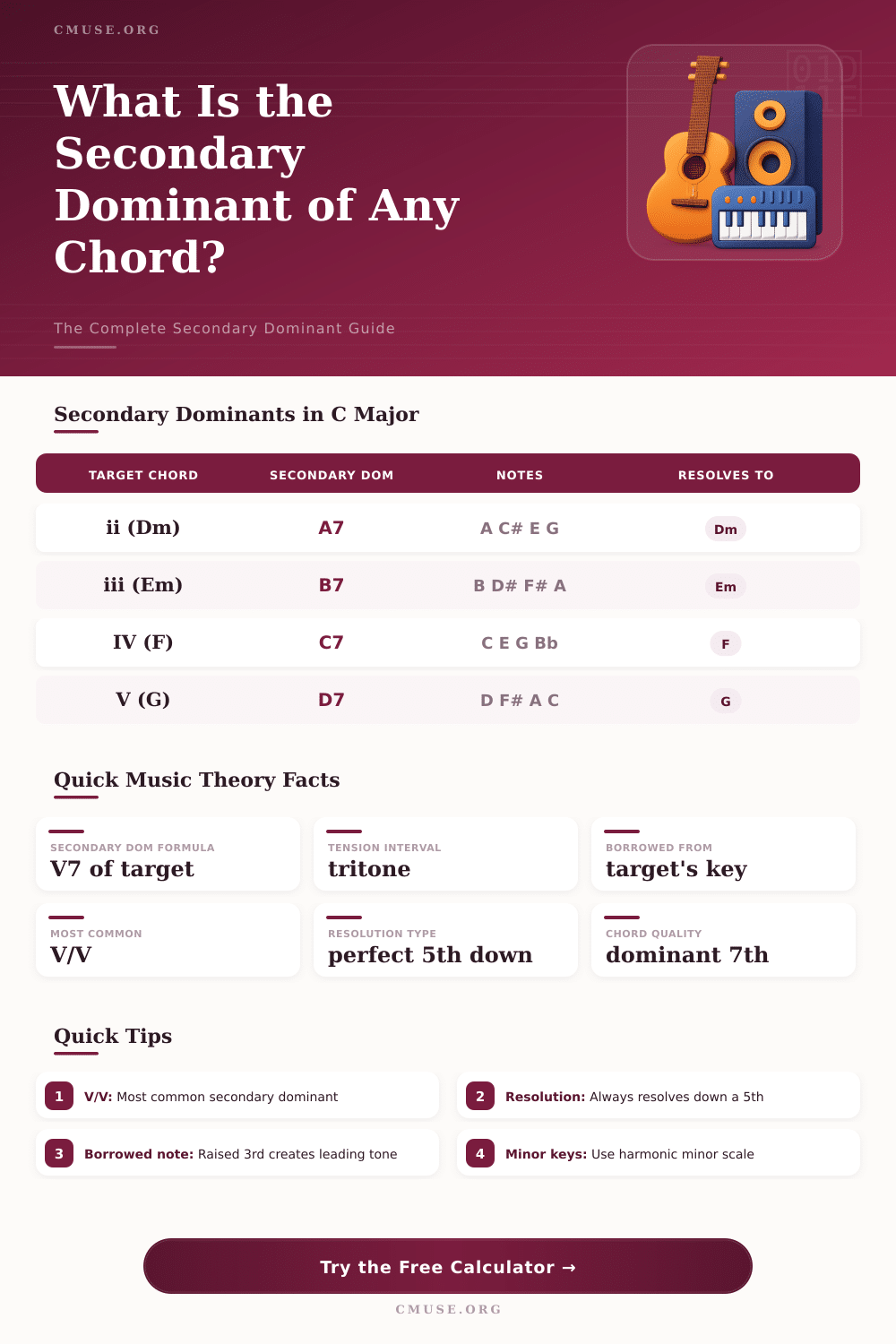
A secondary dominant chord is a chord that temporary function as a dominant chord for a chord other than the tonic chord. Whereas the primary dominant chord point to the tonic chord, the secondary dominant chords point to another chord within the key. The use of secondary dominant chords create tension in the music because they contain note that are not part of the original key.
Such tension is eventualy released when the chord resolve to the target chord. To find the secondary dominant chord for a target chord, simply build a dominant seventh chord a perfect fifth above the root of the target chord. For instance, the secondary dominant for the G major chord in the key of C major is a D7 chord.
What is a secondary dominant chord
The third in the D7 chord is a leading tone to the root of the G major chord. Additionally, the D7 chord create tension due to the tritone within the chord, which demand resolution to the target chord. These chords are not modulation because modulations require changing the key of the music.
Using secondary dominant chords introduce the listener to another key within the music for a short period of time. However, the music eventually return to the original key. If a composer use too many secondary dominant chords in a short period of a song, the music can sound disorganized based off the changes in tension.
By adding different note to a secondary dominant chord, composers can change the sound that the chord make. A secondary dominant can be a simple triad or a dominant seventh chord. In addition to these chords, a composer can also add a ninth to a secondary dominant chord to add more color to there chord, or by adding a flat ninth to a secondary dominant chord, the composer will increase the amount of dissonance in that chord.
These added notes will create a different level of tension than if those same notes were omitted from the chord. In the case of minor keys, composers will often use the notes from the harmonic minor scale to create the secondary dominant chords. For example, if a composer use the key of A minor, they can use the raised leading tone in the scale.
The same process is used in both major and minor scales, but the specific notes will be different in the case of a minor key. By using secondary dominant chords within a musical composition, composers can improve the musical progression. The music may feel more static with a standard musical progression, but using a secondary dominant will give a sense of movement within the composition.
In the case of composing music, secondary dominant chords can be used to create a peak in the song. Once the song resolve the secondary dominant chord, the music will return to it’s stable state.