LUFS Calculator
Match streaming loudness targets, check true peak margin, and keep masters, podcasts, and broadcast spots on spec.
Target
LUFS profile target
Crest
True peak minus LUFS
LRA
Static gain does not change this
Gain
Linear gain factor
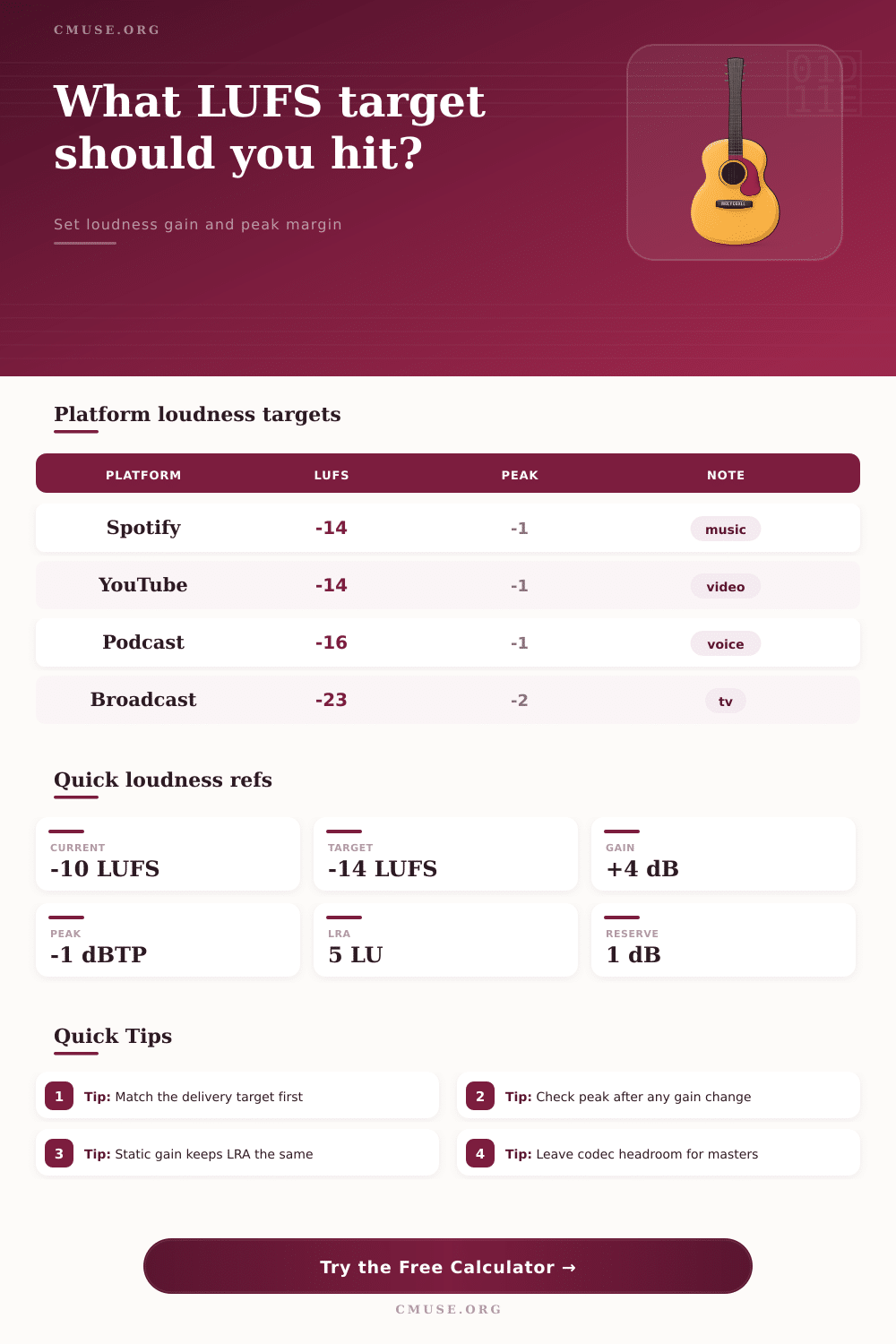
| Platform | LUFS | Peak | Note |
|---|---|---|---|
| Spotify | -14 | -1 | music |
| YouTube | -14 | -1 | video |
| Podcast | -16 | -1 | voice |
| Broadcast | -23 | -2 | tv |
| Mode | Window | Read | Use |
|---|---|---|---|
| Momentary | 400 ms | fast | peaks |
| Short-term | 3 s | phrase | voice |
| Integrated | whole | avg | master |
| LRA | varied | spread | range |
| Use | Cur LUFS | Peak | LRA |
|---|---|---|---|
| Podcast | -16 | -1 | 4-6 |
| Dialogue | -27 | -2 | 5-8 |
| Club | -8 | -0.8 | 6-10 |
| TV spot | -24 | -2 | 3-5 |
| Margin | Status | Action | Risk |
|---|---|---|---|
| 0-1 dB | tight | trim | codec |
| 1-3 dB | safe | hold | low |
| 3+ dB | clear | keep | very low |
| neg | hot | lower | clip |
Streaming platforms like Spotify and YouTube use loudness normalization to ensure that teh music that is played for the listener sound consistent from track to track. Loudness normalization ensures that the volume of each track are adjusted so that each track sounds approximately the same in comparison to another track. If the track that is uploaded to the platform has a loud volume, the streaming platform will automatically reduce the volume of that track.
Conversely, if the track that is uploaded has a too-quiet volume, then the listener may have difficulty in hearing the audio track. Engineering software use a value known as LUFS, or Loudness Units relative to Full Scale to ensure that each track has the apropriate amount of loudness. LUFS is a unit of measurement of the loudness of a sound over time, and is a different measurement than the peak levels of that sound.
Loudness and LUFS for Streaming Music
There are two main measurements of LUFS: integrated LUFS and true peaks. Integrated LUFS measures the average loudness of an audio file from start to finish. Audio engineers typically aim for a specific target for the integrated LUFS of the album that they is creating; for instance, minus 14 LUFS is the target loudness level for Spotify.
In addition to targeting a specific integrated LUFS for the album that is created, audio engineers must also pay attention to the true peaks of the album. True peaks refer to the highest peaks of the audio file, and those true peaks must be lower than a certain threshold, such as minus 1 dBTP; otherwise the audio may distort when the streaming platform compresses it to a specific format. An audio engineer must understand two additional measurements of audio files: the crest factor, and the loudness range (also known as LRA).
The crest factor is the difference between the loudness of a song and the peak loudness of that song. For instance, club music may have a small crest factor, whereas acoustic music may have a large crest factor. The loudness range, or LRA, measure the distance between the quietest parts of a track and the loudest parts of that track.
If an engineer use limiting to increase the loudness of an audio file, then that limiting will reduce the loudness range of that song. Thus, if an engineer creates music with a small loudness range, it may sound flat when that song is played, and the quiet parts of the song may not be heard after normalization by the streaming platform. Different types of audio files may have different target loudness settings.
For instance, podcasts are created with the intention of allowing listeners to hear the speakers clear, so the target loudness for podcasts is not the same as music. Similarly, club music may have a different mastering process different than music that is to be streamed; club music will be mastered with a higher level of integrated LUFS than music that is to be streamed on a streaming platform. Finally, film dialogue is often mastered to a lower level of LUFS, such as minus 27 LUFS.
An engineer may have to make a decision between using compression to adjust the loudness range of the audio file, or using gain to adjust the audio file to the target LUFS. A common mistake in mastering audio files is to focus only on the target integrated LUFS of the master file; an engineer that focuses only on the integrated LUFS measurements may miss loud sections of a song. A better method would be to utilize short-term and momentary LUFS measurements, in addition to the integrated LUFS measurements.
Short-term and momentary LUFS measurements will reveal information regarding the loudness of specific sections of a song. Thus, by utilizing all three types of LUFS measurements, an audio engineer will have better control over the loudness of a song. Finally, another consideration of audio engineers is the headroom that must be provided for codecs.
A codec is a tool that allows audio files to be compressed. If a codec compresses audio, the peaks of that audio will increase. To avoid distortion of that audio, audio engineers should provide headroom for codecs by creating audio files with true peaks that are lower than the absolute maximum allowed true peaks for those audio files.
Thus, if the engineer provides headroom for codecs, the audio will not distort when the codec compresses it. If the engineer dont provide headroom for codecs, however, the audio may distort when it is played back. Thus, mastering audio files that will be released into the world requires engineers to provide headroom for codecs for audio files to not distort during playback.
In order to ensure that audio sounds as intended by the audio engineer, audio engineers must manage the loudness range of audio files, the headroom that should be provided for codecs, and ensure that the target integrated LUFS is hit. These three steps is the steps that should of been followed to prepare audio files for mixing and mastering.