PA System Calculator
Size speaker power, coverage, and speaker count for venues, then estimate the far-row SPL for speech, music, or live bands.
| Use case | Target SPL | Sensitivity | Notes |
|---|---|---|---|
| Speech | 80-85 dB | 95-100 dB | Clear voice |
| Background music | 85-92 dB | 96-100 dB | Warm coverage |
| DJ set | 95-102 dB | 98-102 dB | Dance floor |
| Live band | 100-108 dB | 100-105 dB | Peak headroom |
| Angle | At 20 ft | At 30 ft | Best use |
|---|---|---|---|
| 60 deg | 23 ft | 35 ft | Focused throw |
| 80 deg | 34 ft | 51 ft | Small rooms |
| 90 deg | 40 ft | 60 ft | General PA |
| 120 deg | 69 ft | 103 ft | Wide coverage |
| Venue type | Noise floor | Loss | Density |
|---|---|---|---|
| Conference | 48 dB | 1.0 dB | 8 sq ft |
| Club | 65 dB | 1.5 dB | 6 sq ft |
| Church | 55 dB | 2.0 dB | 10 sq ft |
| Outdoor | 60 dB | 0.8 dB | 5 sq ft |
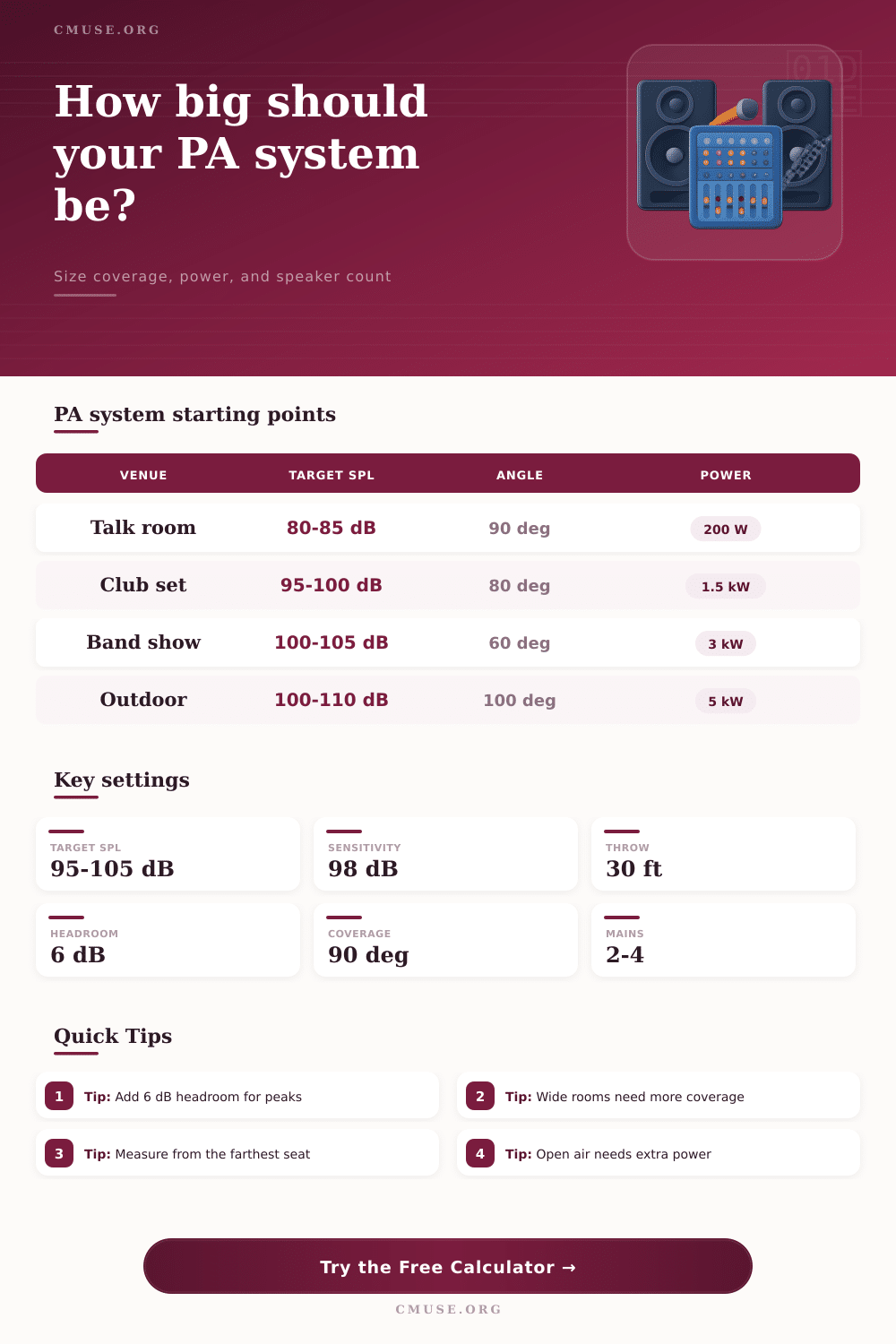
Speech PA
500 W
Small room, 2 mains
Club Rig
1.5 kW
Dance floor, 2 to 4 mains
Live Band
3 kW
Higher headroom and punch
Outdoor Rig
5 kW
Wide throw, more buffer
To size a public address (PA) system correctly, one must calculate the distance from the speaker to the listener and the sound pressure level (SPL) required to reach the listener before selecting an PA system. Selecting a PA system based off guesswork will result in not enough sound volume reaching the listener at the back of the rooms. Similarly, selecting a PA system without calculating the required sound power will also lead to inadequately sound coverage.
Sound engineers must understand the factors that affect sound energy to calculate the power requirements of a PA system. Distance is one of the primary factors that affect the loss of sound energy from a system. Sound pressure level decrease with distance from the speaker.
How to Size a PA System
The sound pressure level will drop by 6 dB for every doubling of the distance from the sound emitter. Thus, a sound that measures 100 dB at close range will measure 88 dB at twice the distance from the speaker. The distance from the speaker to the listener should be measured from the speaker stack to the back of the furthest seat in the venue.
If the distance are measured from the edge of the stage, it will result in calculating a distance that is too short for the PA system requirement. Factors that reduce the SPL of sound in a venue include the absorption of sound by the room and the density of the audience members in the venue. The shape and size of the venue require the selection of speakers with specific coverage angle.
In a rectangular room, the speakers can be pointed down the length of the venue. If the venue has a wide floor area, the speakers should have a wide coverage angle. A wide coverage angle will produce a wide wash of sound from the speaker, while a narrow coverage angle will produce a narrow beam of sound from the speaker.
For instance, a speaker with a 90-degree horn will emit sound that will cover a width of 60 feet if the speaker is placed 30 feet from the area to be covered. Thus, the coverage angle should be selected according to the footprint of the venue. The target SPL for sound at different types of performances will dictate the power requirement of the PA system.
For speech performances, the target SPL is in the range of 80 to 85 dB. For musical performances, the target SPL is 100 dB or higher. The sensitivity of the speakers will also affect the power requirements of the system.
Speaker sensitivity is measured in watts at 1 meter if the speaker emits 1 watt of power. To reach 10 dB higher sound pressure levels, the power has to be increased ten times. Thus, to achieve the sound pressure levels desired for most PA systems, high-wattage amplifiers are required for the speakers.
Besides the factors mentioned above, there are other environmental factors that will affect the SPL of sound in a venue. The human body absorbs high-frequency sound waves, while flat floors reflect low-frequency sound waves. Outdoor venues do not have the same acoustic reflection as indoor venues.
Outdoor venues do not contain the same amount of reverb as indoor venues, which help the sound to travel further. Outdoor PA systems require more higher power than indoor PA systems. Additionally, the density of the crowd will affect the SPL of sound in a venue.
A venue that has a dense crowd will lose more sound energy than a venue with a sparse crowd. One of the most common mistake made by sound engineers is the purchase of a PA system based on the wattage of the system listed in the product specifications sheet. A product that states that it contains 2 kW of sound power may not emit enough sound energy to reach the listener at the back of the venue.
PA systems with high sensitivity, between 98 and 102 dB, allow for higher SPL measurements with lower watts of sound power. Therefore, the purchase of such systems will allow the venue to have a more higher SPL with the same amount of power invested in the system. An additional factor to consider when purchasing a PA system is the inclusion of an overage in the power calculations to account for unexpected factors in the venue that may reduce the SPL of the sound waves from the system.
For example, wind can reduce the SPL of sound waves, just as can an increased number of guest at the event. In addition to the considerations above, there are additional ways to improve sound coverage at a venue. Flown arrays are speakers that are suspended in the air to improve sound coverage over the audience.
Delay speakers are speakers that are used to ensure that the sound reaches the audience at the back of the venue at the same time as the sound that emanates from the stage. These speakers are especially useful for larger venues. Additionally, if the sound from the stage reaches the audience at the front of the venue 20 milliseconds earlier than the sound that reaches the audience at the back, the delay speakers can correct for this difference.
Thus, the sound from the stage and the delayed speakers will arrive at the same time at the audience. Another method of monitoring the PA system is to play pink noise through the speakers at the mix position in the venue. By playing pink noise and walking through the venue, the sound engineer can ensure that the SPL is within the necessary range for each area of the venue.
By calculating the distance between the speakers and the audience members, by calculating the sound loss that will occur due to distance, and by calculating the power that is required to overcome sound loss, the sound engineer can ensure that the PA system will provide sound to all the audience members in the venue.