Subwoofer Box Dimensions Calculator
Scale a draft box to a target net volume, then check sealed or vented behavior, external size, and displacement before you cut.
📦 Subwoofer Presets
🔧 Box Setup
📈 Reference Tables
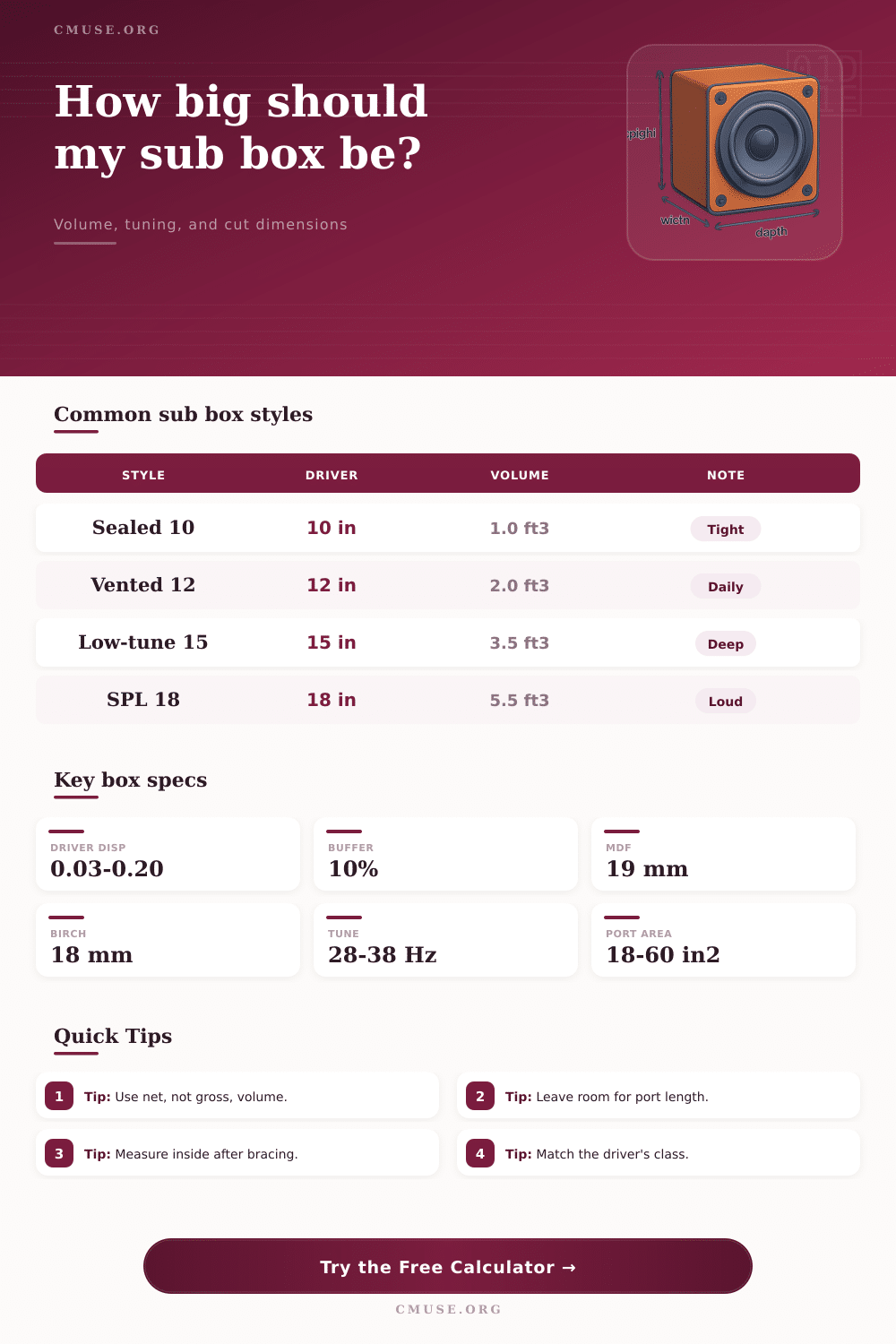
Driver volume guide
| Driver | Sealed net | Vented net | Disp. |
|---|---|---|---|
| 8 in class | 0.45-0.90 | 0.75-1.25 | 0.03 ft3 |
| 10 in class | 0.75-1.40 | 1.10-1.80 | 0.05 ft3 |
| 12 in class | 1.00-2.00 | 1.80-3.50 | 0.08 ft3 |
| 15 in class | 1.80-3.50 | 3.00-5.80 | 0.13 ft3 |
| 18 in class | 2.80-5.00 | 5.00-9.00 | 0.20 ft3 |
Alignment guide
| Alignment | Tune | Volume band | Use |
|---|---|---|---|
| Sealed | N/A | 0.45-2.00 | Tight bass |
| Daily vented | 33-35 Hz | 1.10-3.50 | Balanced |
| Low-tune | 28-32 Hz | 1.80-5.80 | Deeper low end |
| SPL vented | 36-40 Hz | 2.50-9.00 | Upper-bass hit |
Material guide
| Material | Thick. | Density | Note |
|---|---|---|---|
| 15 mm MDF | 15 mm | 740 kg/m3 | Light MDF |
| 19 mm MDF | 19 mm | 760 kg/m3 | Common build |
| 12 mm birch ply | 12 mm | 620 kg/m3 | Thin shell |
| 18 mm birch ply | 18 mm | 650 kg/m3 | Strong all-round |
| 18 mm Baltic birch | 18 mm | 680 kg/m3 | Premium panel |
| 19 mm marine ply | 19 mm | 660 kg/m3 | Moisture ready |
| 12 mm HDF | 12 mm | 880 kg/m3 | Very stiff |
| 15 mm composite | 15 mm | 720 kg/m3 | Stable board |
Port guidance
| Driver | Area | Tune | Note |
|---|---|---|---|
| 8 in class | 12-16 in2 | 34-38 Hz | Small cabin |
| 10 in class | 16-22 in2 | 32-36 Hz | Tight daily |
| 12 in class | 22-30 in2 | 30-34 Hz | Most builds |
| 15 in class | 32-42 in2 | 28-32 Hz | Large trunk |
| 18 in class | 44-60 in2 | 26-30 Hz | Big output |
💡 Build Tips
Building a subwoofer enclosure require mathematical calculations because the dimensions of a subwoofer enclosure will determine the way in which the subwoofer perform. A subwoofer enclosure isnt just a case for the subwoofer; rather, the subwoofer enclosure is a critical component of the subwoofer that dictates the sound qualities that is radiated from the subwoofer. If the dimensions of the subwoofer enclosure is incorrect, the subwoofer will not produce the correct sound.
In order to determine the dimensions of the enclosure that will allow the subwoofer to perform correctly, it is first necessary to calculate the net volume of the enclosure. The net volume of the enclosure is the total amount of air space within the subwoofer enclosure minus the volume that the subwoofer driver, internal braces, and ports take up. If the net volume is too small for the subwoofer driver, the bass will be too tightly for the subwoofer enclosure.
How to Measure and Build a Subwoofer Box
If the net volume is too large for the subwoofer driver, the subwoofer will lose control over the radiated sound and will not be able to produce controlled bass. The volume of the subwoofer enclosure should be within the range recommended by the driver and amplifier manufacturer for the specific subwoofer driver and amplifier. There are two primary types of subwoofer enclosures: sealed enclosures and vented enclosures.
Sealed enclosures use the air within the enclosure as the “spring” that returns the subwoofer cone to its resting position; those who want more clarity from there subwoofers often use sealed enclosures. Vented enclosures use a port in the enclosure to allow for deeper bass from the subwoofer, but require more construction work to build than sealed enclosures. The port in the vented enclosure must be tuned to a specific frequency in order to work with the subwoofer driver.
The area in which you will place the enclosure primarily determines the shape of the subwoofer enclosure. Rectangular enclosures are the most common shape for subwoofers because they tend to fit well into the trunks of cars. Those who wish to place the enclosure into a slanted area, like the trunk of a sedan, use wedge-shaped enclosures.
To find the gross volume of the enclosure, multiply the area of the enclosures front face by the depth of the enclosure. From this number, subtract the displacement of the internal components of the subwoofer enclosure. The subwoofer driver that you will use in the enclosure has a specific displacement; it will take up some of the volume within the enclosure.
Additionally, the internal braces that hold the subwoofer driver in place will also take up some of the volume within the enclosure. Finally, the ports within the enclosure will also take up some of the volume within the subwoofer enclosure. In addition to calculating the dimensions of the enclosure, it is also necessary to make a selection of the materials that will be used to construct the enclosure.
One of the most common materials for constructing a subwoofer enclosure is birch plywood. Birch plywood is strong, yet relatively light. Medium-density fiberboard (MDF) is another material that can be used to construct the enclosure.
However, MDF may flex more than birch plywood if it is too thin. In either case, it is important to add a buffer to the calculated volume for the enclosure to account for potential error in measuring polyfill that you may add to sealed enclosures for volume correction. Ports are used in vented enclosures to allow for the subwoofer enclosure to produce deeper bass.
However, if you construct these ports incorrectly, they can cause various problems for the subwoofer. For instance, if the port is too narrow for the subwoofer, the velocity of the air that passes through that port will be too high, and the subwoofer will choke on the ejection of air from the enclosure. If the port is too wide for the subwoofer enclosure, however, the port may become too long for the subwoofer enclosure.
In order to avoid these problems, you must calculate the area and length of the port in advance, based off the tuning frequency of the subwoofer enclosure. Many people make mistake when constructing subwoofer enclosures. One of the most common mistake is constructing a subwoofer enclosure that is too large for the subwoofer driver.
Subwoofers often produce muddy bass because of the natural amplification of sound that occurs within the cabin of a car. Another mistake that many people make is failing to include internal bracing within the enclosure. If the enclosure is constructed in this way, the side of the enclosure may vibrate in a manner similar to a drum.
Finally, many people often fail to measure the internal dimensions of the enclosure once it is constructed. The internal dimensions of the enclosure will determine the net volume of the enclosure. Additionally, there are various methods that can be employed to adjust the performance of the subwoofer enclosure.
For instance, you can add polyfill to sealed enclosures to make the enclosure behave as if it has a larger net volume than it actualy does. Overall, building a subwoofer enclosure require that you build the enclosure according to the specific needs of the subwoofer driver that will be used within the enclosure. Once you have performed these mathematical calculations, and once you have made the selection of materials, the construction of the enclosure can begin.
You should of considered the rooms size before starting.