Subwoofer Box Port Length Calculator
Estimate vent length from your net box volume, tuning target, and port style, then check fit, displacement, and outside size before you cut.
📦 Subwoofer Presets
🔧 Box Setup
📈 Reference Tables
Driver volume guide
| Driver | Sealed net | Vented net | Disp. |
|---|---|---|---|
| 8 in class | 0.45-0.90 | 0.75-1.25 | 0.03 ft3 |
| 10 in class | 0.75-1.40 | 1.10-1.80 | 0.05 ft3 |
| 12 in class | 1.00-2.00 | 1.80-3.50 | 0.08 ft3 |
| 15 in class | 1.80-3.50 | 3.00-5.80 | 0.13 ft3 |
| 18 in class | 2.80-5.00 | 5.00-9.00 | 0.20 ft3 |
Alignment guide
| Alignment | Tune | Volume band | Use |
|---|---|---|---|
| Sealed | N/A | 0.45-2.00 | Tight bass |
| Daily vented | 33-35 Hz | 1.10-3.50 | Balanced |
| Low-tune | 28-32 Hz | 1.80-5.80 | Deeper low end |
| SPL vented | 36-40 Hz | 2.50-9.00 | Upper-bass hit |
Material guide
| Material | Thick. | Density | Note |
|---|---|---|---|
| 15 mm MDF | 15 mm | 740 kg/m3 | Light MDF |
| 19 mm MDF | 19 mm | 760 kg/m3 | Common build |
| 12 mm birch ply | 12 mm | 620 kg/m3 | Thin shell |
| 18 mm birch ply | 18 mm | 650 kg/m3 | Strong all-round |
| 18 mm Baltic birch | 18 mm | 680 kg/m3 | Premium panel |
| 19 mm marine ply | 19 mm | 660 kg/m3 | Moisture ready |
| 12 mm HDF | 12 mm | 880 kg/m3 | Very stiff |
| 15 mm composite | 15 mm | 720 kg/m3 | Stable board |
Port style guide
| Driver | Area | Tune | Note |
|---|---|---|---|
| 8 in class | 12-16 in2 | 34-38 Hz | Small cabin |
| 10 in class | 16-22 in2 | 32-36 Hz | Tight daily |
| 12 in class | 22-30 in2 | 30-34 Hz | Most builds |
| 15 in class | 32-42 in2 | 28-32 Hz | Large trunk |
| 18 in class | 44-60 in2 | 26-30 Hz | Big output |
💡 Build Tips
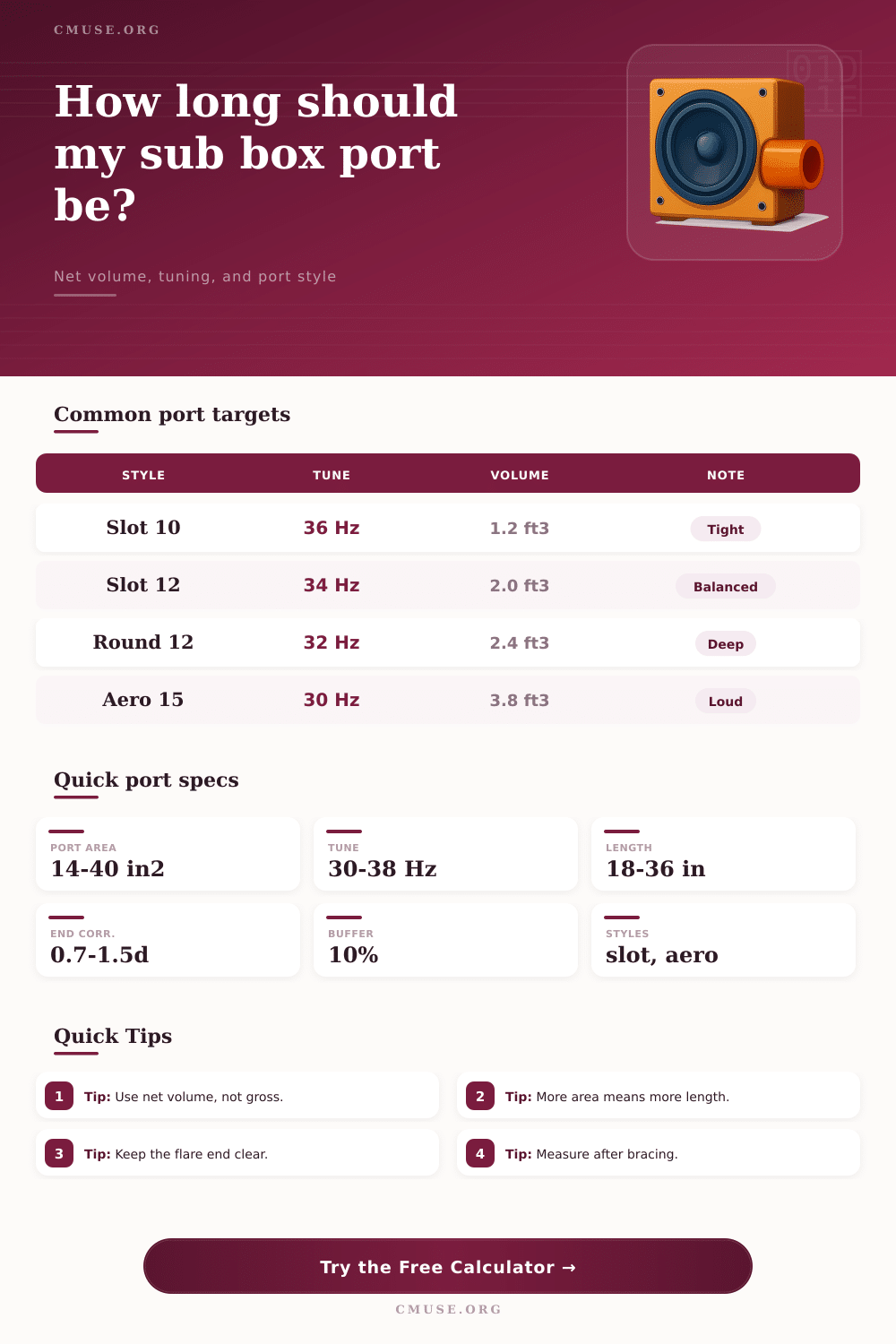
The length of the port is a critical measurement to make for the subwoofer box because the length of the port will determine the tuning frequency of the subwoofer box. If you make the length of the port too short for the subwoofer box, the tuning frequency will be too high for the desired sound. If the length of the port is made too long for the subwoofer box, the tuning frequency will be too low for the desired sound.
If the tuning frequency of the subwoofer box is incorrect, the bass will not be efficient radiated from the subwoofer. The length of the port must be balanced with the internal volume of the subwoofer box and the desired tuning frequency of the subwoofer. The net volume of the subwoofer box is the gross volume of the subwoofer box minus the volume of the subwoofer driver, the volume of the bracing, and the volume of the port.
How to Choose the Port Length for a Subwoofer Box
If you calculate the length of the port using the gross volume of the subwoofer box rather then the net volume, the subwoofer box will not perform as desired by the person who build the subwoofer box. For instance, a 12-inch subwoofer driver will take up some of the volume of the subwoofer box. You may also brace the dimensions of the subwoofer box to provide structural support for the subwoofer box, which will also take up some of the volume of the subwoofer box.
The area of the port will impact the length of the port that is required for the subwoofer box. The area of the port impacts the mass of air that will move through that port. The larger the area of the port, the more longer the length of that port that is required to achieve the desired tuning frequency for the subwoofer box.
Conversely, the smaller the area of the port, the shorter the length of that port that is required to achieve the desired tuning frequency of the subwoofer box. If the area of the port is too narrow, the air that move through that port may create whistling sound. If the area of the port is too large, the length of the port may take up too much of the internal volume of the subwoofer box.
There are different port styles that can be used for the subwoofer box. Slot ports are ports that are built into the walls of the subwoofer box. Slot ports are often easier to design than other types of ports.
Round ports and aero ports are different shaped ports that often experience less loss of sound power than slot ports. Because round and aero ports often experience less loss of sound power than slot ports, the length of the port that is required to achieve the desired tuning frequency may be shorter for those different type of ports than for slot ports. A person can select different tuning frequencies for a subwoofer box.
For instance, a person may select a tuning frequency of 34 Hz to achieve a balanced sound from the subwoofer box that can be used daily. A tuning frequency of 30 Hz may be desired to provide deeper bass from the subwoofer for different application. A tuning frequency of 38 Hz may be desired to provide a higher amount of bass frequencies between 40 Hz and 60 Hz.
Each of these different tuning frequencies will require a different length of port to achieve the desired tuning frequency. Bracing is a component that is necessary for the subwoofer box to provide the desired bass from the subwoofer. If the side walls of the subwoofer box flex, the bass from the subwoofer may sound muddy.
You must measure the internal dimensions of the subwoofer box once the subwoofer box is assembled. The wood that is use to assemble the subwoofer box may expand or contract slightly, which will impact the net volume of the subwoofer box. If a person does not account for the volume of the glue that the person will use to assemble the subwoofer box, the net volume of the subwoofer box may be too small compared to the calculated net volume of the subwoofer box.
The material from which the person builds the subwoofer box can also impact the performance of that subwoofer box. For instance, birch plywood is a popular material for subwoofer boxes because the wood is rigid and it does not easily resonate. Additionally, if the material is thin, like 12 mm wood, the material may resonate at certain frequencies.
Thicker material, like 18 mm wood, is less likely to resonate, which helps it to dampen the vibration that occur within the subwoofer box. Thus, the thickness and the rigidity of the material that is used to build the subwoofer box are two important factor to consider when building that subwoofer box.